
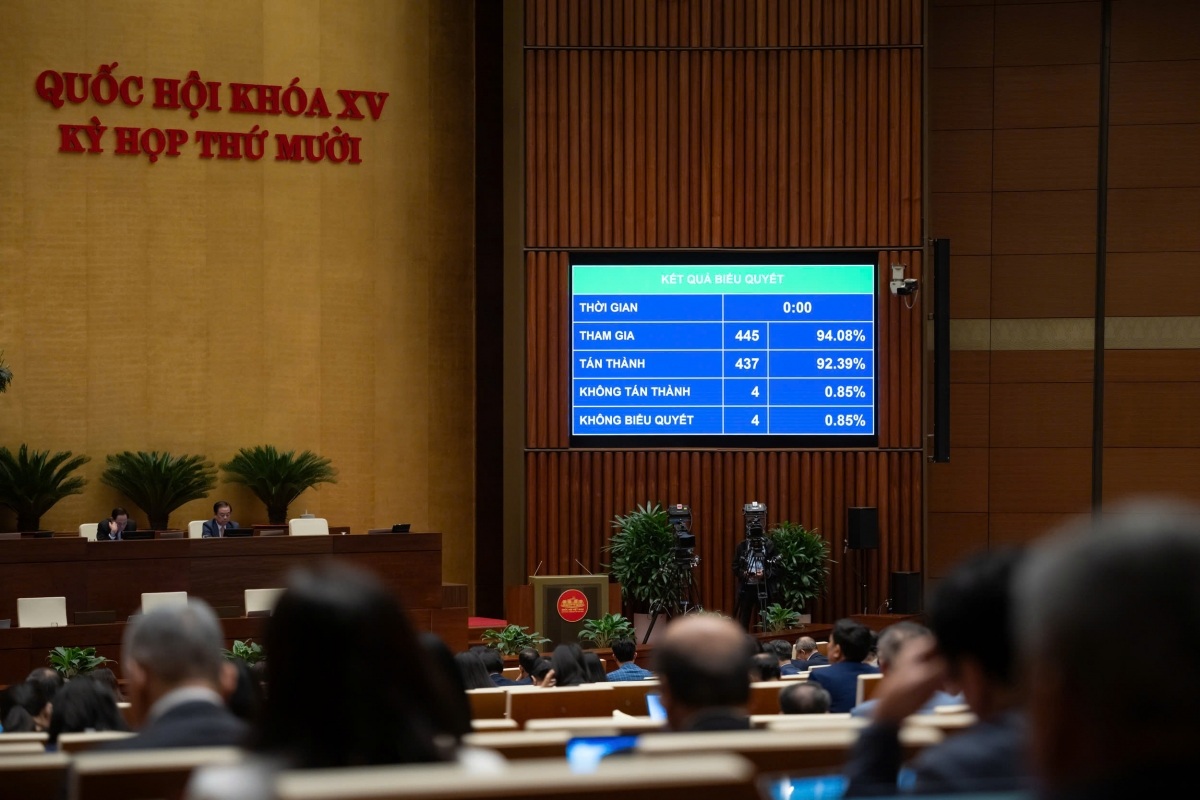
HCMC – The National Assembly has approved amendments to the Education Law requiring a single set of textbooks for all universal education levels from the 2026-2027 school year.
The revised law, passed on December 10, authorizes the minister of Education and Training to select and approve the textbook set. The minister may commission a new set or revise existing ones, depending on actual needs and guidance from higher authorities.
Under the amendments, textbooks must align with the national curriculum, detailing learning objectives, content, student competencies, teaching methods, and assessment approaches. They must avoid bias related to ethnicity, religion, gender, occupation, age or social status. Textbooks may be published in print, Braille, and digital formats.
The Government will regulate free textbook provision for students, while the minister will determine the unified national set. A national appraisal council, established by the minister, will evaluate textbooks for each subject. Council members will be responsible for the accuracy and quality of their assessments. The minister will give final approval to textbooks that receive a passing evaluation.
Education Minister Nguyen Kim Son said the unified-textbook requirement allows flexibility in choosing whether to develop a wholly new set or refine existing ones. He added that the legislation avoids locking in one fixed approach while policy discussions and impact assessments continue.
The Government will continue to consider social contributions or donations of textbooks in accordance with current regulations. The amendments also appear in a draft National Assembly resolution outlining special mechanisms to accelerate education reform. The resolution sets a clearer timeline: the unified textbook set will be implemented from the 2026–2027 school year, and the State will complete the rollout of free shared textbooks by 2030.
The Government will further detail selection criteria, the scope of free textbooks, and management of supplementary materials to ensure efficient use of public funds.
Lower-secondary graduation certificate abolished
The amended law removes the lower-secondary graduation certificate from the national qualifications system. Instead, students who complete primary and lower-secondary programs will receive official confirmation from their school principals, provided they meet conditions set by the Ministry of Education and Training.
Under the revised qualifications framework, national degrees will include the high school diploma, vocational secondary and intermediate diplomas, associate degrees, bachelor’s degrees, master’s degrees, doctorates, and specialized qualifications in specific fields.