
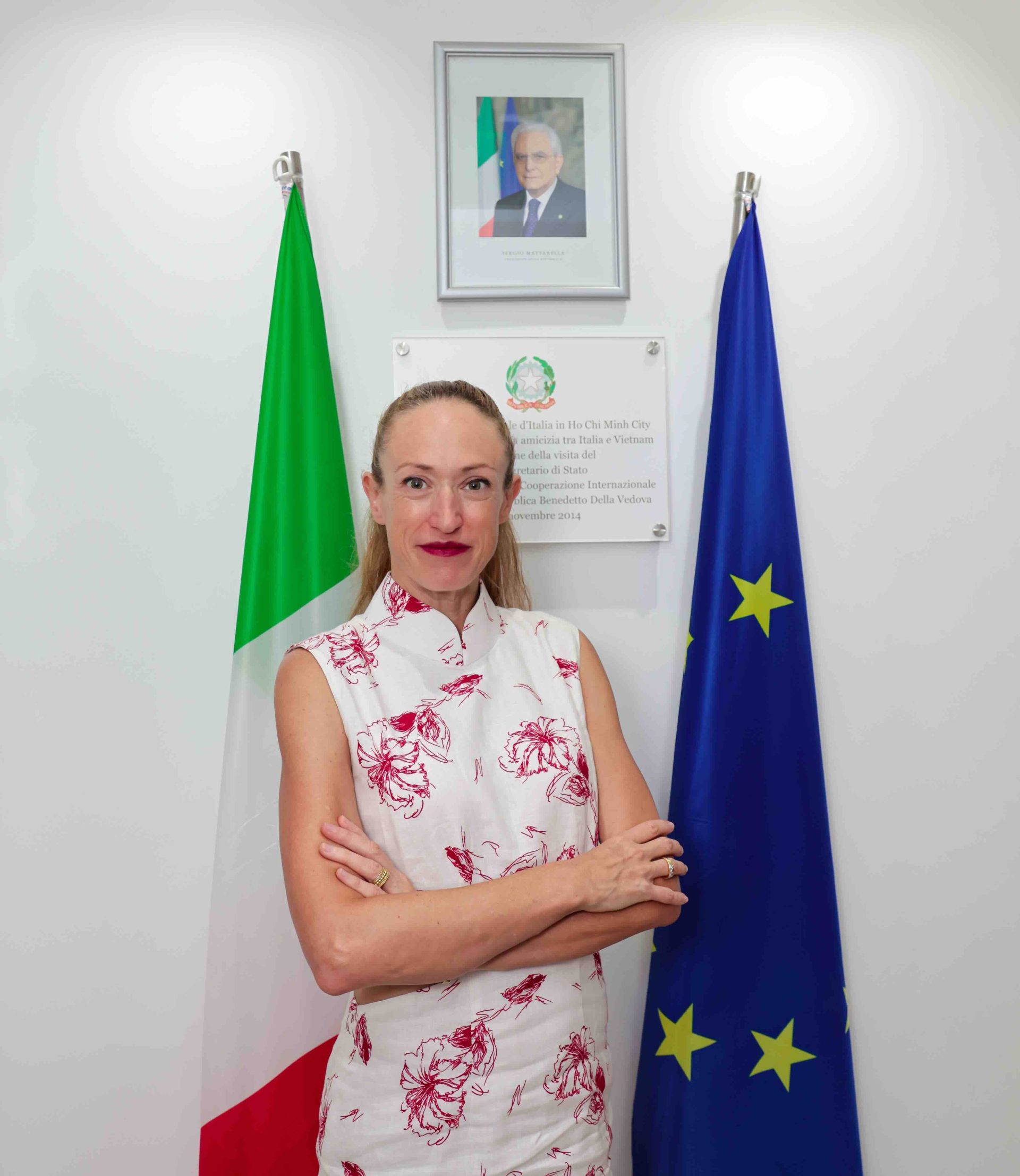
Beyond impressive trade milestones, the relationship between Italy and Vietnam has entered a transformative new chapter—one defined by strategic depth and a shared vision for the future. In an exclusive interview with The Saigon Times, Alessandra Tognonato, Consul General of Italy in HCMC, emphasizes that the synergy between Italian technological excellence and Vietnam’s ambitious transformation is forging a powerful new momentum. From breakthroughs in semiconductors to pioneering green energy solutions, Italy stands not merely as an investor, but as a dedicated partner, co-architecting new standards for sustainable development in Vietnam.
The Saigon Times: The year 2025 saw impressive bilateral trade growth, reaching approximately US$4.3 billion in just the first seven months. As the EVFTA (EU-Vietnam Free Trade Agreement) enters a more profound phase, what are your expectations for a “breakthrough” in 2026, and how is the Consulate General helping Vietnamese exporters meet Italian standards?
Consul General Alessandra Tognonato: The period between the solar and lunar New Year is an ideal moment to evaluate our progress. 2025 was very positive for our bilateral economic relations. Since my arrival in late August, I have witnessed three key milestones: the Bilateral Business Forum in Hanoi in September, with the participation of over 60 Italian companies and 250 Vietnamese counterparts, the High-Level Dialogue on ASEAN Italy Economic Relations in Binh Duong with strong local support, and the first-ever Italian Days in Danang 2025, a multi-sector showcase of Italian excellence spanning lifestyle and interior design, energy and water technologies, machinery and construction solutions, food and services.
For 2026, we are observing the National Party Congress with great interest. The priorities designated by the Party will provide an important framework to further tailor our cooperation in business and investment.
The Vietnamese economy is moving fast, with clear sense of purpose and ambition. As the Consulate General, together with the whole “Sistema Italia”, aligning diplomatic action with trade and investment facilitation, we support this momentum by helping Italian companies understand the local market, assisting Vietnamese exporters in meeting EU and Italian standards, and actively encouraging partnerships, joint ventures and local production, which generate long-term value for both sides.
Beyond the traditional strengths of machinery, fashion, and food, which emerging sectors do you believe will act as the new magnets for Italian investment into HCMC in the near future?
Among these sectors, renewable energy, the entire healthcare spectrum, from pharmaceuticals to biotech and health-tech, smart manufacturing, smart cities and advanced urban solutions, as well as water and waste management—areas where Italy and Vietnam share a common vision centered on innovation, technology and sustainability for shared growth—clearly stand out as strategic priorities. Areas such as space and earth observation complement these efforts by supporting environmental monitoring and climate resilience.
2025 was a very dynamic year for Italy–Vietnam relations. We have seen strong political engagement and, importantly, very concrete economic results. This momentum has helped give greater visibility to Italy’s industrial system and opened new channels for cooperation.
But beyond those initiatives, what really matters is the broader context.
Vietnam’s ongoing economic reforms are creating a more competitive and predictable environment, and this is exactly what companies are looking for when considering long-term engagement and investment.
At the Consulate General, together with the whole Sistema Italia, we are supporting this development in many ways: helping Italian companies understand the local market, and supporting Vietnamese exporters in meeting EU and Italian standards. We also actively encourage partnerships, joint ventures and local production, because these create long-term value on both markets.
Following the Italy-Vietnam Business Forum in September 2025, Italy and Vietnam are accelerating cooperation in semiconductors and artificial intelligence. How do you evaluate the opportunities for Vietnamese engineers to integrate into Italy’s high-tech value chain?
The growing cooperation between Italy and Vietnam in high-tech sectors such as semiconductors and artificial intelligence offers significant opportunities for Vietnamese engineers to integrate directly into Italy’s value chains, as active contributors within joint research and industrial teams.
In this context, innovation platforms such as the Center for the Fourth Industrial Revolution Vietnam (C4IR Vietnam), based in the Saigon Hi-Tech Park in partnership with the World Economic Forum, play an important role in connecting Vietnamese talent with international, including Italian, advanced industrial ecosystems.
To fully realize this potential, a proactive and robust approach to intellectual property management is essential. In the fields of AI and semiconductors, IP goes far beyond trademarks and includes patents, industrial designs and trade secrets—such as semiconductor layouts or proprietary AI algorithms.
A strong IP framework is therefore a key enabler of a trust-based, long-term cooperation between Italian and Vietnamese high-tech ecosystems.
HCMC is striving for a “Green Transition.” How is the Consulate General facilitating the transfer of Italian expertise?
Part of our role is to facilitate dialogue and connections, while staying closely aligned with the city’s development priorities through regular exchanges with local authorities. As the second-largest European producer of renewable energy technologies, Italy is eager to enable, also through instruments such as SACE and SIMEST, investment and risk-mitigation in strategic sectors linked to sustainability and innovation.
A key example is Eni, Italy’s major integrated energy company and a global player in the energy sector. In 2023, Eni signed a Memorandum of Understanding with the Ministry of Agriculture and Environment focusing on the regeneration of degraded land, bio-based feedstock for biorefineries, and carbon credits through nature-based solutions like mangrove protection. These initiatives combine environmental protection with economic development.
I recently attended with interest the launch of the new Science & Technology City, and it is clear that HCMC expects expertise in innovative sectors. Our response is based on listening and matching our skills to the city’s plans for sustainable growth and long-term energy security towards 2030 and 2045.
With the number of Vietnamese students choosing Italy rising significantly, what is your plan to transform HCMC into a more powerful hub for promoting Italian education, ensuring it is as prominent as the efforts in Hanoi?
We have seen increasing participation in the Study in Italy, “Italian Days on Higher Education” and EU Study Fairs in HCMC. Students who study in Italy integrate well into the economic system upon their return because of the growing number of Italian companies investing here. In companies like Datalogic,
Ariston, and Generali, top management and deputy positions are increasingly held by Vietnamese professionals. A student formed in the Italian system is a precious resource particularly because of the strong link between universities, industry, design and engineering.
For the future, we may imagine a roadshow moving from North to South to catch the attention of students across nearby economic hubs such as Binh Duong and Vung Tau.
Italian Design Day has become a cultural hallmark in Vietnam. Could you provide an early preview of the theme this year and how it will reflect the shared commitment of both nations toward sustainability and the “Green Transition”?
This year’s edition will be more ambitious and closely linked to HAWA Expo in HCMC (March 4-7), where Italian designers and companies will contribute concrete expertise in urban regeneration and machinery. Drawing on experiences from cities such as Turin and Milan, Italian design is presented as a driver for the transformation of former industrial areas into high-quality urban spaces.
Sustainability is addressed in its environmental and social dimensions, with a focus on functional, inclusive spaces that respect local identity. Design, as a cross-sector competence, also becomes a platform for cultural dialogue, where
Italian creativity can be reinterpreted through local forms and materials, allowing Italian and Vietnamese influences to converge naturally.
In a vibrant market like HCMC, how does the Consulate General support Italian brands in protecting their intellectual property and ensuring local consumers can access and appreciate authentic “Made in Italy” products?
Our work goes in three directions. First, education plays a key role. We work to raise awareness of the importance of intellectual property as a driver of development. Respecting intellectual property protects creativity, fosters innovation and ultimately benefits consumers through higher-quality products.
Second, we support the strengthening of the legal framework to ensure a predictable and safe environment, which is essential to attract innovation-driven investments and long-term industrial partnerships.
Third, we focus on enforcement and implementation, because fair competition and consumer trust are essential to a healthy market.
Finally, what is your personal message or “wish” for the Italian-Vietnamese community in 2026?
To the Italian–Vietnamese community, my message is simple: observe, listen and engage with passion. This is how lasting partnerships are built in a fast-growing country like Vietnam.
Reported by Kelvin Vo







