
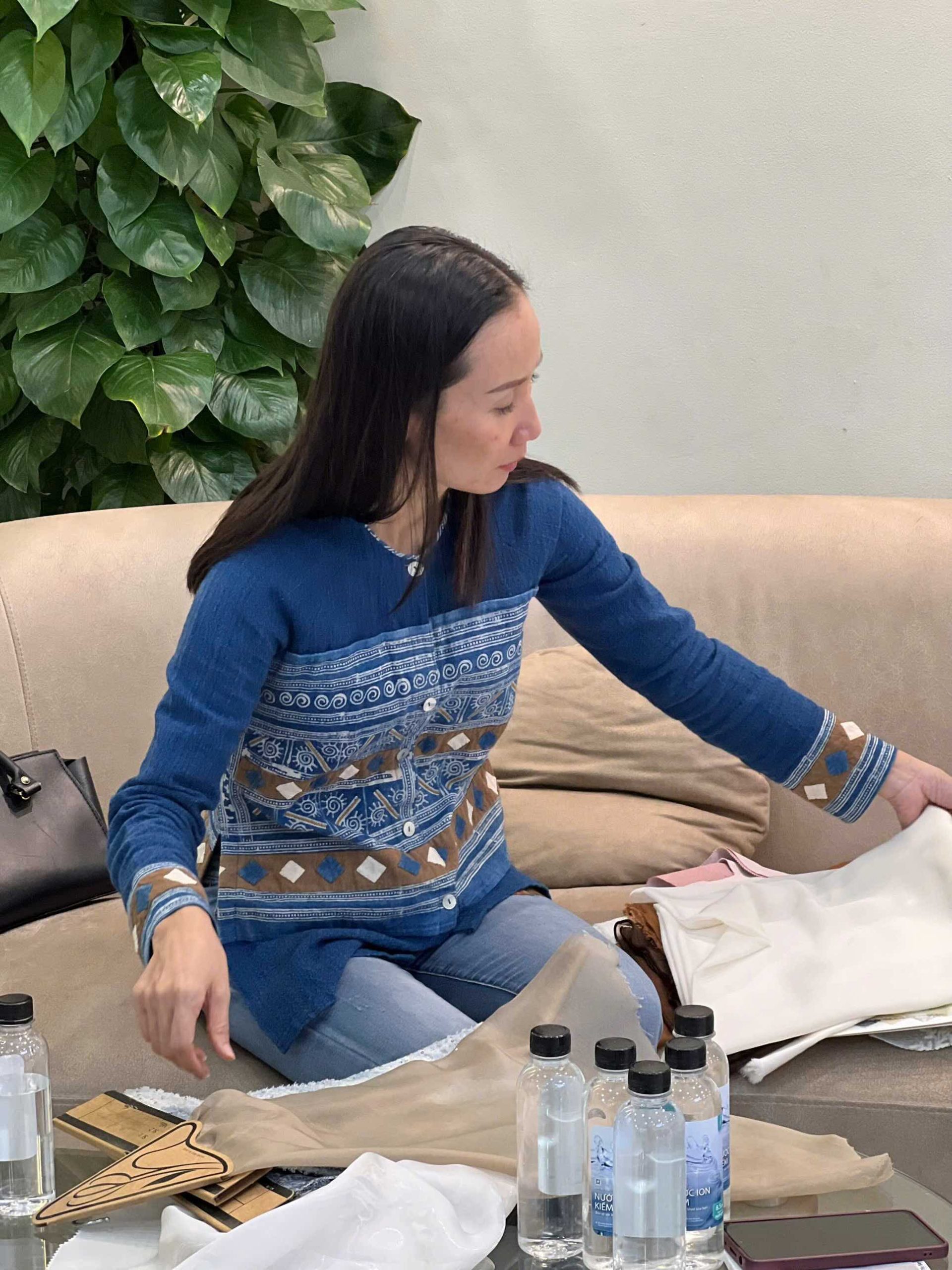
“Áo bà ba” has been worn in southern Vietnam for generations. Once so common that it was almost invisible, it was valued mainly for its practicality and comfort. Farmers wore it while planting rice and pushing their boats along the canals. For a long time, it was rarely regarded as fashion. That perception is now beginning to change—thanks to Mi Trang.
Designer Mi Trang has lived in HCMC for nearly 30 years. Yet her heart—and her craft—remain rooted in the Mekong Delta, where she grew up a barefoot child with only a few sets of clothes.
“Áo bà ba,” a long-sleeved buttoned shirt paired with loose trousers, was as essential as breathing. It shielded the wearer from heat and water, moving easily with the sway of boats and the rhythmic bending of reed harvests.
Her grandmother often wore “áo túi,” a simple, comfortable blouse traditionally worn by women in southern Vietnam at home. When she stepped outside, however, she would change into áo bà ba.
It is for moving
“It was light,” Mi Trang says, her voice carrying the practical wisdom of a seasoned craftswoman. “It dried with a gust of wind.”
The garment was never meant to be pretty; it was designed for movement. Dyed in deep indigo and earthy browns, it was made for work—for the simple fact of living.
Historians still disagree about the origin of áo bà ba. Some believe it was introduced by southern Chinese traders more than three centuries ago, while others say a 19th-century scholar adapted the design after encountering the practicality and beauty of clothing styles in Penang, Malaysia.
For Mi Trang, however, the connection is far more personal. It lives in the haunting image of women pushing boats across lotus-filled streams, their blouses fluttering like quiet banners of strength. It lingers in her grandmother’s calloused hands as she braided palm fronds, and in her mother’s silhouette by the dawn fire, stirring rice porridge while the first light touched the water hyacinths.
By the 1800s, áo bà ba had become a defining symbol of southern Vietnam. It stood in contrast to the northern “áo tứ thân,” the traditional four-panel dress typically tied in the front and worn over a colorful inner shirt. It was also distinct from the imperial “áo dài,” long associated with the royal court in Hue and admired across Vietnam for its graceful, form-fitting elegance.
Áo bà ba, by contrast, belonged to ordinary people. Light, practical, and unpretentious, it could shift from simple to stylish with a change of fabric, yet its essence always lay in the everyday work it accompanied.
“There were no fashion shows,” Mi Trang says. “It was simply the way people lived.”
When she moved to the city, everything changed. Sitting through university lectures on Dior’s New Look and the groundbreaking lines of Chanel, she felt a sharp, personal pang of loss. She wondered why so much attention was given to Parisian couture while the creativity of her own grandparents’ generation was fading into obscurity.
That tension became the foundation of her vision. For more than a decade, she has been quietly but resolutely working to awaken this sleeping sartorial giant through her brand, Bong Bà Ba.
A new idea
“When the idea of heritage fashion comes up,” she says, her eyes lighting up, “it gives me a new perspective, a new way of looking at áo bà ba.”
This perspective matters because it brings the garment down from the museum shelf and back into everyday life—honoring its past while showing that it still belongs in the present.
But before any piece of clothing can make that leap, it has to be wearable. “A garment with such a long life must first be useful,” Mi Trang says. It is easy and comfortable to wear. It makes the wearer feel both connected and at ease in daily life. It can be worn by men and women alike.
“It is for everyone,” Mi Trang says.
That universality is important, but it does not mean the garment remains unchanged. Over time, áo bà ba has evolved in subtle ways. The men’s version largely retains the traditional straight sleeve, giving it a clean and structured look. For women, however, the raglan sleeve has become increasingly popular.
Cut in a single piece that extends from the collar to the underarm, the raglan sleeve creates a softer, more fluid line that moves naturally with the body.
“Everyone used to wear the straight sleeve,” Mi Trang explains. “But over time, to make it more suitable, the women’s áo bà ba was adapted with the raglan sleeve.” It is a small change with a big impact—proof that tradition and evolution can go hand in hand.
The path to this point was never a carefully crafted business plan. When asked why it took a decade for her vision to gain momentum, Mi Trang offers an unexpected answer.
“I wasn’t waiting. I didn’t wait at all,” she says. “I simply loved it, so I kept preserving and protecting it. One day I looked back at my journey and realized ten years had already passed. I never set out to wait for anything.”
Her initial project, “I Love Bà Ba,” grew out of something deeply personal. “It was just like a hobby,” she confesses, “a way to preserve my own memories.”
A timeless soul
While the soul of áo bà ba remains timeless, its form is being thoughtfully updated. The most noticeable change lies in the fit.
“The shape of the shirt today is designed so that when you wear it, you feel neat, not baggy,” Mi Trang explains. “It shows your figure more beautifully.”
Historically, the garment was loose and roomy, prioritizing ease of movement for daily labor. Today’s versions are more tailored, offering a sleeker silhouette that celebrates the body without sacrificing comfort.
The real revolution, however, is happening at a deeper level—in the very fibers of the fabric.
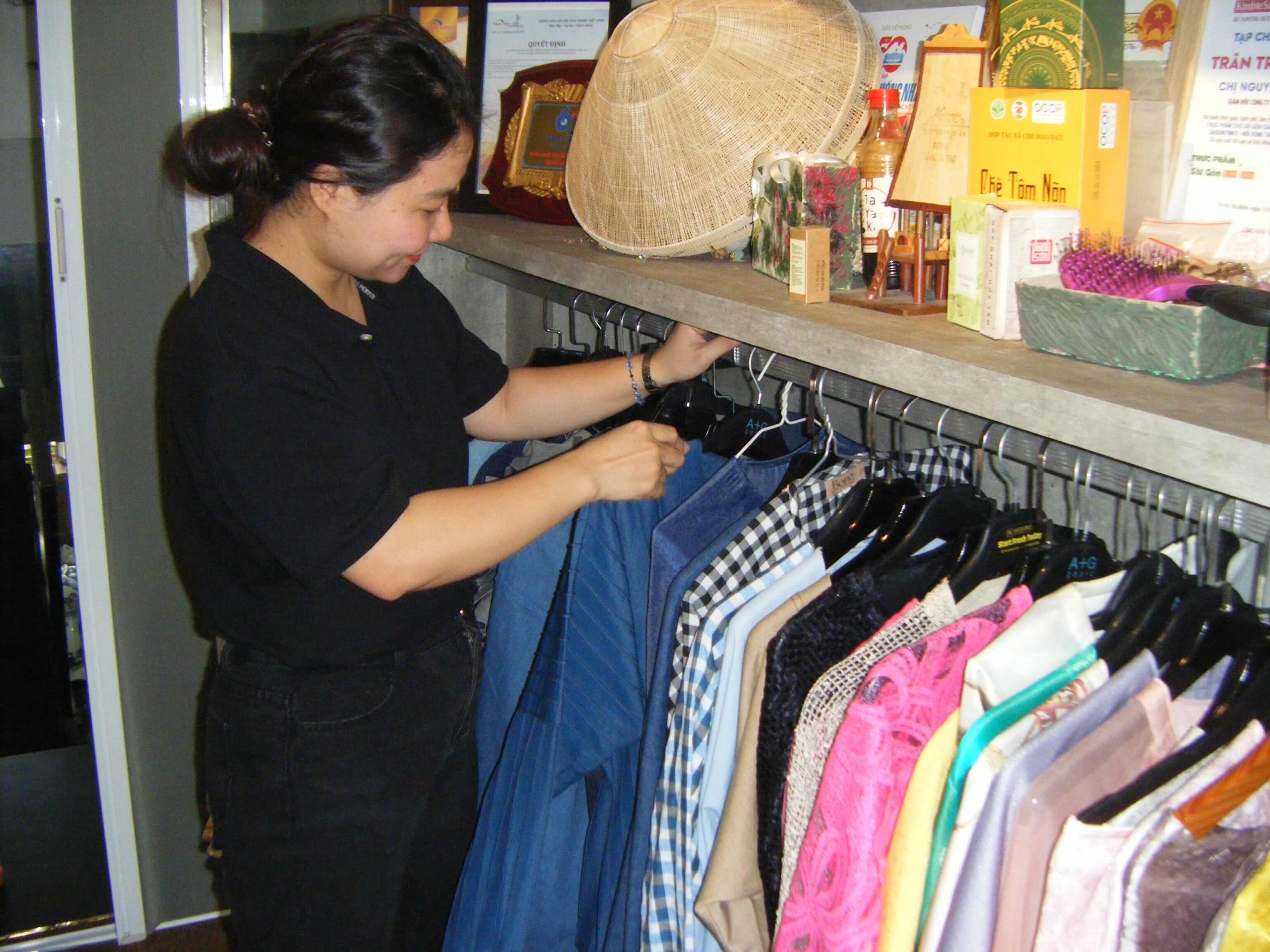
Mi Trang’s studio is filled with cotton, linen, and silk. But the most exciting material is one you might not expect: pineapple fiber.
She gestures to the shirt she is wearing. “This one is made from pineapple fabric,” she says. It is not a gimmick, but part of the cutting edge of sustainable fashion.
The fiber is extracted from pineapple leaves—an agricultural byproduct—and spun into a fine, durable thread. The shirt she is wearing blends 25% pineapple fiber with 75% cotton, the result of collaborative research with a partner factory in Bac Ninh.
Such innovation comes at a cost. A shirt with a higher concentration of pineapple fiber can carry a price tag of VND1.3 million or more. “R&D is very time-consuming and expensive,” Mi Trang admits. For now, most of this specialized fabric is exported, as international brands are more willing to pay a premium for sustainable materials.
By choosing to incorporate it into áo bà ba, Mi Trang positions herself not only as a preserver of tradition but also as a pioneer of Vietnam’s emerging green fashion future.
The question is no longer whether áo bà ba can return, but what form it will take when it does. Not as a folk artifact, but as a vibrant expression of heritage fashion worthy of global attention.
Through Mi Trang’s dedication, the garment is being rediscovered—not as a relic of a bygone era, but as a timeless, elegant, and deeply meaningful piece of clothing, ready to find its place in the wardrobes of Vietnam and beyond.
The journey of áo bà ba, it seems, is only just beginning.