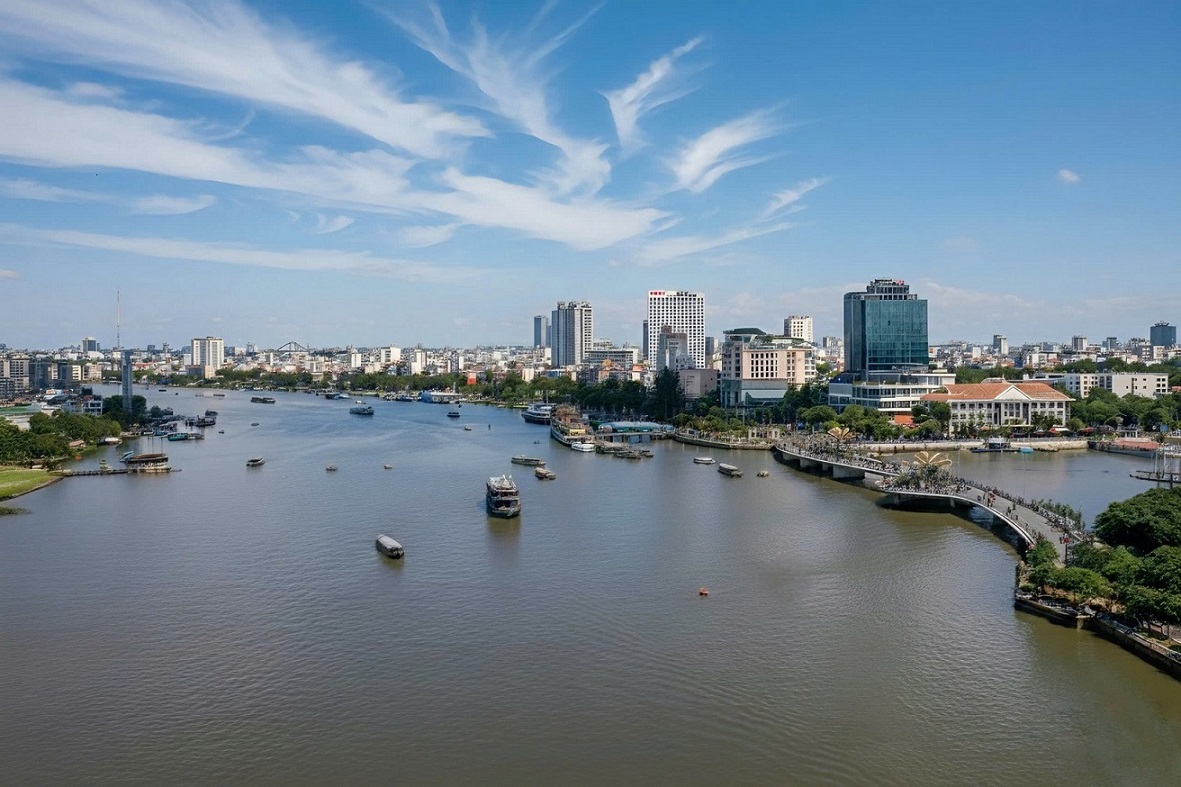
CAN THO – Can Tho City has approved a new master plan to develop the city as a modern river–sea urban center, targeting average annual growth of more than 10%, the city government said.
Under the plan, Can Tho aims to become a national growth pole by 2030 and a distinctive river–sea city in Southeast Asia by 2050. The baseline growth scenario projects average expansion of 10.32% to 11.29% per year.
The plan divides the city into five development zones with different economic functions. These zones will be linked by economic corridors connecting the Mekong Delta and HCMC to strengthen regional integration.
The northern zone will serve as a gateway linking Can Tho with the Long Xuyen Quadrilateral, the Plain of Reeds and HCMC. It will focus on trade and services tied to processing industries, beverages, electronics, mechanical engineering, vehicle assembly, textiles, supporting industries, logistics and warehousing.
The central zone will function as the city’s administrative, political and cultural hub. It will concentrate on financial services, science and technology, education and training, trade, logistics and high-quality healthcare. Priority sectors include high-tech industries, digital economy services, banking and real estate.
The western zone is designated as the city’s main agricultural area, supported by land availability and irrigation systems. It will develop advanced agriculture, agro-tourism, telecommunications, and the processing and preservation of agricultural and aquatic products.
The southeastern zone, which borders the sea and major river mouths, will serve as Can Tho’s maritime gateway. Economic activities will include seaports, marine-based industries, logistics, mechanical engineering, processing and assembly, as well as shipbuilding, ship repair, fisheries, and coastal eco-tourism.
The southern zone will focus on saline-water agriculture and high-tech farming. It is planned as a key center for aquaculture, seafood processing and exports in the Mekong Delta. The area will also host coastal renewable energy projects combined with marine tourism services.