
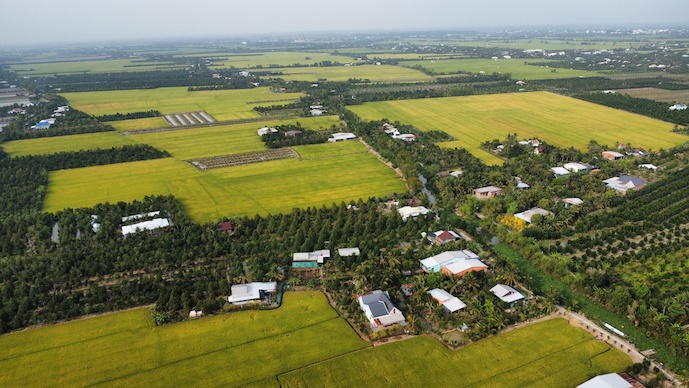
HCMC – The government of Dong Thap Province has approved a proposal to convert inefficient rice-growing areas into more profitable land-use models.
This initiative aims to address a long-standing challenge in the Mekong Delta, where traditional rice farming often yields minimal profit, sometimes failing to cover reinvestment costs. By shifting toward high-value alternatives, such as perennial fruit trees, aquaculture or even non-agricultural purposes, the Mekong Delta province will be able to maximize economic output per unit of land while ensuring better climate change adaptation and alignment with national agricultural restructuring goals.
The plan, with a specific focus on the period from now until 2030, will involve a comprehensive audit to analyze the factors causing rice land inefficiency. Authorities will review current production data against official land cadastral records to determine the exact acreage suitable for conversion. The scope of the study covers all water-based and low-productivity rice fields across Dong Thap, while also considering their strategic relationship with the broader land-use trends in the Mekong Delta.
The conversion will target areas where farmers have already shown high demand for change, particularly in the Dong Thap Muoi region, where spontaneous shifts to high-income crops like durian and jackfruit have already outpaced traditional rice yields by dozens of times.
To implement this master plan, Dong Thap has allocated a budget of approximately VND2.38 billion for 2026, managed by the provincial Department of Agriculture and Environment. This funding will support the establishment of clear criteria for identifying inefficient land, as well as the principles and conditions under which conversion can be authorized. By creating a formal legal framework, the province aims to transition from spontaneous, fragmented agricultural shifts to a regulated, sustainable and high-value agricultural ecosystem that secures the livelihoods of local farmers.







