
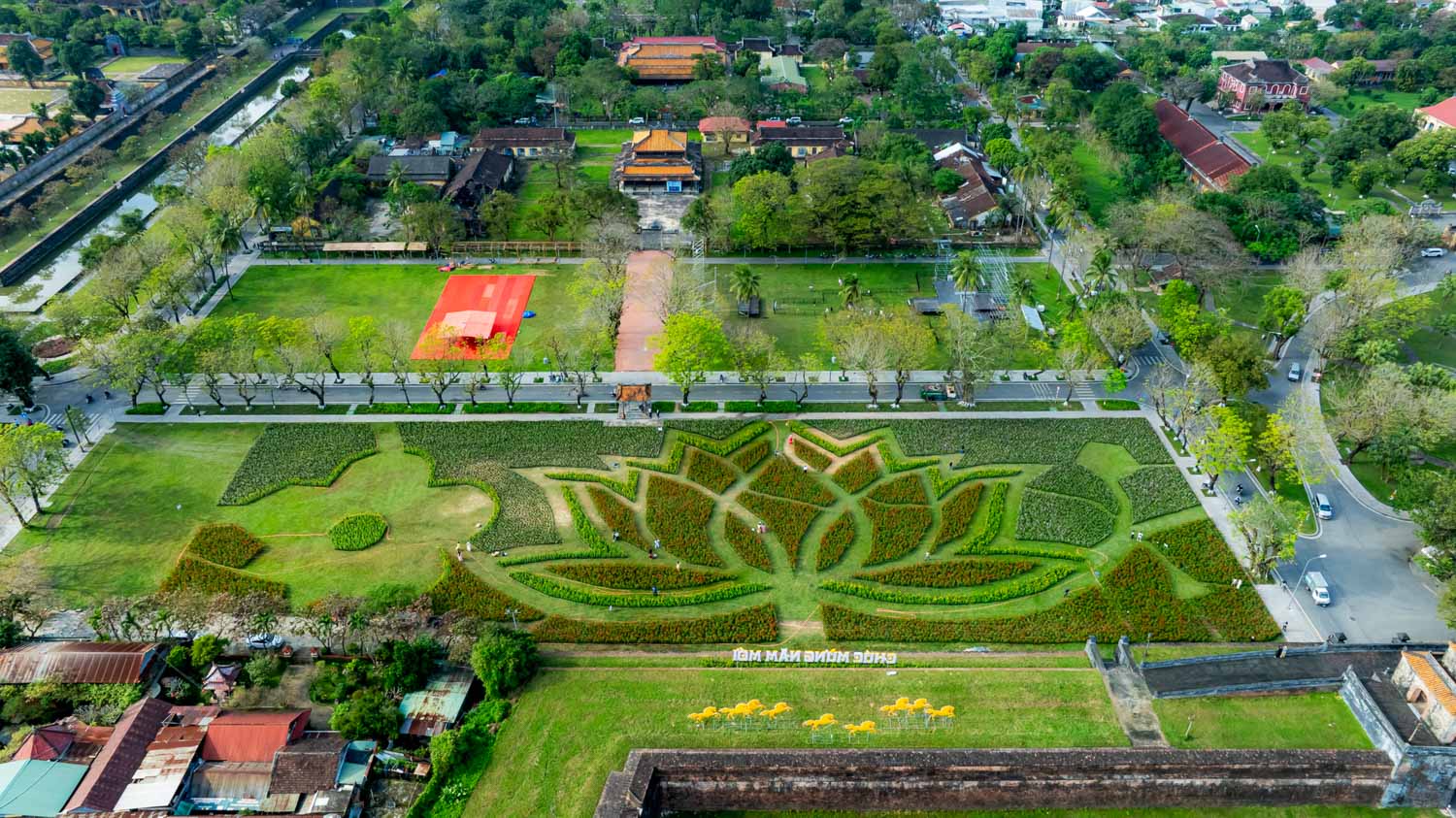
On the threshold of Tet, Lunar New Year Festival, the Ham Nghi Square-Thuong Tu Gate area in Phu Xuan Ward, Hue City, attracted quite a few visitors thanks to a giant lotus flower made by the arrangement of 50,000 pots of flowers. This was a highlight of the “Tet Phu Xuan – Color and Flavor of the Imperial City” program in 2026.
The “Tet Phu Xuan – Color and Flavor of the Imperial City” program took place from February 2 to 8, 2026 (from the 15th to the 21st days of the 12th lunar month), stretching from Thuong Bac Park to Quoc Tu Giam Square, Ham Nghi Square and 23 Thang 8 Street. The program’s highlight was a giant lotus flower made from the arrangement of 50,000 pots of flower at Ham Nghi Square.
Themed “Color and Flavor of the Imperial City,” the program marked the harmonious blend between color and flavor. Color was depicted through the landscape designed at Thuong Bac Park, which will be opened to the public from February 2 to the end of Tet holiday. Flavor was the essence of Hue cuisine, featuring traditional Tet preserves such as ginger preserves, lotus seed preserves and royal cakes and preserves, baochinhphu.vn reported.
The man who changes Mong people’s mindset
Ly Ba Thai was born in Tham Hoc Village, Muong Long Commune, Nghe An Province. At that time, many children in the border commune could not go to school because of poverty. However, Thai and his sisters and brothers were allowed to go to school.
The Mong ethnic people in Nghe An used to celebrate two Tet festivals: the Mong New Year and the national Lunar New Year. Since the two festivals took place in the last two months of the lunar year, Mong children who had to study far from home often missed the Tet of their people.
In 1995, Thai wrote a letter to the leaders of Nghe An Province to suggest merging the Mong New Year into the Traditional Lunar New Year. At the end of this year, Nghe An authorities decided to merge the two festivals into the traditional Vietnamese Lunar New Year.
In 1995, Tham Hoc and several villages in Muong Long Commune celebrated just one Tet, the traditional Lunar New Year. Since 1996, the Mong people in the commune have celebrated only one Tet. One year later, the Mong people in other communes have followed suit. Since 2000, almost all the Mong communities in the province have only celebrated the traditional Lunar New Year, dantocphattrien.vietnamnet.vn reported.
Tet greetings from Border Guards in Gia Lai
On February 3, the Gia Lai Province Border Guard Command held a meeting to extend greetings and present gifts to 43 village elders and respected people among ethnic minority groups in the border areas on the occasion of Tet.
According to dantocphattrien.vietnamnet.vn, Gia Lai Province’s border areas comprise 22 wards and communes with 451 quarters and villages and 184, 200 households. The land border area has seven communes with over 12,000 households, whereas the sea border area has 15 communes with over 172,000 households.
 The province now has 43 village patriarchs and respected people living in the border areas. Given their prestige and responsibility, these village elders and respected people have cooperated with the Border Guards to propagate and encourage people to comply with the Party’s guidelines and the State’s policies and laws.
Earlier, the officers and soldiers of the Gia Lai Province Border Guard offered free medical examinations and presented free medicines to these village elders and respected people.
Thirty national treasures recognized
Deputy Prime Minister Mai Van Chinh has signed a decision recognizing 30 national treasures.
According to tuoitre.vn, they are: 1) Dong Son culture bronze drum collection from Vac Village, dating back to the 3rd-1st centuries BC, kept at Nghe An-Soviet Nghe Tinh Museum, Nghe An Province; 2) Collection of bronze ladles from Dong Son culture, the 2nd-1st centuries BC, Kinh Hoa Museum, Hanoi; 3) A set of bronze bells from Dong Son culture, the 2nd century BC-1st century AD, Kinh Hoa Museum, Hanoi; 4) A set of bronze armor from Dong Son culture, the 1st century BC-1st century AD, Kinh Hoa Museum, Hanoi; 5) Dong Son culture bronze drum-shaped basin, the 1st century BC-1st century AD, Kinh Hoa Museum, Hanoi; 6) Hoa Loc culture ceramic bowl, 3,800-4,000 years old, Museum of Ceramics from the Founding Period, HCMC; 7) Oc Eo culture stone Buddha statue, the 6th-7th centuries, private collection of Dao Danh Duc, Hanoi; 8) Oc Eo culture Vishnu God stone statue, the 6th-7th centuries, Dao Danh Duc’s private collection, Hanoi; 9) Cham culture Durga Goddess bronze statue, the 7th century, National Museum of History; 10) Collection of gold worship items from An Phu Cham Tower, the 9th-10th centuries, Pleiku Museum, Gia Lai Province; 11) Lid of a green porcelain box from the Ly Dynasty, the 11th century, Thang Long-Hanoi Heritage Conservation Center; 12) Nghia Xa Pagoda stone stele, 1122, Nghia Xa Pagoda, Ninh Binh Province; 13) Dragon rampart from the Ly Dynasty, the 11th-13th centuries, Thang Long-Hanoi Heritage Conservation Center; 14) Brown porcelain pot from the Tran Dynasty, the 13th century, Thang Long-Hanoi Heritage Conservation Center; 15) Bronze lamp plate collection from the Tran Dynasty, the 13th-14th centuries, Thang Long-Hanoi Heritage Conservation Center; 16) Thanh Nam stele from the Tran dynasty, 1335, Thanh Nam Mountain, Nghe An Province; 17) Stone Buddha altar at Thuong Nuong Pagoda, 1364, Thuong Nuong Pagoda, Ninh Binh Province; 18) Stone Buddha altar at Huong Trai Pagoda, 1370, Huong Trai Pagoda, Hanoi; 19) Stone Buddha altar at Dai Bi Pagoda, 1374, Dai Bi Pagoda, Hanoi; 20) 18 Arhat rock carvings in Lien Hoa Cave, the Tran Dynasty, Phong Phu Pagoda; 21) King Le Thanh Tong’s decree, the Early Le Dynasty, Cau Khong Temple, Ninh Binh Province; 22) White porcelain vase with dragon drawings from the Early Le Dynasty, the 15th century, Thang Long-Hanoi Heritage Conservation Center; 23) Stone Buddha altar from the Mac Dynasty, the 16th century, Nhan Thap Pagoda, Hung Yen Province; 24) Three wooden altars from the Mac Dynasty, the 16th century, Da Hoa Temple, Hung Yen Province; 25) The bell from An Xa Pagoda, 1690, Bac Bien Pagoda, Hanoi; 26) Three stone steles, 1613-1704, Keo Hanh Thien Pagoda, Ninh Binh Province; 27) Mau Man Nuong Buddha wooden statue, the 18th century, To Pagoda, Bac Ninh Province; 28) Tam Quan Dai De multicolored porcelain statues, the 19th-20th centuries, Le Thanh Nghia’s private collection, HCMC; 29) Ko Do gong set, the 20th century, Pleiku Museum, Gia Lai Province; 30) Nguyen Ai Quoc School’s Golden Book, 1949-1950, National Museum of History.