
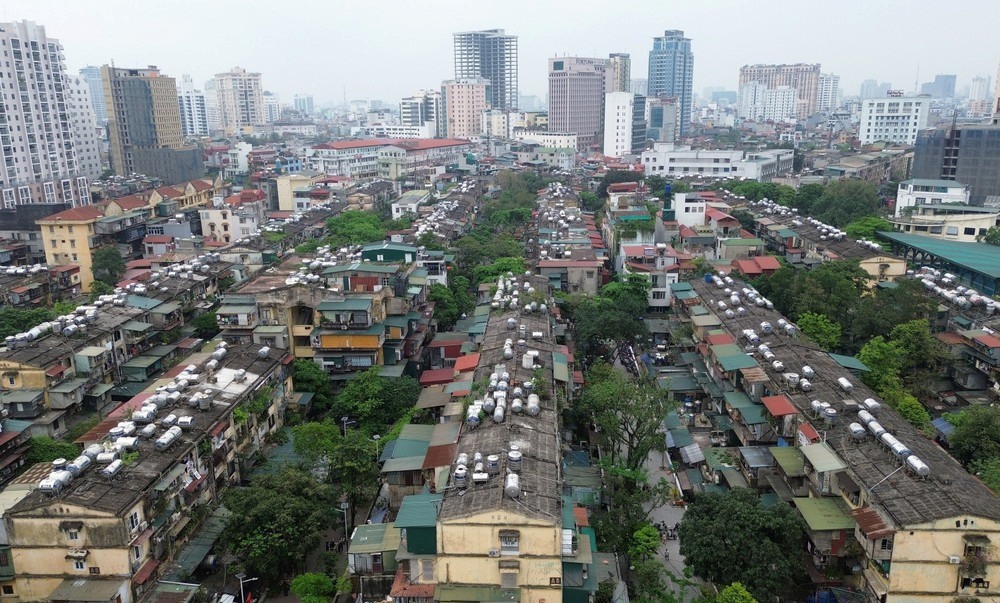
HCMC – Hanoi will relocate about 861,000 residents from its inner-city areas by 2045 as part of a major urban restructuring plan, according to the city administration.
The plan focuses on reorganizing urban space inside Beltway No. 3, with priority given to areas within Beltways No.1 and No.2, where population density is high and infrastructure is under strain. This is outlined in the capital’s master plan with a 100-year vision, recently approved by the Hanoi People’s Council.
Areas with historical, cultural and architectural value will be renovated with an emphasis on preservation and upgrading rather than widespread demolition.
Priority zones include the Ba Dinh political-administrative center covering about 134.5 hectares, Hoan Kiem Lake and surrounding areas, the Old Quarter of roughly 81 hectares, the French Quarter of around 200 hectares, and West Lake and adjacent areas spanning about 462 hectares, excluding the lake surface.
Land along the Red River, totaling about 11,000 hectares, is planned as a landscape axis combined with service, financial and cultural functions. Recognized historical sites, religious facilities, and areas related to national defense and security will be subject to special management.
In other areas within Beltway No.3 that do not meet standards on architecture, urban landscape or infrastructure quality, the city plans comprehensive restructuring alongside population relocation.
According to the Hanoi People’s Committee, residents affected by relocation will be resettled either on-site or moved to new urban areas in growth centers such as Dong Anh, Gia Lam and Hoa Lac.
During 2026–2035, the city plans to relocate about 200,000 residents from the Red River area, another 200,000 from West Lake and surrounding zones, and around 42,000 from selected streets within Beltway No.3. In the 2036–2045 period, relocation is expected to increase to about 26,730 residents from the Old Quarter, 23,000 from the French Quarter, and around 370,000 from other inner-city areas.