
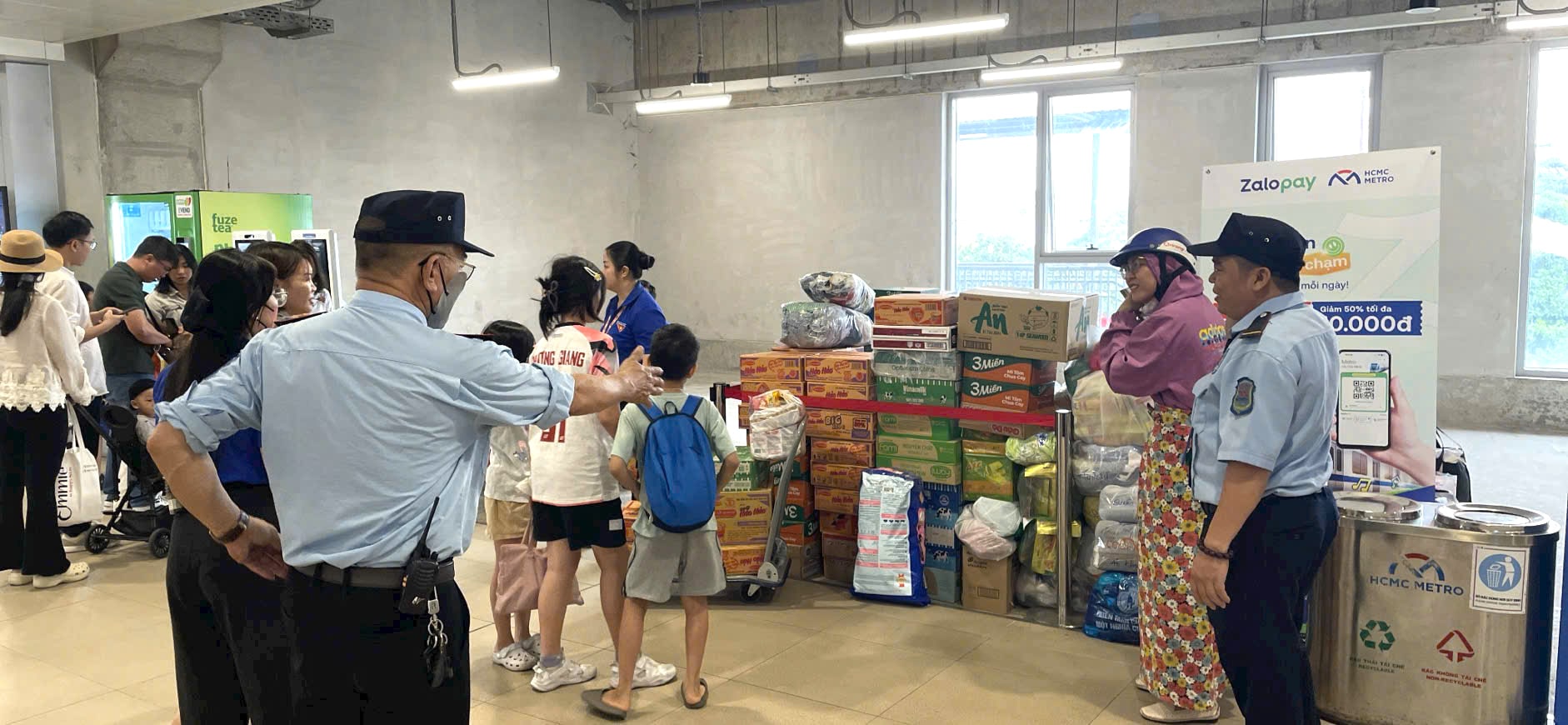
In a bid to help flood victims in the central region, the HCMC Fatherland Front Committee allowed the HCMC Urban Railway Co. No. 1 to use the 14 stations of Metro Line No. 1 as venues to receive public donations from 5 a.m. to 10 p.m. on weekdays and from 5 a.m. to 11 p.m. on Saturday and Sunday.
Accordingly, all contributions from the general public will be transferred to the office of the HCMC Fatherland Front Committee to be organized and delivered to people affected by heavy floods in the south-central region.
Priority donations included clothes that were washed, dried, and separately sorted for men, women, and children (clearly labeled on each bag), as well as essentials like instant noodles, canned foods, bottled water, and rice (in sealed packages and well within expiration dates), blankets, raincoats, and more.
Farmers’ scientist in Lang Son
Born into a Tay ethnic minority family in Lang Son Province, Nguyen Khanh Toan, 35, graduated from the Thai Nguyen University of Agriculture and Forestry with a master’s degree in 2012. After seven years working at a vocational school in Lang Son, Toan moved to work at the province’s Department of Science and Technology in 2019.
To fulfill the task of science research for the application and transfer of technology to farmers in rural and remote areas, Toan began building a cultivation model for local ri chickens in three rural communes. He encouraged local farmers to select qualified breeds and to apply proper vaccination for chickens and to use biological bedding in coops. He also taught cultivation techniques to participating farmers. The model was successful with 80-85% of chicken growing up healthily.
Since 2022, Toan has been leading a project to apply science and technology to recover Lang Son’s Van Linh chickens sustainably. He and his colleagues managed to look for purebred Van Linh chickens to build a core flock; improve the cultivation process toward biological safety; and sustainably develop Van Linh chickens for commercial purposes. The core flock of Van Linh chickens is growing well.
Given his contributions, Toan was granted the Vu A Dinh award by the Central Committee of the Ho Chi Minh Communist Youth Union. He was selected as one of the 32 Scientists of Farmers 2025, danviet.vn reported.
HCMC’s Vinh Khanh Street honored by Time Out
Vinh Khanh Street, known for its variety of mollusk dishes in Khanh Hoi Ward, HCMC, was recognized on the list of 31 coolest streets in the world in 2025 by Time Out, a global magazine published by Time Out Group.
Vinh Khanh ranked 10th on the list of the world’s 31 coolest streets in 2025. According to Time Out, Vinh Khanh was recognized as a food street in 2018. The one-kilometer-long street is home to dozens of eateries serving grilled clam, scallop, snail, and mussel dishes overnight, earning it the nickname “gastronomy paradise,” which attracts many local residents and tourists, both local and international.
The list of 31 coolest streets in the world was chosen based on food, fun, culture, and community. This year’s top 10 coolest streets are Rua do Senado (Rio de Janeiro, Brazil), Orange Street (Osaka, Japan), Rua do Bonjardim (Porto, Portugal), Fanghua Street (Chengdu, China), Sherbrooke Street West (Montreal, Canada), Montague Road (Brisbane, Australia), Maybachufer (Berlin, Germany), Olympou Street (Thessaloniki, Greece), Orchard Street (New York City, U.S.), and Vinh Khanh Street (HCMC, Vietnam).
A 35-year-old village patriarch
Kon Chenh Village in Mang Den Commune, Quang Ngai Province, is home to 103 households with 360 residents, 90% of whom are Xo Dang (Mo Nam branch) ethnic minorities. Most villagers earn their living by farming.
With his love and understanding of the Mo Nam culture, A Nac, a 35-year-old villager of Kon Chenh, encouraged local residents to improve their income through community-based tourism. He learned how to run community-based tourism from nearby areas and the Internet. To set an example for others, he transformed a traditional stilt house into a homestay to welcome tourists.
A Nac and his wife prepared traditional Mo Nam dishes and showcased gong performances and traditional dance as unique tourism attractions to draw visitors. Their economic success encouraged other households in the village to follow their lead, building stilt houses as homestay accommodations and joining the village’s tourism service supply chain.
Thanks to A Nac’s guidance, seven households in the village have taken part in community-based tourism efforts. This has also revived several traditional crafts that help boost income for the villagers. Because of his reputation, A Nac was chosen as the patriarch of Kon Chenh Village earlier this year, dantocphattrien.vietnamnet.vn reported.