
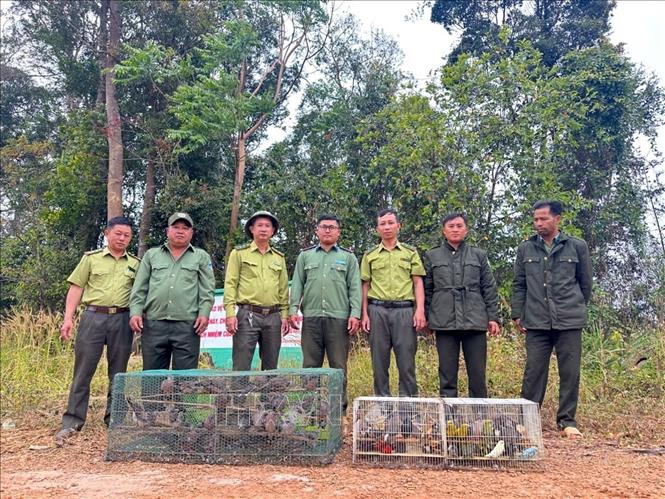
Recently, many local residents in Lam Dong Province have voluntarily handed over wild animals to relevant agencies for release into their natural habitats.
The Management Board of the Ta Dung National Park and related agencies freed four monkeys, including three crab-eating macaques (Macaca fascicularis) and one pig-tailed macaque (Macaca leonina), into the forest. Earlier, the four monkeys were handed over to the Ta Dung Forest Protection Unit by local residents. The animals’ health conditions were checked, and they were confirmed to be ready for release.
In December last year, some residents in Bac Gia Nghia Ward (Lam Dong Province) caught a pangolin when it crossed the road in their neighborhood. They transferred the pangolin to the ward police. After a health checkup, the scaly anteater was released into the forest of Ta Dung National Park.
The Lam Dong Forest Protection Sub-department has just freed nearly 200 birds into the Dak Nong-Gia Nghia Protected Forest. These birds were confiscated from poachers and traders by relevant agencies, baotintuc.vn reported.
Building houses for natural disasters’ victims
Storms and floods in the final months of last year completely destroyed five houses and partially damaged nine in Hue City, including three collapsed houses and seven damaged ones in Khe Tre Commune.
To tackle consequences caused by natural disasters, the prime minister launched the Quang Trung campaign to build houses and repair damaged ones for those victims to be able to celebrate the upcoming Tet (Lunar New Year) in their new houses.
Tran Van Quang, vice chairman of Khe Tre Commune, told baotintuc.vn that the local government mobilized military and police forces and people to build and repair houses for local victims, adding that all construction tasks had been completed and new and repaired houses were transferred to the recipients on January 10. Aside from new and repaired houses, these families also received seedlings and livestock granted by local authorities to make ends meet.
Together with the participation of military forces, Hue City police forces lent a hand to build and repair houses for people in need. The police also donated VND300 million for the construction of two houses for two families with houses collapsed during storms and floods.
Introducing folk music instruments to the world
 Ro Cham Tih, a meritorious artist of the Gia Rai ethnic group, has preserved his people’s folk music instruments for years as though it were his own mission. Not only a player, but he has also introduced folk music instruments made from bamboo and rattan to many countries around the world.
Born and raised in Ia Hrung Commune, Gia Lai Province, Ro Cham Tih was lucky to learn to play folk musical instruments from his grandfather, father, and old villagers when he was young. The Gia Rai artist was quoted by dantocphattrien.vietnamnet.vn as saying that he likened his people’s musical instruments, such as T’rung, Goong, K’long But, Ting Ning, and Bro Amom, to his own children. Discharged from the army in 1993, he began performing Gia Rai music with instruments he made at festivals and rituals throughout the country. He has been awarded 30 medals, including 10 gold medals, certificates of merit, and many honorable titles.
Over the past three decades, Ro Cham Tih has introduced Gia Rai music and instruments made by himself from bamboo and rattan to audiences in Cambodia, Britain, Finland, Japan, South Korea, Laos and the U.S. He has set aside a house to display folk music instruments and teach his children and young villagers how to play Gia Rai music.
The patriarch of Kon Brap Ju Village
A Jring Deng, the patriarch of Kon Brap Ju Village (Kon Braih Commune, Quang Ngai Province), has devoted his life to protecting the identity of the Ba Na ethnic people. The man in his seventies is respectfully named the “Village Soul Keeper” by the Ba Na community and the local government.
In his traditional stilt house next to the rong (communal) house of Kon Brap Ju Village, A Jring Deng weaves rattan and bamboo products, including back-mounted baskets and various sizes of baskets, in accordance with Ba Na styles every day. Each of his products is an artistic work combining meticulousness, patience, and a handed-down secret.
A Jring Deng told dantocphattrien.vietnamnet.vn that such handicrafts are tools and cultural symbols of the Ba Na people, adding that the traditional craft handed down for generations had to be preserved and taught to the youth.
Aside from being a skillful weaving artisan, the patriarch is also a living historian of the village. He has a deep understanding of the Ba Na people’s gong culture, customs, festivities, and rituals. He thus presided over all the important rituals of the community. Under his guidance, all villagers, 94% of whom are Ba Na people, are focusing on production to have a better life.