
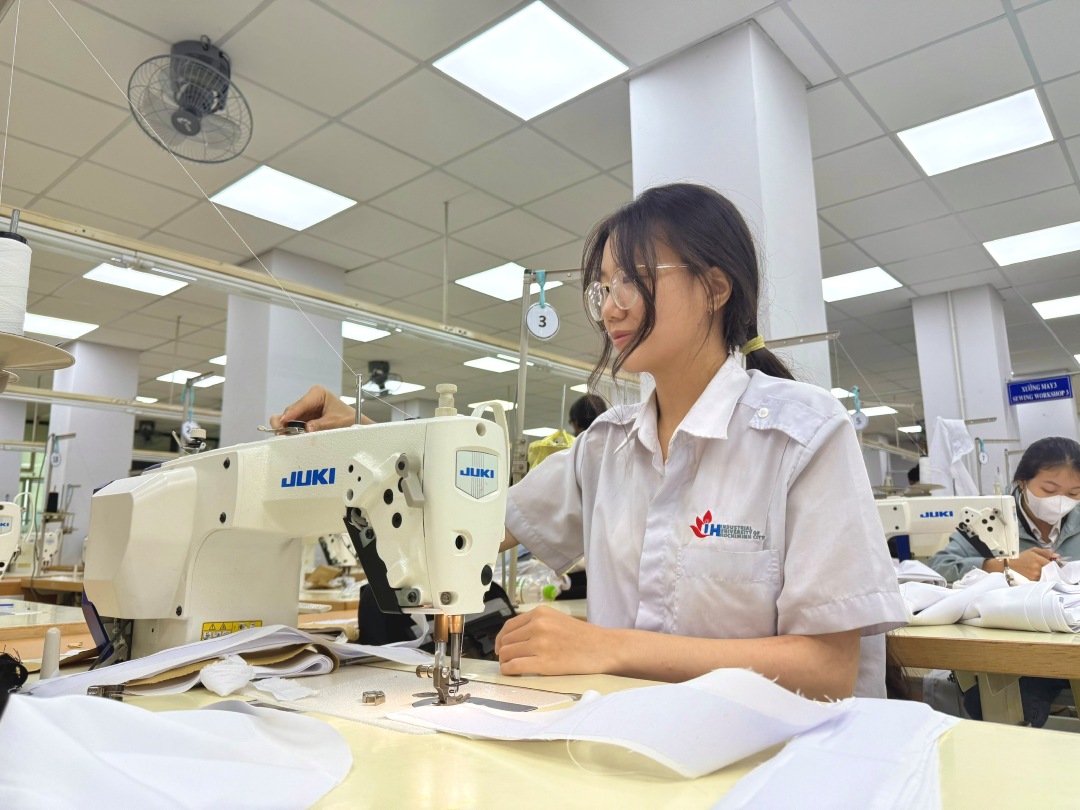
More than 300 uniforms were made by the teacher, students and ex-students of the Industrial University of HCMC (IUH) for students impacted by recent floods in the central region.
Bui Thi Cam Loan, lecturer at the IUH’s Faculty of Garment and Fashion Technology, told plo.vn that she thought of making uniforms for flood-affected students after talking with her friend, a high school teacher. She asked for permission from the university and received the fabrics from ex-students.
To accelerate production, the cutting process was made at a garment factory and the cut trousers and shirts were sent to the IUH for students at the Faculty of Garment and Fashion Technology to continue the sewing process at the garment practice room under the supervision of the lecturer.
As projected, on December 4 or 5, all the finished uniforms would be packed and transported to students in need in the central region, along with tables and chairs, to help students in flood-affected areas continue their learning which was disrupted by heavy floods.
Vovinam collective performances in town
On December 1, nearly one million students from 1,500 schools in HCMC took part in performing a form of Vovinam, a martial arts sect of Vietnam, in order to set a world record for the Vovinam collective performance with the most participants.
At 8:30 a.m. on that day, students at 1,500 schools of all levels in HCMC performed a form of Vovinam in line with music together as part of the activities to mark 50 years of development of the education and training sector of HCMC.
Nearly 1,200 students at Marie Curie Senior High School in Vo Thi Sau Ward took part in Vovinam collective performance on December 1. Similarly, about 900 students at Le Quy Don Senior High School in Xuan Hoa Ward also participated in this event.
Earlier, on November 30, some 60,000 high school students in HCMC performed a Vovinam form online and offline to set both Vietnam’s and world’s records for an event attracting the most participating students, sggp.org.vn reported.
A young female village leader
 Tan Thi Cuc, 35, is the Party secretary of Tan Bao Village in the border commune of Bat Xat, Lao Cai Province. The village is home to 165 households with 648 people, 70% of whom are ethnic minorities.
Although there are eight poor households in Tan Bao, the village is still leading in all public activities. It has won the “Cultural Village” title for three consecutive years. Regarding the program to put an end to dilapidated houses in the village, the local Party cell has assigned the task of helping poverty-stricken households to every Party members. Ten dilapidated houses have been rebuilt so far this year with the contribution of hundreds of working days of the villagers.
As regards Lao Cai Province’s land clearance and resettlement projects for the implementation of the Lao Cai-Hanoi-Haiphong high-speed railway project, Tan Thi Cuc and members of the local Party cell encourage some villagers to leave part of their arable land for the construction of the high-speed railroad.
Under the leadership of the young Party secretary, Tan Bao Party cell has accomplished all of its annual tasks and the village has been selected as a typical model, vietnamnet.vn reported.
Old artisan protects traditional blacksmithing
A Gip was born in 1918 into a Ba Na ethnic family in Kon Tuc Village, Dak Rve Commune, Quang Ngai Province. Blacksmithing is the traditional craft of his family, which has been preserved until today by the centenarian artisan.
Learning blacksmithing from his father, A Gip has been working in his forge next to his house since his childhood. Despite his old age, he has made thousands of knives, machetes and hoes for Ba Na villagers.
A Teo, head of Kon Tuc Village, told vietnamnet.vn that of the 54 households in the village, 30 are A Gip’s offspring, adding that blacksmiths at the six smithies in the village learned the traditional craft from the old artisan. Thanks to A Gip, traditional cultural values of the Ba Na people in the village have been protected.
Aside from blacksmithing, A Gip can make traditional drums and gongs and know how to play them. The centenarian has never missed any festival in the village. He hopes all Ba Na ethnic group’s traditional crafts and cultural festivities will be preserved well for the young generation.