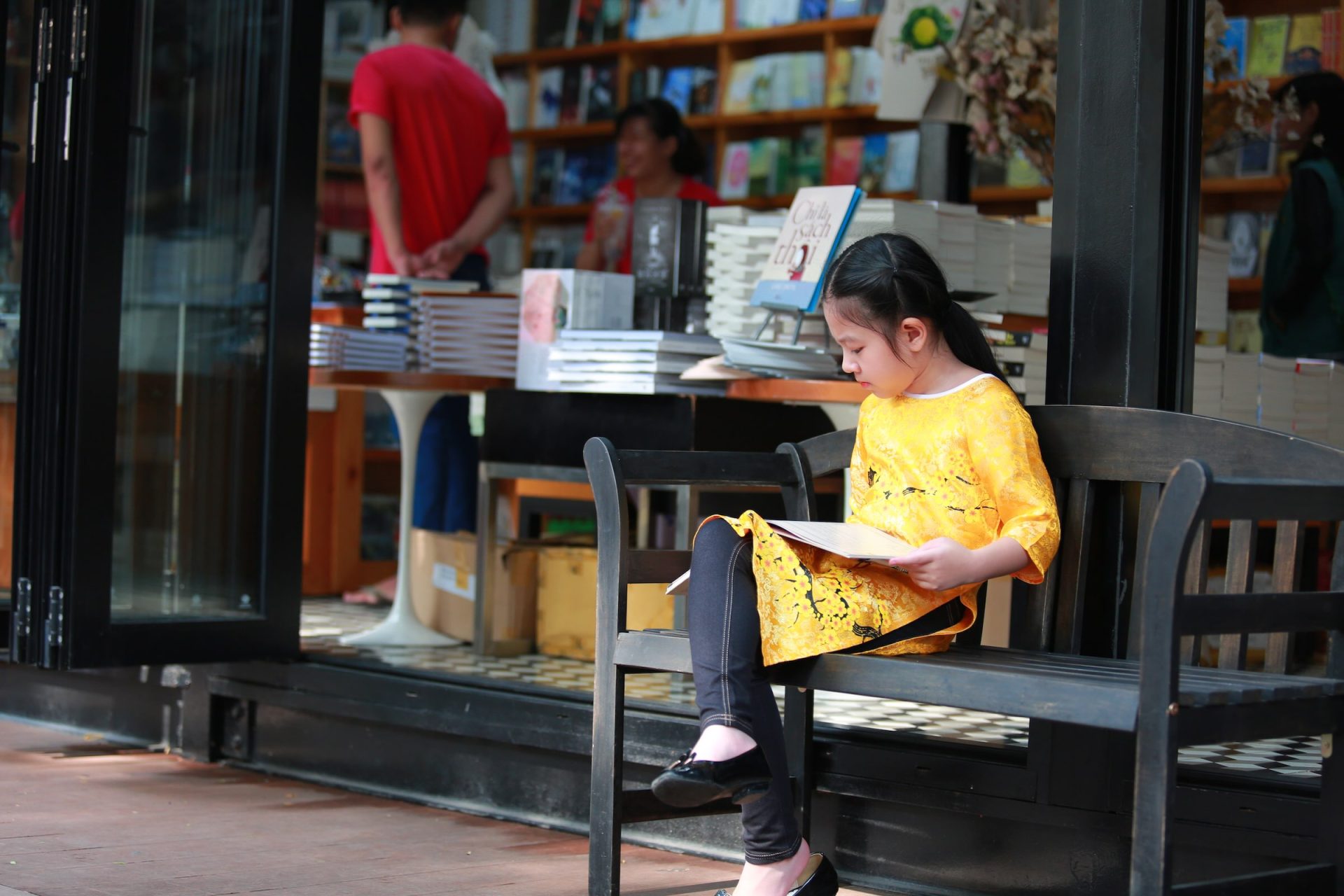
Since its launch on January 1, 2016, HCMC Book Street has proven to be an important hub for the publishing scene and a popular tourist spot.
Starting with the article, “What book street for Saigon?” by journalist and writer Le Van Nghia in 2015, over the past decade, the HCMC Book Street has continuously evolved, not just as a place to sell books but also as a gathering space for publishing houses, authors, translators, readers, and more. When people mention the HCMC Book Street or Nguyen Van Binh Book Street today, they think of it not only as a place to find books but more importantly as a spiritual space.
Memorable achievements
Besides trading, the book street is a gathering place for various establishments, including nostalgic old bookstores, coffee shops with unique styles, and regular book exchanges and discussions.
According to statistics from the book street management, besides more than 73,000 new book titles, over VND433 billion in revenue, and 6.7 million books published in the past ten years, it should be noted that the book street has organized over 3,000 events with various forms, such as 50 book festivals, 280 student exchange programs, 275 art exhibitions, 130 cultural and artistic performances, and over 800 interaction and skill playgrounds.
This indicates that the HCMC Book Street has evolved from just a simple name to a cultural space. Another notable fact is that the book street welcomes more than 3,000 visitors daily, with over 30% of them being international tourists. What once was a small street with little traffic and passers-by has gradually taken on many important roles in the minds of both city residents and tourists from around the world, whether local or foreign. It can be said that this is a very special example, especially given its proximity to culturally significant landmarks like The Notre Dame Cathedral, the Central Post Office, and further away, the Opera House and the Majestic Hotel. The book street has become an essential part of tourism development—a unique spiritual space where knowledge, culture, and tourism come together.
Over the past years, street management has worked hard on this effort, organizing many programs to encourage tourists and visitors to explore the street. Recently, to develop evening activities, it has organized the book and night culture festival with various activities like quiet mind tea, southern amateur singing, cuisine talks, and folk games. These activities show that there is still plenty of room to make the book street unique and even more engaging.
Challenge and development opportunity
In the near future, HCMC Book Street will still need to change significantly to remain an appealing destination for both nationwide and international tourists. The key is to continually improve service quality by maintaining and expanding the number of bookstores and further diversifying cultural experience spaces.
Furthermore, exchanges and talks should be enhanced in quality, making the street the top destination for book enthusiasts. Additionally, as continuous changes occur, the book street should also modernize and embrace the digital age. It not only features traditional paper books but should also focus on introducing and promoting interest in spoken books and e-books. Moreover, it should utilize advanced technologies like QR codes and artificial intelligence to stay current.
To accomplish this, the book street must first establish a clear legal framework, be recognized as a public cultural space, and be sponsored by the city government. Once these conditions are met, the management, staff, and publishing ecosystem can feel confident in working and contributing to the development and modernization of the book street.
Additionally, management should be consistent in development while ensuring the preservation of cultural significance, along with spiritual and tourist values, rather than allowing deviant transformation and use, as reported in many accounts of the recent commercial space appearance.
To ease this pressure, there should be studies on the harmonious integration of the state budget with private resources. This will ensure that the initial values are not only preserved but also continuously enhanced through the participation of multiple individuals, businesses, and organizations.
The book street needs to establish extensive cooperation with schools, libraries, reading clubs, and other organizations so that it can become a familiar space from childhood, helping to cultivate a new generation of citizens who are not only comfortable with modern technology but also see its value. For foreign tourists, it should feature shops catering to their specific needs.
There should be collaboration with travel businesses to make the HCMC Book Street a prominent destination; for example, in 2023, the book street was chosen by experts and tourists as one of the 10 interesting shopping venues and one of the 100 interesting things in HCMC in a poll conducted by the HCMC Tourism Department. In 2024, it was recognized as one of the 50 tourist attractions in HCMC and 13 cities and provinces of the Mekong Delta through a selection by the HCMC Tourism Development Association Council and other regional cities and provinces.
With this success, this model can be replicated for projects with the same goal and scale, such as Thu Duc Book Street and Nguyen Dong Chi Book Street (former District 7), which are operational, as well as Vung Tau Book Street, which remains lackluster and not yet attractive.
Once accepted and expanded, these areas will not only boost the revenue of HCMC’s budget and the country’s overall income but also become a distinctive feature of HCMC after the administrative boundary merger. This will support the city’s vision of becoming a smart, modern, and compassionate city, as well as a major hub for the economy, finance, services, science and technology, culture, and education for both the country and the region. It will pave the way for a broader outlook where not only main book streets exist but also book streets in each hamlet and village, making the reading culture a living, integral part of city life.