
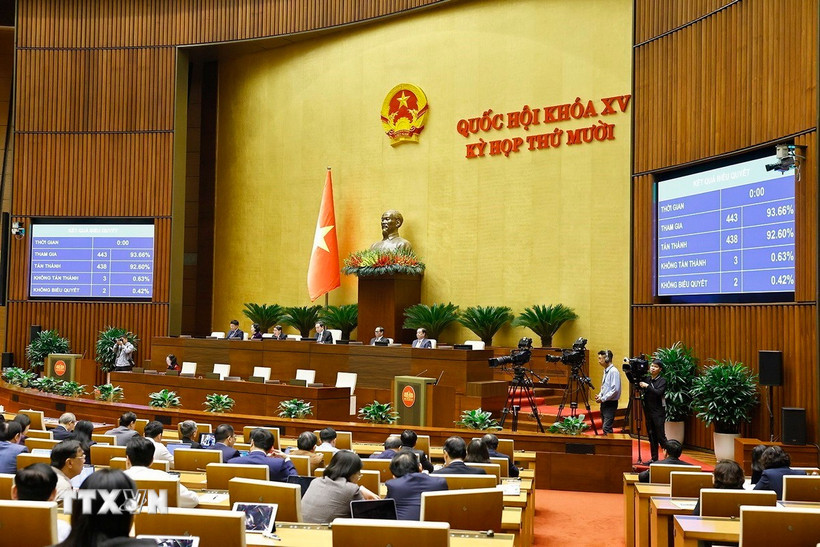
HCMC – Vietnam’s National Assembly (NA) has approved amendments to the Personal Income Tax Law, with the number of tax brackets reduced from seven to five while the top marginal rate kept at 35%.
With 438 out of 443 NA deputies present voting in favor, the legislature passed the amended Personal Income Tax Law at the session today, December 10. The amended law is scheduled to take effect on July 1, 2026.
Under current regulations, the personal income tax schedule consists of seven progressive brackets with rates of 5%, 10%, 15%, 20%, 25%, 30% and 35%. The amended law streamlines the system to five brackets.
The lowest rate is still 5% for monthly income up to VND10 million. The top rate stays at 35% but will apply only to income above VND100 million a month, instead of the current threshold of VND80 million.
The revised tax brackets will apply from the 2026 tax year. Starting January 1, 2026, employers will calculate and withhold monthly or quarterly personal income tax for employees based on the new rates. From January 1 to March 31, 2027, taxpayers will finalize their tax filings to determine their total personal income tax liability for 2026.
The Government said the 35% top tax rate remains in the mid range globally. Thailand, Indonesia and the Philippines all apply the same maximum rate, while China’s top rate is 45%.
The amended law also specifies that personal income tax on real estate transfers will be calculated at 2% of the transaction value. The tax is assessed at the time the transfer contract takes effect under relevant regulations or when procedures for registering land use rights or property ownership are completed.
The law also imposes a 0.1% tax on each transfer of gold bullion. The Government is authorized to set the taxable threshold, the start date for collection and any future adjustments to the tax rate in line with its roadmap for managing the gold market.
This is the first time such a provision has been included in law, and given its broad impact, the design is considered aligned with the policy goal of tightening gold market oversight, curbing speculation and redirecting capital back into the economy.







