
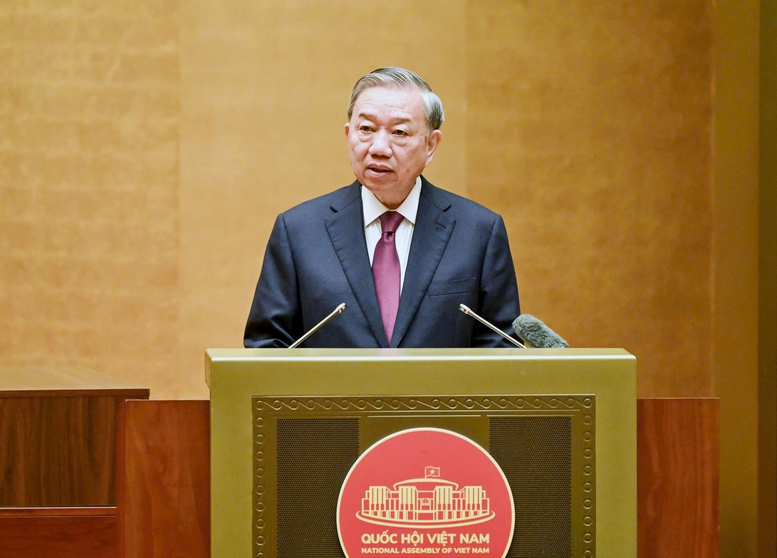
HCMC – Party General Secretary and State President To Lam called for the State to shift from direct investment to a role that designs and enables a market-based allocation of resources.
He was speaking at a national hybrid conference held today, April 13, to introduce key contents of the resolution adopted at the second plenum of the 14th Party Central Committee.
High and sustainable growth cannot depend on a single source of capital or place the full burden on the State, he noted.
State capital should function as “seed capital” to shape development, reduce initial risks, and mobilize private investment, he noted.
Corporate capital, including from the private and foreign investment sectors, should be directed toward high value-added production, innovation-driven projects, and knowledge-based value chains.
External borrowing should be used selectively, aligned with repayment capacity and absorption ability, with priority for key infrastructure and projects with broad spillover effects.
Financial markets, including capital, credit, and bond markets, should serve as medium- and long-term funding channels for the real economy. Capital flows should be directed to production, innovation, and essential infrastructure.
He also highlighted the need to mobilize resources from the population, describing it as a strategic breakthrough. This includes financial capital, skills, labor, entrepreneurship, and aspirations for wealth creation.
Energy planning should be prioritized within overall national planning. He noted that stable, sufficient, and affordable energy supply is necessary for industrialization, sustained growth, and new development space.
Energy development should align with industrial, urban, logistics, digital infrastructure, and green transition strategies, while ensuring resilience and national security.
Lam called for an end to fragmented and short-term investment practices, including those driven by administrative approval mechanisms or fixed terms.
All projects must align with overall planning and be assessed rigorously, he noted, adding that large-scale investment should not come with low standards or weak quality.
Project evaluation should be based on socio-economic impact, with public benefit as the central criterion. He cautioned against prioritizing capital size, project numbers, or disbursement speed over long-term effectiveness.