
HCMC – Private enterprises are encouraged to develop small modular nuclear power alongside state entities under the newly approved national energy development resolution through 2030.
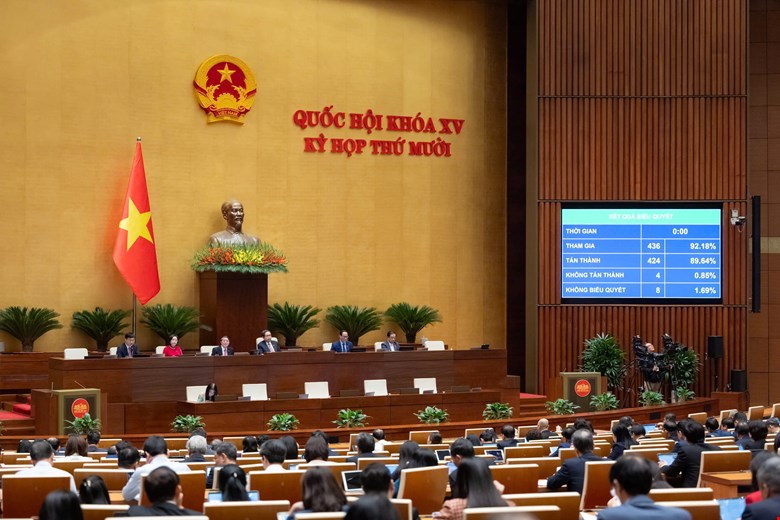
With almost 95% of the National Assembly’s deputies present voting in favor, the legislative body endorsed a resolution on mechanisms and policies for national energy development for the 2026-2030 period at the session today, December 11.
The resolution is expected to take effect on March 1, 2026.
Under the resolution, the Government is authorized to develop an investment framework for small modular nuclear reactors depending on demand and the level of technological commercialization.
Both state-owned and private enterprises are encouraged to participate in small modular reactor (SMR) research and development, with strict requirements to ensure nuclear safety and security.
The Government noted that SMR technology worldwide remains in the experimental stage, with costs and safety levels yet to be verified, while the domestic regulatory framework is still incomplete.
With no commercial SMR projects available for benchmarking, the Government says it is not in a position to introduce concrete incentives. It will seek National Assembly consideration of support measures once the technology is commercialized, meets safety requirements and fits Vietnam’s conditions.
At the end of last year, the National Assembly decided to resume investment in the Ninh Thuan nuclear power project after an eight-year halt.
Vietnam also plans to develop small-scale nuclear power nationwide. Small modular reactors are advanced nuclear units with capacities of up to 300 MW each, roughly one third the size of conventional reactors.
The modules can be factory built and transported to the installation site as individual units, reducing costs and construction time while maintaining safety through passive safety features.
Investment costs for SMRs are estimated at US$7,000-12,000/kW, putting a 300 MW plant in the range of US$2.1-3.6 billion with a construction time of 2–3 years. By comparison, a conventional nuclear plant typically costs US$6-9 billion and requires around five years to build, with some projects taking more than a decade.
For offshore wind power projects, the resolution allows companies to finance their own surveys and have those costs recognized if no investor is selected. The prime minister will decide on investment approvals for projects through 2030 without requiring land auctions or competitive investor selection.
From 2030 to 2035, this authority will shift to provincial People’s Committee chairpersons. Projects must meet requirements on national defence, security, maritime sovereignty and environmental resources, and must be included in the national power plan with an operating schedule for the 2025-2030 period.
Under the resolution, electricity retailers in industrial parks, high tech farming zones and free trade oriented urban commercial areas will be eligible to join the direct power purchase agreement mechanism (DPPA).
Contract prices under DPPA arrangements, regardless of the grid used, will be determined by the parties.
In addition, oil, gas and coal projects deemed nationally important and urgent will be exempt from investment-policy approval procedures. For ongoing projects, land compensation and site clearance will continue in parallel with any related planning adjustments.