
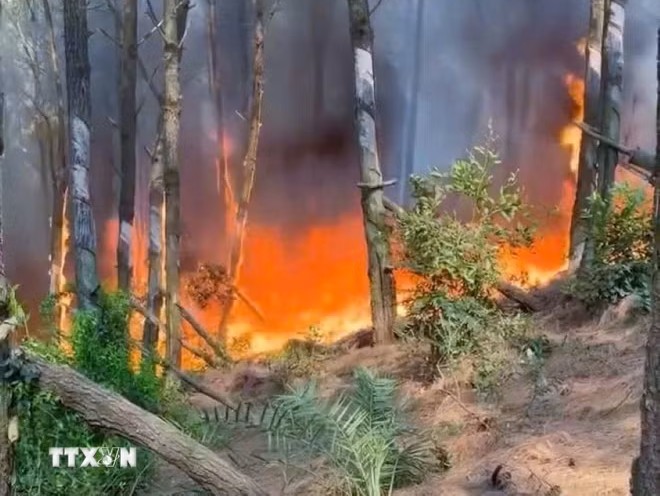
HCMC – The Forestry and Forest Protection Department under the Ministry of Agriculture and Environment has issued warnings of Level IV (dangerous) and Level V (extremely dangerous) wildfire risks in multiple areas nationwide, particularly in the north-central region, from April 13 to 19, as a prolonged heatwave and unusually dry conditions persist.
The epicenter of the heatwave and wildfire threat this week is expected to stretch from Thanh Hoa Province to Hue City.
Temperatures are forecast to range from 38 to 40 degrees Celsius, with some areas exceeding 40 degrees Celsius, while humidity levels have dropped to a record low of 30–35%. Under such conditions, pine and acacia forests in the north-cenral region face a heightened risk of rapidly spreading fires. Official warning maps have already turned largely orange (Level IV) and red (Level V) across these areas.
In the north-west, temperatures are expected to hover between 35 and 38 degrees Celsius, with Level IV fire warnings in place. Meanwhile, the Central Highlands and southern regions are also under Level III (highly risk) and IV alerts.
Forestry experts have raised particular concern over fire-prone pine and dipterocarp forests in Dak Lak and Lam Dong provinces, as well as melaleuca forests with dry peat layers in An Giang and Ca Mau provinces, where fires can smolder underground and prove difficult to extinguish.
Amid the extreme weather, authorities have urged localities to maintain round-the-clock readiness, ensuring that personnel and equipment are on standby to tackle fires at an early stage. Forest rangers have been instructed to closely monitor conditions on the ground and assess vegetation dryness to issue timely alerts.
In addition, local authorities have been told to strictly prohibit the use of fire in and near forests, while guiding residents on regulated farming practices. Chairpersons of local people’s committees and forest protection forces are required to take direct command at fire scenes if incidents occur, mobilizing all available resources to prevent small outbreaks from escalating into large-scale disasters.







