

HCMC — Developing a truly robust State economic sector, including State-owned enterprises (SOEs) that undertake a leading, pioneering, and guiding role while supporting other economic sectors – is of decisive significance. This growth is essential to successfully achieving the nation’s 2030 goals and 2045 vision.
Throughout over 80 years of national development, particularly after 40 years of the Doi Moi (Renovation) process, the State sector has consistently maintained its leading role in the Vietnamese economy. This is demonstrated through business activities as well as the effective management, allocation and utilization of key resources such as the national budget, land, natural resources, infrastructure, credit and national reserves.
Defining the leading role in the new era
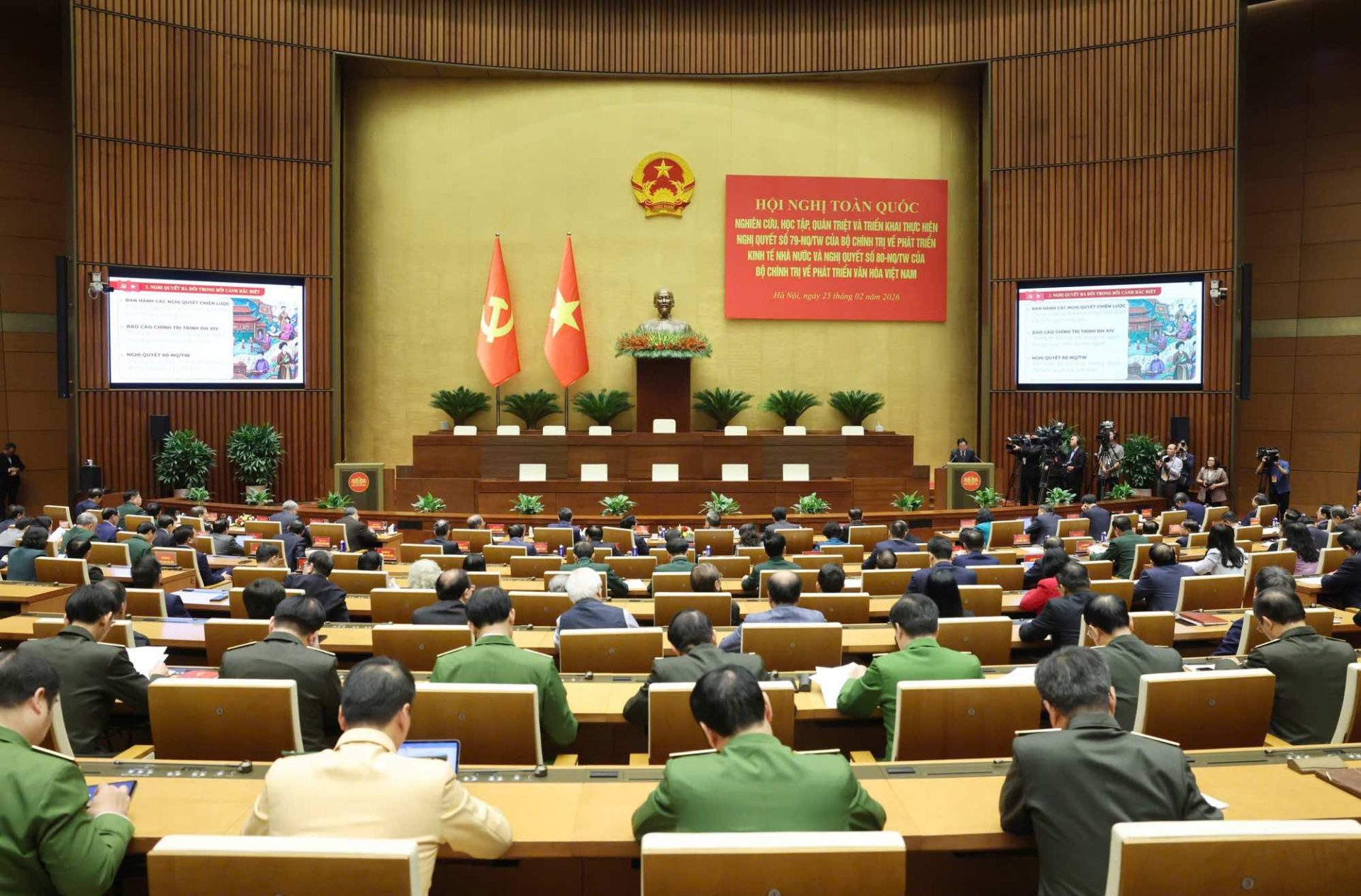
At a national hybrid conference on Resolution No. 79-NQ/TW on State sector development and Resolution No. 80-NQ/TW on development of Vietnamese culture held today, February 25, Party General Secretary To Lam evaluated the State and private sectors as the two vital pillars of the socialist-oriented market economy.
While the private sector is increasingly dynamic and integrated into global value chains, the State sector maintains its leading role by ensuring major macro-economic balances, stability and regulation. It executes strategic medium- and long-term tasks directly related to energy, financial, monetary, and telecommunications security, as well as essential infrastructure and key sectors.
In this new stage, To Lam stated that the State sector must occupy the commanding heights of the economy through rigorous restructuring. The leading role must be proven through guiding capacity, efficiency, and substantive contributions to macro-economic stability and economic security.
He emphasized that the State must firmly and professionally hold sectors necessary to ensure sovereignty and stability. In fields where the State should only lead, create foundations, or pave the way, mechanisms must be designed for the private sector to participate, compete, and grow together. Any field where State involvement is unnecessary or inefficient must be resolutely reorganized according to market principles and transparency, combating group interests, manipulation, policy profiteering and the like, he said.
Presenting the core contents of Resolution 79, Nguyen Thanh Nghi, Politburo member and head of the Commission for Policy and Strategy of the Party Central Committee, clarified that the State sector is a unified entity comprising all resources held, managed, and controlled by the State, including land, minerals, airspace, and maritime zones.
The resolution also affirms the State sector’s role as a strategic tool for the State to direct and regulate economic activities, enhancing national self-reliance and promoting sustainable development. Besides, five systematic guiding viewpoints have been established for the new era, notably innovating the definition of the “leading role” and fundamentally reforming the relationship between the State and other sectors. Specifically, the State sector must pioneer development creation, taking science, technology, and digital transformation as the main drivers.
Five strategic pillars for national self-reliance
As Vietnam aims to become a high-income country by 2045, General Secretary To Lam stressed that the State sector must be manifested through five major pillars.
The first is the pillar of economic security and sovereignty, where the State masters the nation’s lifeblood and backbone to ensure sovereignty and avoid dependence. The second is the pillar of regulation and resilience, maintaining essential markets and public services during overlapping global shocks. The third serves as a lead for the private sector, acting as a foundation and a pathfinder to help domestic firms join global value chains and increase localization rates.
The fourth pillar focuses on leading innovation and core technology, where leadership is measured by mastering technology and managing data as a strategic resource. Finally, the fifth pillar establishes standards for governance and public integrity, requiring SOEs to exemplify the highest discipline and accountability. The General Secretary asserted that there is no room for prolonged losses without clear responsibility or short-term investments.
To realize these objectives, according to Nguyen Thanh Nghi, Resolution 79 outlines seven groups of tasks involving resources from land and minerals to space and digital assets. Notably, the amended Land Law and relevant documents are expected to be issued in 2026 to unlock land resources. Regarding equitization and divestment, the new orientation ensures that State control is maintained in strategic sectors and prestigious national brands are preserved.
The Politburo emphasized a shift from “administrative management” to “development creation” and modern governance, moving from pre-inspection to post-inspection. Furthermore, attracting talent and building mechanisms to protect officials who dare to think and do based on a transparent evaluation process are other highlights.