
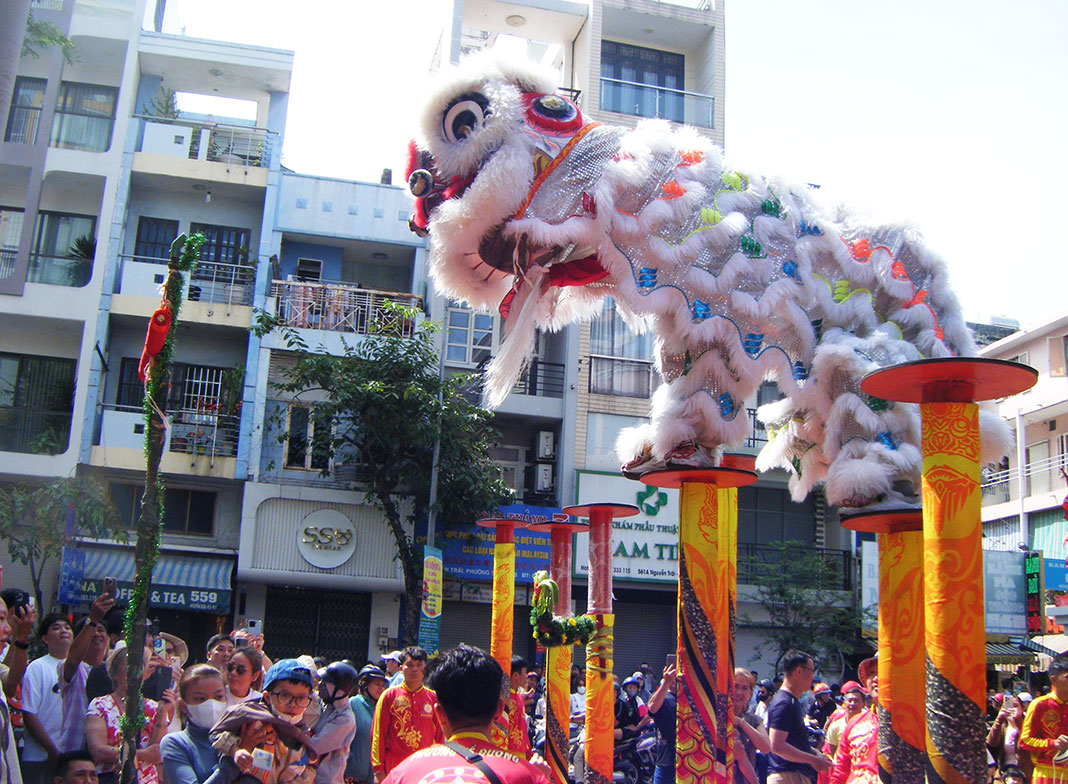
On the morning of the third day of Tet, a stretch of Nguyen Trai Street in what was once District 5 begins to slow. The city, defined by relentless motion, feels as though someone has placed a steadying hand on its racing heart. Conversations soften. Motorcycles ease to the curb. Children tug at their parents’ sleeves. Phones rise into the air. Anticipation thickens.
The first drumbeat resounds — deep, commanding — as if rising from the earth itself. The sound does not merely reach the ears; it travels through the pavement and settles in the chests of those watching.
In Ho Chi Minh City, the drum that announces the qilin dance signals more than the start of a performance. It marks a fragile boundary between the old year and the new — between what has ended and what is about to begin.
Like a bridge
The first qilin appears — motley red, its eyelids fluttering, its wide mouth edged with fur that trembles with each drumbeat. Known in Vietnamese as ky lan, the qilin is a mythical creature of East Asian tradition, a symbol of prosperity, protection and benevolence. Unlike the Western unicorn, it is not a solitary horned horse but a composite being — part lion, part dragon — said to appear only in times of peace and good fortune.
Inside the costume, two young men move in perfect coordination, giving breath and balance to the imagined beast. Beside them walks Ong Dia — the Earth God — round-bellied and smiling, waving his fan with theatrical leisure. He teases children, feigns clumsiness, pats adults on the shoulder. He serves as mediator between the visible world and the invisible one — the realm of spirits believed to watch over families, businesses and the fortunes of the coming year.
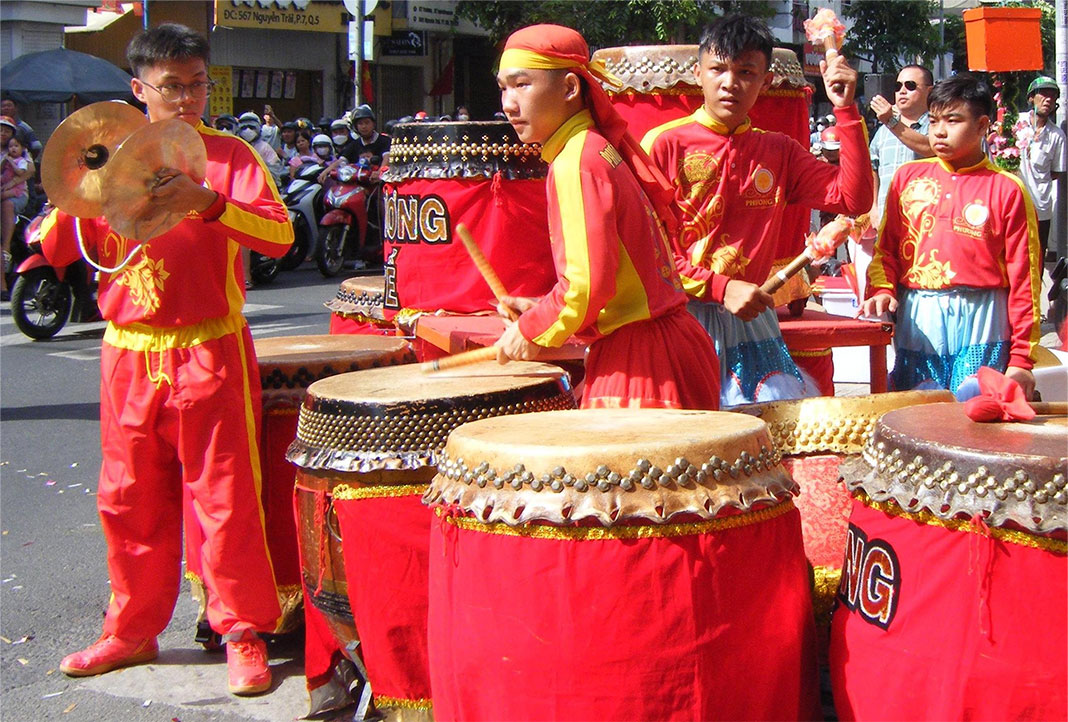
The Phuong Te Duong troupe is invited to perform in front of the Yen Sao A Dung (Hua Cam Nhung) shop.
La Hung, Nhung’s husband, stands nearby with a quiet smile. He speaks softly, as if Tet — the Lunar New Year — requires a certain restraint.
“We are the third generation here,” he says. “My sisters-in-law from Singapore, Canada and the United States have all come back. Everyone is together.”
In earlier decades, long strings of firecrackers hung outside homes and shops, exploding into clouds of smoke and fragments of red paper. The noise was believed to drive away evil spirits. Firecrackers have been banned since 1994.
But not entirely.
Today, drums, cymbals and pull-string firecrackers that release bursts of sound and confetti recreate the atmosphere. Some troupes even use recorded effects to mimic the sharp crackle of real explosions.
The need for sound
“Sound is essential,” dancer Tran Huu Thanh Tam says, leaning close to be heard over the rhythm. “Without sound, there’s no luck. It has to feel like the old days — even without real fire.”
The qilin halts before a red envelope placed ahead of it. It steps back, tilts its head as if calculating. Then it lunges forward and “swallows” the envelope to roaring applause.
Inside the house, near the floor, stands the altar of Than Tai, the God of Wealth. Fruit is stacked in a pyramid. Incense smoke curls upward. Teacups are aligned with precision. When the qilin bows and dances before the altar, the meaning shifts. This is not merely entertainment to attract customers; it is an invocation of prosperity.
Behind the symbolism are clear numbers. A one-hour qilin dance in Ho Chi Minh City costs between three and five million dong. Hiring a renowned troupe or adding acrobatics on thung — leaping between tall iron poles in the demanding sequence known as Mai Hoa Thung — can push the fee beyond 20 million dong.
“It’s more expensive here,” says Nguyen Truong An, leader of a 30-member troupe, smiling. “Big house, big ceremony.”
Tet generates its own seasonal economy. During the first three days, a troupe may perform at four or five locations in a single day.
Inside the qilin’s head, the heat is suffocating. Every movement must be exact. Two bodies must function as one. There is no margin for error.
Around 10:30 a.m., attention shifts to a set of iron poles, four to five meters high, erected along the side of the house. The crowd tightens.
A white qilin approaches. It lowers its head, as if contemplating the challenge. Then it springs onto the first pole. Drums and gongs crash in unison.
Qilin on the thung
High above the ground, the qilin leaps from pillar to pillar. The gaps are uneven; some appear impossible to cross. The crowd holds its breath.
“This is the most dangerous part,” Nguyen Truong An says quietly. “The two young men inside must be extremely strong. Many train in martial arts. The most important thing is trust.”
The qilin pauses on the final pole — a suspended second of silence — then vaults across the last gap. Applause erupts. A pair of German tourists film without blinking.
“Truly impressive,” the man murmurs.
For foreign visitors, it is spectacle. For locals, it is omen. If the qilin does not fall, the year ahead will be steady.
In the courtyard, sisters who have returned from abroad arrange crispy-skinned roast pig, Peking duck and Cantonese dishes. They move easily between Vietnamese, English and Mandarin. Children dart between tables.
“It’s been ten years since we were all together like this,” La Hung says. “On the tenth day of the new year, some will fly back to the United States.”
The gathering mirrors the city itself — families dispersed across continents, businesses expanding, and borders crossed. Yet the qilin dance endures, a red thread tying past to present.
The qilin descends at last, its artificial fur soaked with sweat. More red envelopes are offered. Children shyly extend small bills.
“The first days are crucial,” La Hung says. “A good beginning brings customers with confidence. You can’t measure it with data, but it matters.”
Tet is both ritual and commerce. The qilin dance draws attention, invites customers, and anchors business within tradition. The message is simple: We open under auspicious signs.
By 11:30, the troupe packs up. The qilin heads are lifted into a truck. The young performers drink water, laugh, and take photographs. La Hung shakes hands and offers thanks.
One final burst of simulated firecrackers crackles — an echo of earlier times. Then quiet returns. Motorcycles glide forward once more.
In a city racing toward glass towers and global ambition, the qilin dance persists. It connects migrants to homeland, business to belief, present to memory. Real firecrackers have been gone for more than three decades. The drums keep their spirit alive.
La Hung watches the troupe’s vehicle disappear down the street. He speaks almost to himself.
“It’s not about making an impression,” he says. “It’s about honoring tradition.”
Tet is not only a holiday. It is a conversation with the unseen.