
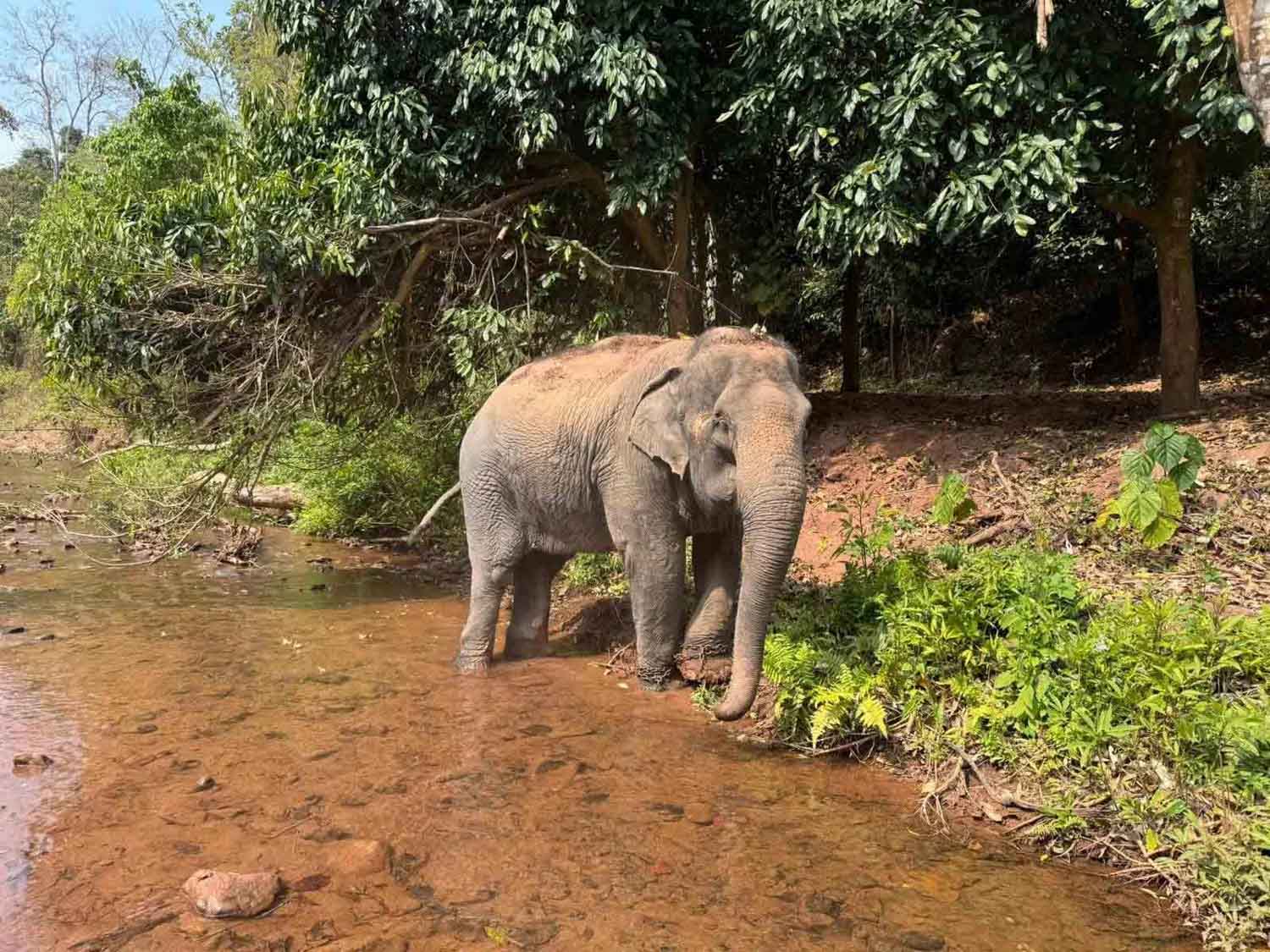
Kham Manh 2 was one of the six female elephants Japan borrowed from Laos in 2019 for conservation and research purposes. Recently, when international wildlife conservationists and the owner of the nature reserve where Kham Manh 2 was born in Laos 59 years ago visited Japan to see the elephant, they found something unusual. The elephant did not eat well and acted slowly despite being carefully looked after in the best conditions.
Thinking that Kham Manh 2 was not “happy” when living in Japan, the experts then decided to return the female elephant to Laos. They decided to carry the elephant weighing three tons from Japan to Vietnam onboard a wide-body Boeing 747-409F operated by China Airlines Cargo. The elephant would be transported from Vietnam to Laos by a special container truck.
On February 5, after a light morning meal at Japan’s Nasu Safari Park, Kham Manh 2 was led into a specialized container and was transported to the airport. The international flight took off in the evening and later landed at Taiwan’s Taoyuan Airport. After a three-hour rest at the airport, the aircraft with the elephant on board continued its flight and landed at Noi Bai International Airport at 1:45 a.m. on February 6.
After being examined and bathed, Kham Manh 2 was transported by a specialized truck to the Cau Treo Border Gate in Ha Tinh Province. The elephant was transferred to the Lao authorities, who continued to carry the giant mammal to the final destination on February 7, thanhnien.vn reported.
A unique medicinal herb village
Nghia Trai Village (Nhu Quynh Commune, Hung Yen Province) has been well known for cultivating and processing traditional medicinal herbs for nearly 1,000 years.
Legend has it that, circa 1572, after assisting King Ly Thanh Tong in defeating Champa invaders, three generals settled down in Nghia Trai. They cultivated herbal plants and practiced medicine to help locals. Villagers later built a temple to honor and worship them as the village’s gods. The cultivation and processing of medicinal herbs have become a livelihood for local villagers ever since.
Herbal plants are grown year-round in Nghia Trai. The most famous of all is the chrysanthemum, also known as “royal chrysanthemum.” The flowers are used as a nutrient, as a refreshing drink, or to treat eye diseases and high blood pressure.
Up to 80% of households in Nghia Trai grow herbal plants and process medicinal herbs. The village supplies 4,500-5,000 tons of traditional Vietnamese medicine and 2,000-3,000 tons of traditional Chinese medicine per year, vietnamplus.vn reported.
Heart transplant for an 11-year-old girl
Prof. Dr. Nguyen Hoang Dinh, vice director of the University Medical Center of HCMC, told vietnamplus.vn that at 4 p.m. on February 22, the National Organ Transplant Coordination Center announced a heart donated by a brain-dead donor at Bach Mai Hospital in Hanoi. About an hour later, a team of cardiovascular surgeons, anesthesiologists, nurses, and technicians from the University Medical Center of HCMC took the earliest flight to Hanoi to receive the heart.
 The selected heart transplant recipient was an 11-year-old girl with end-stage heart failure. Dr. Dinh said without a heart transplant, the young girl could die because of her severe heart failure. At 3:45 a.m. on February 23, the donated heart arrived in HCMC and the heart transplant was promptly performed. An hour later, the grafted heart beat again in the chest of the lucky girl, who continued to be taken care of at the hospital’s ICU.
According to Dr. Dinh, the University Medical Center of HCMC has so far performed 214 organ transplant surgeries, including 97 kidney transplants, 108 liver transplants and nine heart transplants. In the future, the hospital will enhance cooperation with the National Organ Transplant Coordination Center and medical facilities nationwide to shorten transportation times and optimize surgical outcomes, offering more opportunities for patients in need of organ transplants.
Rare wild animals handed over to authorities
On February 23, Doan Hong Hai, 50, who lives in Loc Quang (Bao Lam Commune, Lam Dong Province), handed over an adult pangolin measuring 52cm in length and weighing over 5kg to the Bao Lam 1 Commune Police Office. The pangolin is a rare, endangered species listed in Vietnam’s Red Data Book.
Hai told vietnamplus.vn that he happened to find the scaly anteater near his house. Realizing that this might be a rare, endangered species that should be protected, he brought the pangolin to the local police office. The police then transferred the wild animal to the local Forest Protection Office and the local Wildlife Rescue Center would release it to its natural habitat.
Since early this year, residents in Lam Dong Province have voluntarily handed over rare and endangered animals and birds to local authorities, including wild cats, pygmy slow lorises, yellow-cheeked gibbons, mountain eagles, stump-tailed macaques, alligator snapping turtles, and small Indian civets.