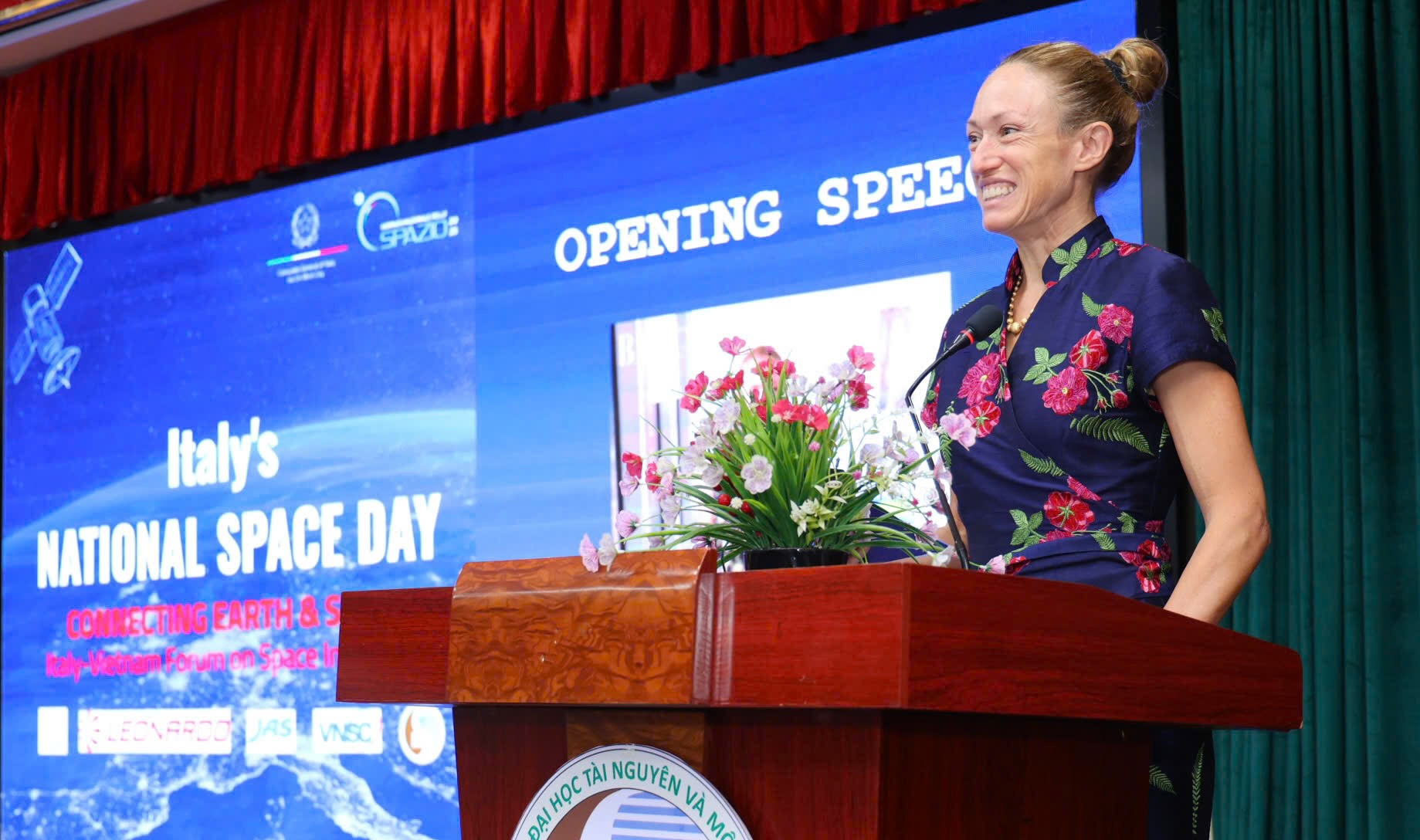
HCMC – Vietnam and Italy highlighted plans to expand cooperation in space technology, focusing on satellite data, climate resilience and urban planning, at the Italy–Vietnam Forum on Space Innovation held in HCMC on December 10.
The event comes as Vietnam accelerates investment in space infrastructure and digital transformation under Resolution 57-NQ/TW, which identifies satellite applications among 11 national strategic product groups. The southern region, especially the Mekong Delta and HCMC, is viewed by policymakers as a high-priority area for climate-adaptation research.
Italy sent representatives from Leonardo, the Italian Space Agency (ASI), the Italian Aerospace Network (IAN) and the Italian Embassy’s Science Office. The country is promoting its industrial and academic capabilities in Earth observation, satellite telecommunications and environmental monitoring.
Vietnamese partners include the Vietnam National Space Center (VNSC), HCMC University of Natural Resources and Environment, research institutes, universities and technology firms.
Two joint research projects were presented at the forum, including satellite-based monitoring of land subsidence in HCMC and land-use mapping in the Can Gio Biosphere Reserve using COSMO-SkyMed data.
Speaking to The Saigon Times, Italian Consul General Alessandra Tognonato highlighted Italy’s six-decade involvement in space, beginning with the San Marco program, which made Italy the third country to place a satellite in orbit with its own system in 1964.
“We would like to intensify cooperation at university and research level so our scientific communities can get ready for the future together,” she told reporters on the sidelines. She said Italy also wants young scientists from both countries “to get to know each other and explore needs” in order to develop joint products, patents and startups tailored to Vietnam’s priorities.
Tognonato said Italian companies, from major aerospace groups to small and medium-sized firms, see Vietnam as a strategic partner. “Vietnam has strong human resources and high-quality universities. We are aware of the challenges Vietnam is facing, especially erosion and extreme meteorological phenomena, and Italy has solutions that could be ideal,” she added.
The event also featured fresh innovation from young Vietnamese talents. Project OPTIGEO, led by Huynh Nguyen Gia Phat — team leader of The Third Eye — was recognized as a Global Nominee at the NASA Space Apps Challenge 2025. Developed by Phat and four teammates, the project applies ESA Sentinel-1 radar data and machine-learning models to monitor flooding risks and identify vulnerable areas.
Gia Phat said the idea emerged after watching frequent reports of severe storms and floods late last year. “We wanted to analyze water-level changes before, during and after storms so that AI could learn the patterns and generate early warnings for residents,” he said. The team also built features that guide users away from heavily flooded areas and an emergency reporting function that collects GPS coordinates and images to support rescue operations.
The student, who has studied computer science since childhood, credited university mentors for helping him understand satellite datasets and build AI models. His project was selected for presentation after his father encouraged him to share his work more widely.
Italy is set to chair the UN Committee on the Peaceful Uses of Outer Space (COPUOS) for the 2026–2027 term and will co-chair the next ESA Ministerial Council, moves expected to widen global collaboration in space science—including with Vietnam.