
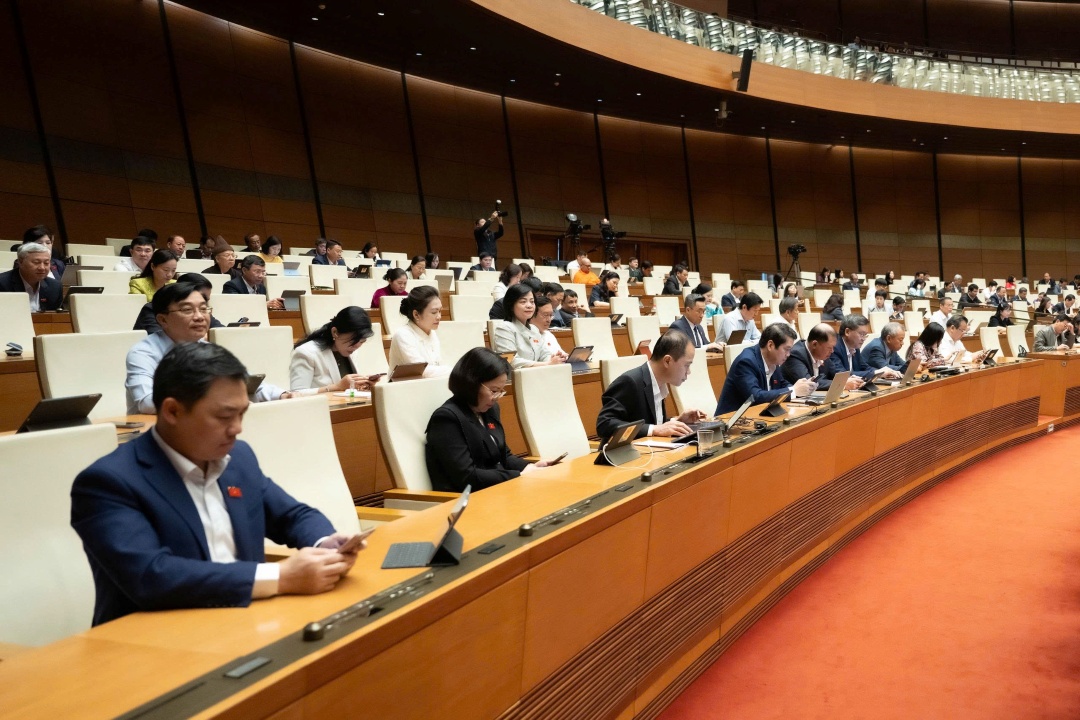
HCMC — The National Assembly has approved a plan to increase health insurance contributions from 2027 to support a roadmap toward basic hospital fee exemptions for all insured citizens from 2030.
Lawmakers on December 11 passed a resolution introducing special mechanisms to strengthen healthcare services. The Government will define the groups eligible for higher insurance benefits, the list of diseases covered for screening and early treatment, and the schedule for higher contribution rates.
The increase aims to expand coverage of basic hospital fees within the current insurance benefit package, aligned with economic conditions and the capacity of the Health Insurance Fund.
The resolution calls for higher reimbursement rates for medical examinations, screenings, diagnostics and early treatment, and for expanding priority groups funded by the Health Insurance Fund.
Near-poor households and people aged 75 and older receiving social retirement support will be fully covered for eligible medical expenses. Other vulnerable, low-income and priority groups will receive increased benefits. The fund will also pay for screening and early treatment of selected diseases, and insurance packages will be diversified.
Vietnam’s current health insurance contribution is set at 4.5% of the base salary. According to data from the Ministry of Health, the country recorded 183.6 million insured medical visits in 2024, up 5.6% from 2023. Insurance payouts reached VND139.1 trillion, a 15% year-on-year increase. Inpatient treatment remains the largest cost driver, with average spending of nearly VND4.6 million per admission.
Health insurance coverage reached 94.29% of the population, equivalent to over 95.5 million people. However, out-of-pocket payments account for around 40% of total healthcare spending. An estimated VND24.8 trillion represents costs outside the health insurance benefit package that patients must pay directly.
The resolution also introduces incentives for healthcare workers. Doctors and pharmacists will start at salary grade II upon recruitment until new wage policies are issued. Staff working in psychiatry, forensic medicine, emergency care and pathology will receive a 100% occupational allowance. Commune-level health workers in ethnic minority, mountainous, remote, border and island areas will also receive a 100% allowance, while those elsewhere will receive at least 70%.
Legislators also approved the investment plan for a national program on healthcare, population and development for 2026-2035.
Total funding for 2026-2030 will be VND88.6 trillion, including VND68 trillion from the central budget, VND20 trillion from local budgets and nearly VND600 billion from other sources. Funding for 2031-2035 will be proposed later.
The program aims to expand primary healthcare, strengthen early disease prevention and support vulnerable groups. It also targets population measures, including raising birth rates and responding to population ageing.
By 2030, Vietnam aims to cut stunting among children under five to below 15%, increase the crude birth rate by 0.5 per thousand compared to 2025, and lower the sex ratio at birth to fewer than 109 boys per 100 girls. The target for pre-marital health counselling and check-ups is 90% by 2030 and 95% by 2035.