
HCMC – Vietnam’s exports of agricultural, forestry and fishery products are on track to reach a new record of nearly US$70 billion in 2025, despite global economic uncertainties, reflecting a clear shift toward higher value, quality and resilience across key sectors.
Deputy Minister of Agriculture and Environment Phung Duc Tien said export turnover for the sector reached US$64.01 billion in the first 11 months of 2025. If December results match recent monthly performance, full-year exports could approach US$70 billion, well above the US$65 billion target. Several product groups are expected to post their highest export values on record.
Strong growth was recorded across major commodities, including coffee, pepper, seafood, fruits and vegetables, and wood products. Coffee stood out as the top performer. For the first time, Vietnam’s coffee exports surpassed US$8 billion, even as export volume was limited to around 1.5 million tons. Average export prices rose by about 40% from 2024, signaling a shift from volume-driven growth to higher value-added production and reinforcing Vietnam’s position as a major global coffee supplier.
The export structure of coffee also continued to evolve. Robusta remained the backbone in terms of volume, while processed coffee products posted strong growth, reflecting deeper participation in the value chain. In key growing regions such as Dak Lak, Gia Lai, Lam Dong and Quang Ngai, smart farming models have been expanded to improve productivity, quality and climate resilience. Farmers are increasingly adopting standardized production processes, digital tools, and traceability systems to meet stricter market requirements.
Seafood exports also delivered robust results. Companies accelerated shipments ahead of expected changes in U.S. seafood import regulations and the final outcome of an anti-dumping case involving shrimp. In November alone, seafood exports reached nearly US$990 million, up 6.6% year on year. Based on 11-month performance and year-end prospects, the Vietnam Association of Seafood Exporters and Producers (VASEP) forecasts full-year seafood exports of US$11.2–11.3 billion, the highest level to date.
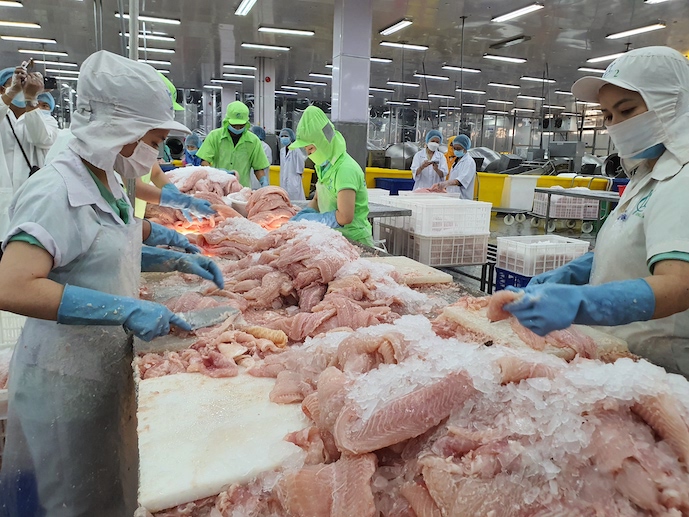
Shrimp exports are expected to exceed US$4.6 billion, setting a new record. Pangasius exports are estimated at over US$2.1 billion, supported by recovering demand in Asia and China. Tuna exports are projected to surpass US$900 million, approaching the US$1 billion mark.
Le Hang, deputy secretary general of VASEP, said the strong 2025 performance has reinforced Vietnam’s seafood supply position in major markets. However, stricter U.S. import requirements expected from 2026 will pose challenges, requiring greater transparency in supply chains, compliance with labor standards, stronger measures against illegal, unreported and unregulated (IUU) fishing, and a higher share of value-added products.
The fruit and vegetable sector also reached an unprecedented milestone. While the national plan had set a target of over US$5 billion in fruit exports by 2025, the sector is now expected to achieve around US$8.5 billion this year, up nearly 20%. Durian remained the sector’s flagship product, with exports surging since gaining official access to the Chinese market.
Dang Phuc Nguyen, secretary general of the Vietnam Fruit and Vegetable Association (Vinafruit), said exports faced difficulties early in 2025 due to tighter technical barriers from China on durian and the impact of U.S. tariff policies. However, flexible government management and rapid adaptation by businesses and farmers helped push exports to a record high. He said the sector is targeting US$10 billion in exports by 2026.
In forestry, Vietnam is steadily advancing toward its goal of US$25 billion in exports by 2030. Key strategies include strengthening linked production ecosystems, building a national brand for Vietnamese wood products, and diversifying markets, products and distribution channels.
Nguyen Quoc Khanh, chairman of the Vietnam Timber and Forest Product Association, said the industry must develop a more self-reliant supply chain, invest in technology, green production and workforce training, and build a national wood brand based on four pillars: sustainability, quality, flexibility and competitiveness, supported by transparent data aligned with international standards.
To sustain growth, the Ministry of Agriculture and Environment said it will continue reviewing and refining sector regulations to meet integration requirements, improving standards on quality control, quarantine, traceability and food safety, and strengthening inspections to ensure export quality from the source.







