
HCMC – The Ministry of Construction has urged the Government to direct local authorities to accelerate licensing procedures and expand the output of existing quarries, as major transport projects across the country face acute shortages of construction materials that threaten project schedules.
The ministry said that despite special mechanisms allowing faster licensing and extraction of common construction minerals, many key infrastructure projects continue to struggle to secure sufficient supplies. Local governments have worked to address bottlenecks, but shortages remain widespread as multiple large-scale projects are being built simultaneously.
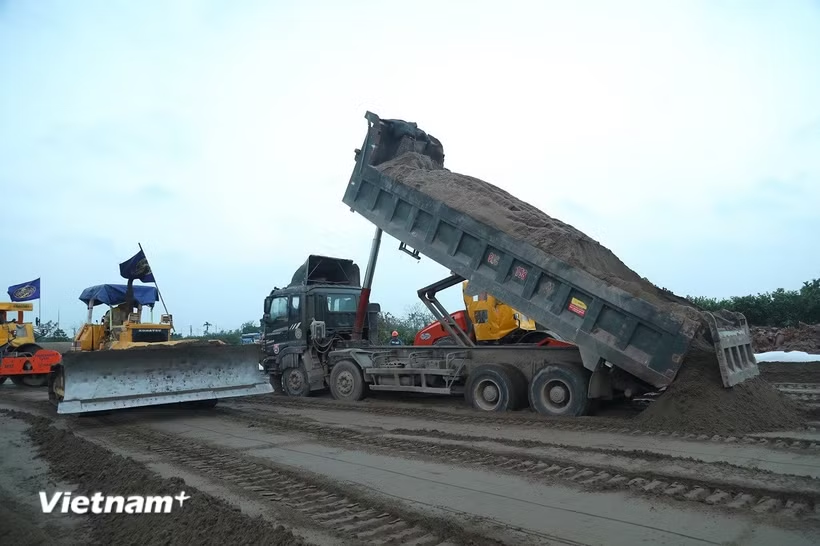
A shortage of fill material has left around 600,000 cubic meters of earth without an identified source for the Hanoi Beltway No. 4 project, reported local media.
Stone supplies are also under pressure. More than seven million cubic meters of stone have yet to be secured out of total demand of nearly 13 million cubic meters for nine expressway projects and project components. These include the Can Tho–Ca Mau Expressway, the Cao Lanh–An Huu Expressway, the Chau Doc–Can Tho–Soc Trang Expressway, the My An–Cao Lanh Expressway, and the expansion of the HCMC–Trung Luong–My Thuan Expressway.
The most severe shortage involves sand, a critical material for road construction in southern Vietnam. The ministry reported that more than 22 million cubic meters of sand remain without identified sources, accounting for roughly half of the nearly 45 million cubic meters required by seven nationally important transport projects.
The affected projects include sections of the Chau Doc–Can Tho–Soc Trang Expressway, the HCMC–Trung Luong–My Thuan Expressway expansion, Hanoi’s Beltway No. 4, and the Tay Ninh section of HCMC’s Beltway No. 4.
Southern cities and provinces with sand mines, including An Giang, Vinh Long, Dong Thap and Can Tho, have issued new licenses, opened additional mines and increased extraction capacity at existing sites. However, the ministry said these measures still fall short of meeting construction demand.
The supply of quality stone presents another challenge. Although reserves are largely sufficient in localities such as An Giang, HCMC and Dong Nai, quarry output has not kept pace with project requirements.
Several provinces have prioritized material allocations for strategic developments in their areas, including Long Thanh International Airport, HCMC’s Beltway No. 3 and urgent local projects linked to preparations for the 2027 APEC summit. As a result, other transport projects have been left with limited access to stone supplies, raising the risk of further delays.
To ease the shortages, the Ministry of Construction has recommended that the Government instruct local authorities to proactively complete licensing procedures and approve higher extraction capacity based on actual project needs.
The ministry also called on provinces without mineral resources to work with neighboring localities to secure supply sources, streamline licensing procedures and introduce policies encouraging businesses to develop stable construction material supply chains.
In addition, local authorities were urged to publish material price notices and construction price indices in line with market conditions, while strengthening oversight of selling prices to prevent market manipulation by businesses.