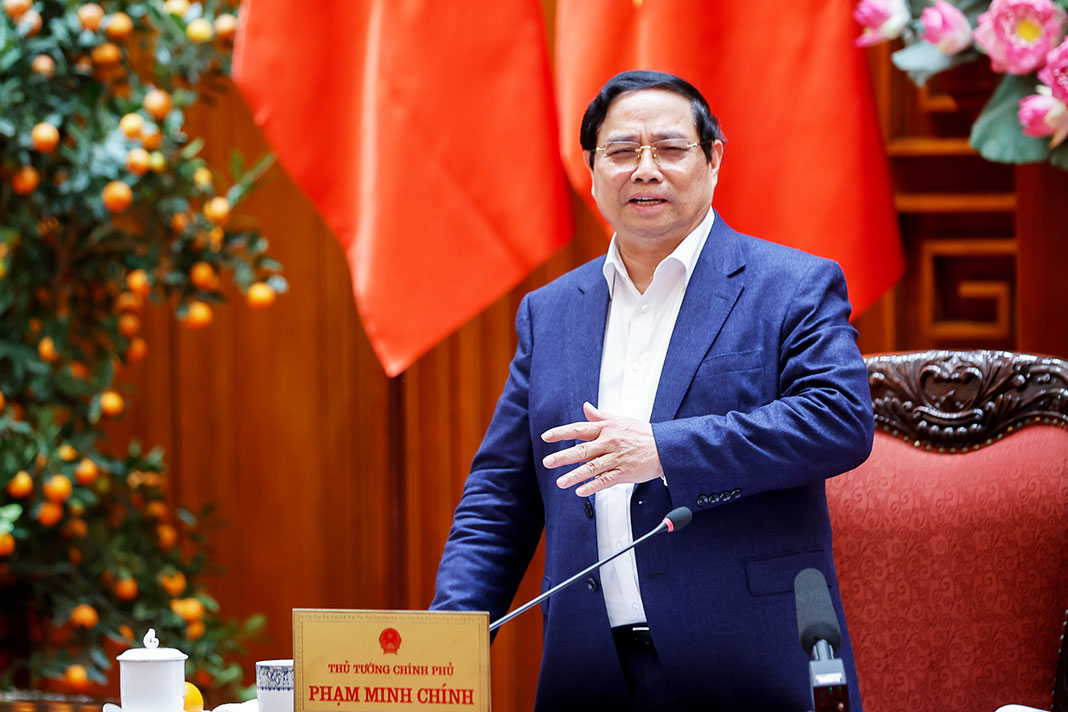
HCMC – Prime Minister Pham Minh Chinh has agreed in principle with a Ministry of Industry and Trade proposal to use the fuel price stabilization fund to keep the market stable, ensuring its use complies with regulations and can be applied from March 11.
If necessary, the Ministry of Finance will report to the Government at its nearest meeting and propose a plan to reduce the environmental protection tax on fuels to zero, the PM said at his meeting with the Task Force on Energy Security on the afternoon of March 10.
He stressed that as soon as the conflict in the Middle East erupted, the Government had assessed that it could affect Vietnam’s energy supply and macroeconomic management, particularly economic growth and inflation control. The conflict could also affect production costs and logistics, trigger speculation and hoarding, and encourage cross-border smuggling, thereby increasing costs and weakening the competitiveness of Vietnamese goods.
The situation has so far been put under control and negative impacts have been minimized. PM Chinh called for further diversification of crude oil supply sources and the prompt implementation of outcomes from his recent phone talks with leaders of Gulf countries. He also requested Petrovietnam to mobilize its existing partners to increase supply.
Regarding petroleum imports, the Ministry of Industry and Trade was instructed to direct key importers to proactively seek supply sources, step up imports, and allocate them according to assigned plans to ensure that 30% of domestic petroleum demand is met through imports. Businesses were also asked to maintain mandatory reserve levels and prepare supply scenarios for different situations.
For domestic market management, the Ministry of Finance will continue to closely coordinate with the Ministry of Industry and Trade to manage fuel prices in line with regulations, closely monitor daily price movements, and ensure timely, flexible, and effective adjustment measures. This aims to prevent hoarding, price manipulation, and stockpiling ahead of price hikes.
On this occasion, the PM called on people nationwide to work together in solidarity—remaining calm and not panicking or becoming overly worried, while also avoiding complacency.
The public was urged to raise awareness and act in unity, avoiding hoarding, price gouging, or rushing to stockpile goods. The Ministry of Public Security was instructed to step in and strictly handle negative practices that disrupt the market, including hoarding, price manipulation, and incitement.
He also assigned relevant ministries and agencies to study revisions to the fuel price management mechanism to give businesses greater flexibility. Under the proposed approach, the State would not set specific retail prices but would regulate the market through policy tools.
Regarding solutions, the PM called for stronger promotion of E10 biofuel in line with a Government resolution, along with the launch of a nationwide movement on energy conservation and the use of green energy to reduce emissions. The Ministry of Industry and Trade was tasked with preparing scenarios for this campaign.
Efforts should also be intensified to promote the “Vietnamese people use Vietnamese goods” campaign and encourage a shift toward electric and clean-energy vehicles.
The Prime Minister added that the current situation also presents an opportunity to accelerate the energy transition, strengthen fuel savings in the transport sector, and promote the use of public transportation. Fuel supplies must be ensured for key national projects, and if necessary, petroleum prices should be prioritized or reduced for strategic projects, particularly those serving the APEC Economic Leaders’ Week in 2027 (APEC 2027).
The Ministry of Public Security will coordinate with the Ministry of Industry and Trade to inspect, monitor, and handle acts of hoarding or price manipulation that destabilize the market, thereby safeguarding energy security. Local police units were also instructed to facilitate the transportation of fuels into urban areas to avoid localized shortages.
Meanwhile, the Ministry of Industry and Trade was tasked with accelerating research and implementation of a national oil reserve program and developing a strategy for national energy self-reliance. The Ministry of Finance will allocate funding from contingency reserves to support these efforts and ensure national energy security.