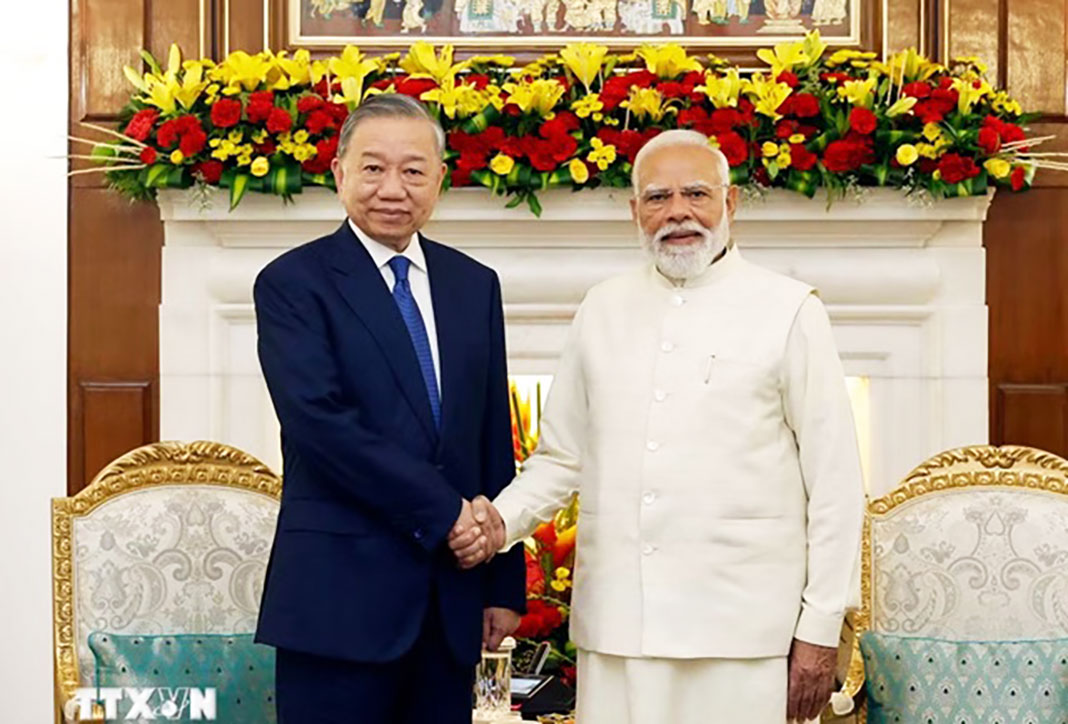
HCMC – Vietnam’s Party General Secretary and State President To Lam and Indian Prime Minister Narendra Modi have agreed to make science and technology, innovation, and digital transformation key drivers of a new phase in bilateral relations.
Following a state welcome ceremony co-chaired by Indian President Droupadi Murmu and Prime Minister Modi at the Presidential Palace in New Delhi on May 6, the two leaders held talks to discuss measures to strengthen cooperation.
PM Modi warmly welcomed To Lam and the high-level Vietnamese delegation on their state visit to India, and congratulated him on being elected State President by Vietnam’s 16th National Assembly.
He emphasized that the visit, coming shortly after the successful 14th National Congress of the Communist Party of Vietnam and the completion of Vietnam’s leadership consolidation, carries historic significance, especially as the two countries mark the 10th anniversary of their Comprehensive Strategic Partnership (2016–2026).
To Lam said Vietnam attaches great importance to and seeks to further strengthen its traditional friendship and Comprehensive Strategic Partnership with India, considering it a top priority in its foreign policy of independence, self-reliance, diversification, and multilateralization.
The Vietnamese leader congratulated India on its remarkable development achievements, noting that under the leadership of Prime Minister Modi and the ruling Bharatiya Janata Party-led coalition, India has become the world’s fourth-largest economy and a leading science and technology hub. He expressed confidence that India will achieve its goal of becoming a developed nation by 2047 with an increasingly prominent global role.
Prime Minister Modi, for his part, affirmed that India regards Vietnam as one of its most important partners in its “Act East” policy. He voiced confidence that Vietnam will achieve its development targets, becoming an upper-middle-income developing country with modern industry by 2030 and a high-income developed nation by 2045.
He noted that the two countries share common values and visions regarding independence, self-reliance, and a rules-based international order, providing a solid foundation for closer cooperation and joint contributions to regional and global peace and development.
Both leaders expressed satisfaction with the remarkable progress in bilateral ties over the past decade, highlighting growing political trust, deepening defense and security cooperation as a strategic pillar, and expanding economic, trade, and investment ties. Bilateral trade reached over US$16.4 billion in 2025, while cultural exchanges and people-to-people connectivity have flourished.
The two sides agreed to upgrade their relationship to an “Enhanced Comprehensive Strategic Partnership” under the spirit of “shared vision, strategic convergence, and substantive cooperation,” opening a new chapter in bilateral ties.
They pledged to strengthen political trust through high-level exchanges and regular contacts, and to enhance the effectiveness of cooperation mechanisms.
Defense and security cooperation will continue to serve as a key pillar, with expanded collaboration in defense and security industries, maritime security, cybersecurity, information sharing, and counterterrorism. India also committed to supporting Vietnam in training and capacity building in defense and security.
In economic, trade, and investment cooperation, both sides agreed to pursue breakthroughs to enhance complementarity on a win-win basis, particularly by strengthening supply chain and global value chain linkages. They aim to raise bilateral trade to US$25 billion by 2030 in a balanced and sustainable manner, while removing trade barriers to facilitate market access.
Vietnam pledged to increase imports from India to diversify production inputs, and called on India to gradually ease regulations related to standards set by the Bureau of Indian Standards (BIS) on Vietnamese goods.
Both countries encouraged high-quality two-way investment and called for favorable conditions for major corporations to undertake large-scale, flagship projects in areas such as infrastructure, renewable energy, pharmaceuticals, and high technology.
The two leaders also agreed to expand cooperation in core technologies, including semiconductors, artificial intelligence, information technology, 6G, healthcare, critical minerals, and peaceful nuclear energy, while promoting joint innovation ecosystems, research and development centers, and technology partnerships.
They underscored the importance of strengthening the social foundation of bilateral ties through enhanced cooperation in culture, tourism, and people-to-people exchanges; leveraging shared values in culture, history, and religion; and pushing for connectivity in aviation, logistics, and local-level cooperation.
Prime Minister Modi noted that many Vietnamese visit India annually for pilgrimage and called for stronger tourism cooperation, encouraging Vietnamese firms to invest further in India’s tourism sector.
On regional and international issues, both sides agreed to enhance coordination and mutual support at multilateral forums, particularly the United Nations, ASEAN, and ASEAN-led mechanisms. PM Modi emphasized ASEAN’s central role.
They also stressed the importance of maintaining peace, stability, and freedom of navigation and overflight, and resolving disputes through peaceful means in accordance with international law, including the 1982 United Nations Convention on the Law of the Sea (UNCLOS).
Following the talks, the two leaders witnessed the signing of multiple cooperation agreements in areas such as science and technology, critical minerals, healthcare, tourism, culture, finance, cybersecurity, local cooperation, and auditing. They agreed to direct relevant ministries and agencies to promptly implement these agreements.
On this occasion, To Lam conveyed greetings from Vietnam’s Party and State leaders to Prime Minister Modi and other Indian leaders, and invited Prime Minister Modi to visit Vietnam in the near future. The Indian government leader accepted the invitation.