
As the Saigon Times Group comes to the end of its 35-year journey, I am saying goodbye to more than a publication. For the past three years, as a contributor learning under its guidance, I have come to see the newsroom as my school of journalism – a place that shaped the way I think, sharpened my writing, and left a lasting mark on my professional life.
For more than three decades, the Saigon Times Group has grown alongside Vietnam’s economic transformation, its history closely intertwined with the country’s journey of reform and global integration. Founded in the early 1990s, at a time when the notion of a market economy was still met with caution, the magazine soon emerged as one of Vietnam’s most respected and influential voices on economic policy, finance and business.
Scholars of media and journalism often regard the magazine’s archives as a “living chronicle” of modern Vietnam. Its pages preserve the milestones of the country’s economic development, from the fledgling days of a stock market with only a handful of listed companies to the era of billion-dollar initial public offerings. It was also here that the implications of the Vietnam-U.S. Bilateral Trade Agreement (BTA) were rigorously debated, with contributors openly confronting difficult questions about Vietnam’s competitiveness in an increasingly globalized economy.
The newspaper went on to chronicle many defining moments of the reform era: Vietnam’s accession to the WTO, the cycles of boom and correction in the Phu My Hung property market, and the expansion of international retail corporations into the country. Through it all, the Saigon Times Group maintained a distinctive editorial voice: analytical and measured, yet underpinned by a deep commitment to the country’s development.
Beyond its Vietnamese-language publications, the Saigon Times Group also built a strong presence through its English-language titles, most notably The Saigon Times Daily, which served as an indispensable bridge between foreign investors and Vietnam’s business landscape. For more than three decades, at a time when international news organizations were often grappling with the nuances of local policies and regulations, analyses published by the Saigon Times Group became essential reading for Wall Street market reports and multinational corporations seeking to explore the Vietnamese market. Such influence reflected more than expertise alone. It was international recognition of a journalistic standard built on credibility, integrity and the ability to deliver timely, insightful reporting.
Yet the newsroom’s influence extended far beyond the printed pages. If daily journalism was its heartbeat, then the economic forums and conferences organized by the Saigon Times Group were its intellectual pulse. It had programs that brought together provincial leaders, business executives and journalists to discuss local economic development, investment opportunities and policy priorities, along with the Economic Outlook conference, professional training programs and policy roundtables, created a rare space where the boundaries between government, business and academia could be bridged through open and constructive dialogue.
Under the great moderation of Saigon Times journalists, these events often became more than formal conferences. Corporate leaders openly discussed divestment plans, leading economists engaged in candid talks over inflation and growth prospects, and policymakers faced probing questions about accountability and governance. For those fortunate enough to take the stage as speakers, the experience offered a lesson in journalism at its best. Watching the organizers prepare briefing materials, frame questions and guide discussions revealed what it truly means for journalism to shape public discourse rather than merely react to it.
A mentor in world of intellectual property
It was in this newsroom that I spent three formative years as a contributor, after being invited by the print editorial team to help develop a new area of coverage: international intellectual property.
Three years ago, when intellectual property was still largely overlooked in Vietnam’s business press, the editorial team had already anticipated the profound changes reshaping global supply chains and the growing legal challenges facing Vietnamese enterprises. Rather than taking the easier route of repackaging reports from Reuters or Bloomberg, they set out to create something more meaningful: stories that would inform, challenge and prepare readers for a rapidly changing world. Their goal was to produce journalism that translated complex legal and technological issues into practical business realities, helping a plastics manufacturer in Binh Duong understand how a patent filed thousands of miles away in Silicon Valley could ultimately determine whether his products were allowed to enter international markets.
The newsroom entrusted me with a role that felt almost like that of a special correspondent in this field: to write about intellectual property through an economic lens, close to the realities of business, and to draw lessons for Vietnam. Each article became a demanding exchange with my editors. They required every figure to be cross-checked, every legal term to be translated into language that a businessperson without legal training could understand, and, above all, every piece to point toward meaningful and constructive action.
Thanks to that disciplined editorial guidance, intellectual property coverage became much more than a technical niche on the business pages. It emerged as a platform that shed light on cross-border counterfeiting in the digital economy, examined the growing value of intangible assets, and anticipated the legal risks that Vietnamese businesses could face as they ventured into international markets. When I was invited to speak at conferences organized by the print newsroom on the subject of intangible assets, I understood that I was not standing there as an individual expert. I was carrying forward the work of an editorial process that demanded accuracy, depth and relevance at every stage. Behind every article stood countless hours of research, verification and debate. It was a newsroom culture in which truth and intellectual integrity were always placed above all else.
Three years may be only a brief chapter in a journalist’s career, but my three years at the Saigon Times Group were a formative education in what disciplined journalism looks like. The newsroom did not simply teach me how to write. It nurtured a habit of critical inquiry: to remain mindful of the nation’s long-term interests and the legitimate needs of the business community.
A void that will not be easily filled
Some absences are felt in small, familiar routines. Thursday mornings will no longer begin with the sight of a freshly printed magazine on the desk, its pages filled with the kind of thoughtful analysis that demands time and attention. Future economic forums will feel different as well, missing the familiar organizing team that had a rare talent for turning conference halls into places where ideas were challenged, refined and advanced.
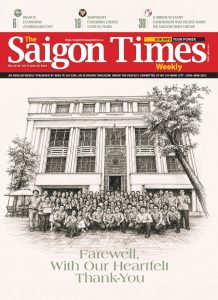 But the dissolution of the Saigon Times Group leaves a deeper void than these rituals alone. It marks the loss of a distinctive voice in Vietnam’s media landscape, a publication that valued understanding over attention, substance over sensation, and long-term insight over fleeting trends. It was the kind of journalism willing to question prevailing optimism when others were celebrating, yet equally prepared to identify opportunities when public sentiment had turned pessimistic.
In an era when algorithms increasingly shape what people read, a magazine that preserves its identity and editorial standards until its final day achieves something quietly remarkable. The Saigon Times Group is coming to an end, but not for lack of conviction. The true value of a newsroom has never resided in ink and paper alone. It lives on in the minds it has shaped and the principles it has passed on to those who learned within its walls.
To the editors and mentors who painstakingly reviewed every draft, every sentence and every punctuation mark in the intellectual property articles; to those who entrusted a young writer with the responsibility of exploring an emerging field and believed that such work could make a difference: my gratitude is beyond words.
The magazine’s legacy will endure in the work of the generations of contributors it helped shape, in the habits of critical thinking forged through countless deadlines, and in a national media landscape that continues to search for enduring values. A long and distinguished chapter has come to an end, but its influence will not.
Its legacy lives on – steady and resilient, like the final words printed on its front page.







