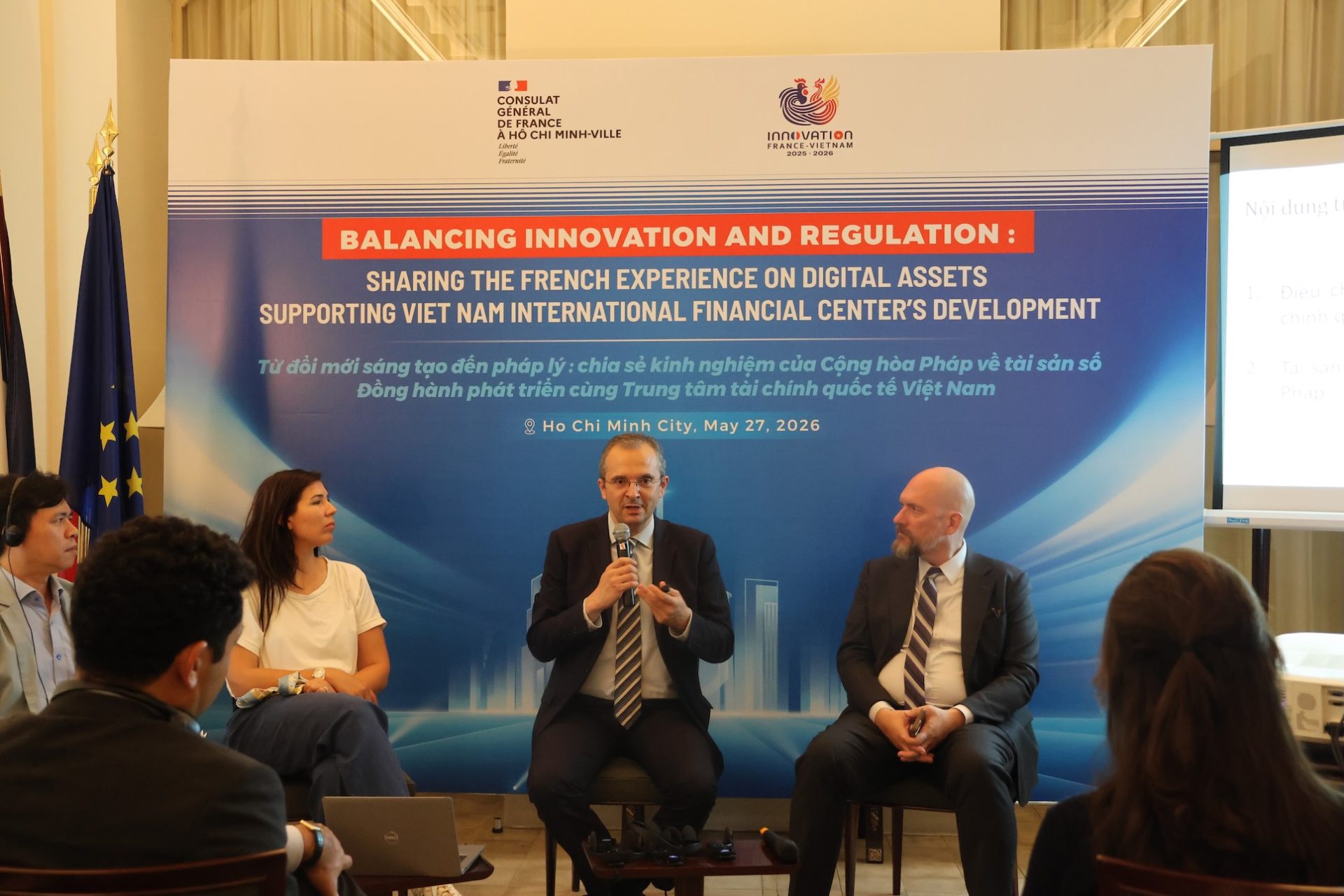
HCMC – French financial experts on May 27 highlighted eight key regulatory challenges in developing digital asset markets, sharing lessons from the European Union’s crypto-asset framework as Vietnam considers legal mechanisms for the fast-growing sector.
The issues were presented at a seminar organized in HCMC by the French Consulate General and the Vietnam International Financial Center (VIFC), part of a series of discussions in HCMC and Danang on digital assets and financial innovation.
Presenting France’s experience under the European Union’s Markets in Crypto-Assets (MiCA) regulation, Olivier Vigna, general delegate of Paris Europlace, pointed out eight major challenges that regulators and market participants may face when developing digital-asset markets.
The first challenge is determining whether a crypto asset or service falls within the scope of regulation and how it should be classified, particularly when tokens combine governance, utility, payment and investment features.
The second challenge concerns overlaps between MiCA and existing financial regulations, requiring banks, investment firms and payment institutions to align governance, internal controls and risk-management systems with multiple regulatory frameworks.
A third involves governance requirements, as regulators increasingly expect senior executives and board members to demonstrate expertise in blockchain technology, token issuance, custody systems, cybersecurity and compliance.
The fourth is anti-money laundering and counter-terrorism financing compliance. Financial institutions are required to monitor blockchain transactions, screen digital wallets and strengthen due-diligence procedures while meeting data-protection requirements.
The fifth relates to custody services and private-key management. Regulators scrutinize how firms secure client assets, manage wallet access, recover lost keys and protect systems against cyberattacks.
Cybersecurity and operational resilience form the sixth challenge. Digital-asset infrastructure faces risks including smart-contract vulnerabilities, protocol failures, validator attacks and distributed denial-of-service attacks, requiring robust risk-management and incident-reporting frameworks.
The seventh challenge concerns outsourcing and dependence on foreign service providers, including cloud-computing operators, liquidity providers and blockchain infrastructure companies. Regulators seek assurances regarding audit rights, data access and business continuity.
The eighth challenge involves prudential treatment and capital requirements for crypto assets. According to the presentation, uncertainty remains over international standards governing capital deductions, risk exposure limits, liquidity treatment and accounting valuation of digital assets.
Vigna said building a competitive digital-asset ecosystem requires clear and predictable regulations, alignment with international standards, effective consultation mechanisms and cooperation between regulators and industry participants.
“Vietnam has all the necessary potential to succeed, especially its economic growth, a rapidly expanding digital environment and the dynamism of reforms led by the Government,” French Consul General Etienne Ranaivoson said.
Ranaivoson said digital assets had evolved beyond a purely technological or financial issue and were becoming part of a broader transformation affecting economies, business practices and international exchanges. He said Vietnam’s growing digital economy, expanding technological capabilities and ambitions to develop international financial centers reflected its determination to position itself as a regional player in financial innovation.
The seminars, he said, offered an opportunity to exchange practical experience and explore approaches to building a predictable legal framework for the sector.