
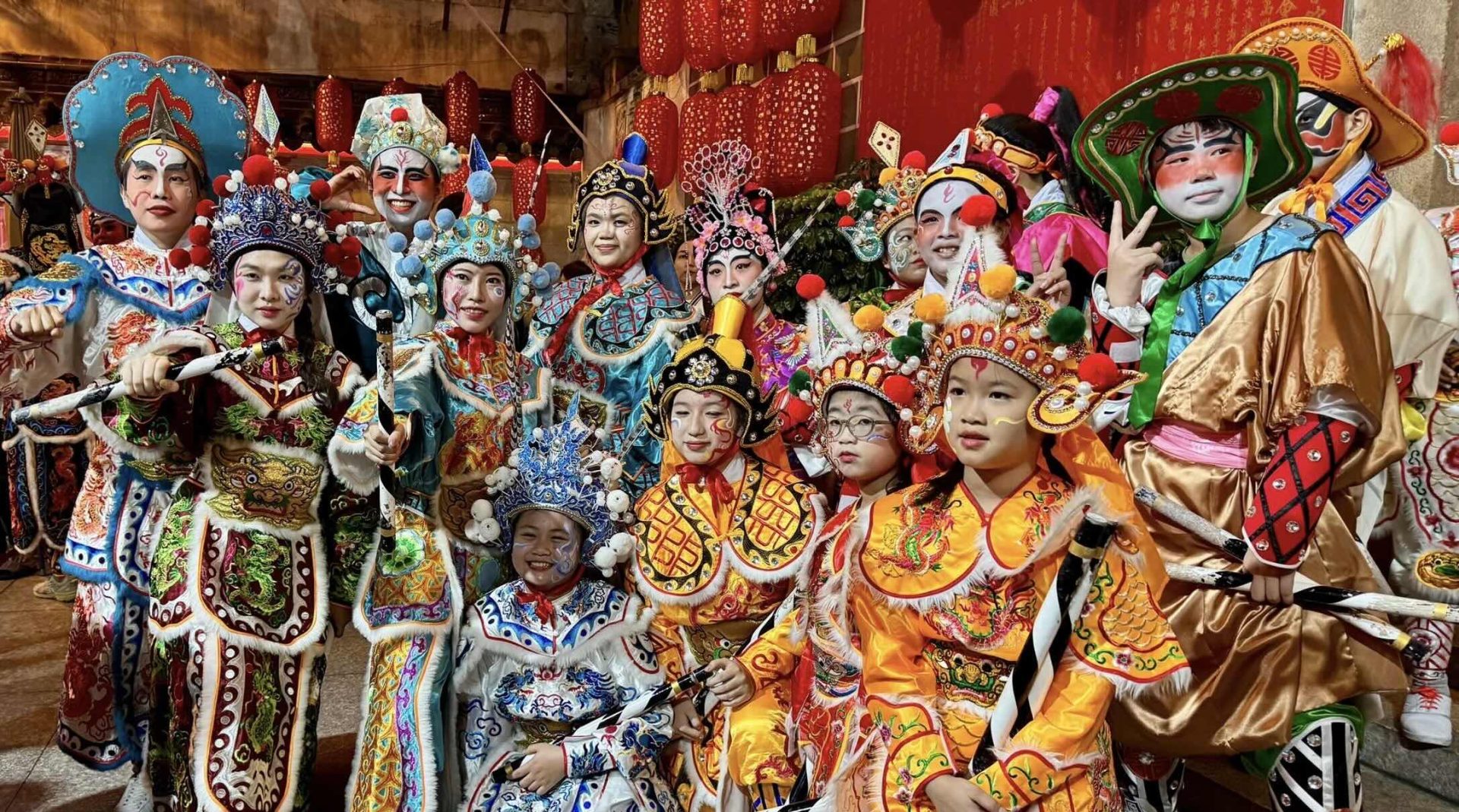
Amid the relentless pace of life in Cho Lon, HCMC, where many cultural traditions are gradually fading into memory, a dedicated group of people continues to safeguard the sound of wooden sticks striking against one another. What they are preserving is not an ancient dance but the living memory of a community.
Every evening, in the courtyard of Nghia An Assembly Hall, the sounds of drums and wooden sticks echo through the air. Standing quietly at the edge of the practice ground, Quach Giai Phat, leader of the Anh Ca Vu troupe, watches closely as nearly eighty young performers rehearse their movements, as if he were guarding a fragile thread connecting the past to the future.
The sound of a distant homeland
At first, there are only a few sharp, dry clicks of wood meeting wood. Then come the drums.
Soon, more drums join in, their rhythms weaving into a powerful pulse. Before long, the courtyard of Nghia An Assembly Hall comes alive as dozens of children and teenagers form up. They turn, crouch, advance, and retreat in patterns they have practiced hundreds of times.
Under the evening lights, their synchronized movements create the impression that a piece of history has stepped out of another century and into the present.
Phat is watching them.
Officially, he is the leader of the Anh Ca Vu troupe. In reality, his role extends far beyond that title. He is an organizer, instructor, community builder, and guardian of a tradition that once stood on the brink of disappearing.
What unfolds before him each evening is far more than a mere rehearsal.
It is an ongoing effort to preserve the cultural heritage carried by Teochew migrants who crossed the sea centuries ago and settled in southern Vietnam, helping shape the character of what is now Cho Lon.
For many visitors, Cho Lon, the old Chinatown of Saigon and now part of HCMC, is known as a bustling commercial district filled with wholesale markets, restaurants, gold shops, and family-owned businesses.
Yet behind its commercial façade lies a much deeper cultural story.
For more than three centuries, Cho Lon has been home to Chinese communities, including the Teochew, Cantonese, Fujianese, Hainanese, and Hakka. Each group brought its own language, customs, beliefs, and artistic traditions. Over time, some traditions adapted and endured, while others gradually disappeared.
A heritage beyond dance
Originating in the Chaoshan region of southern China, the ancestral homeland of the Teochew people, Yingge Dance, known locally as Anh Ca Vu, is a blend of folk performance, religious ritual, martial arts, and communal celebration.
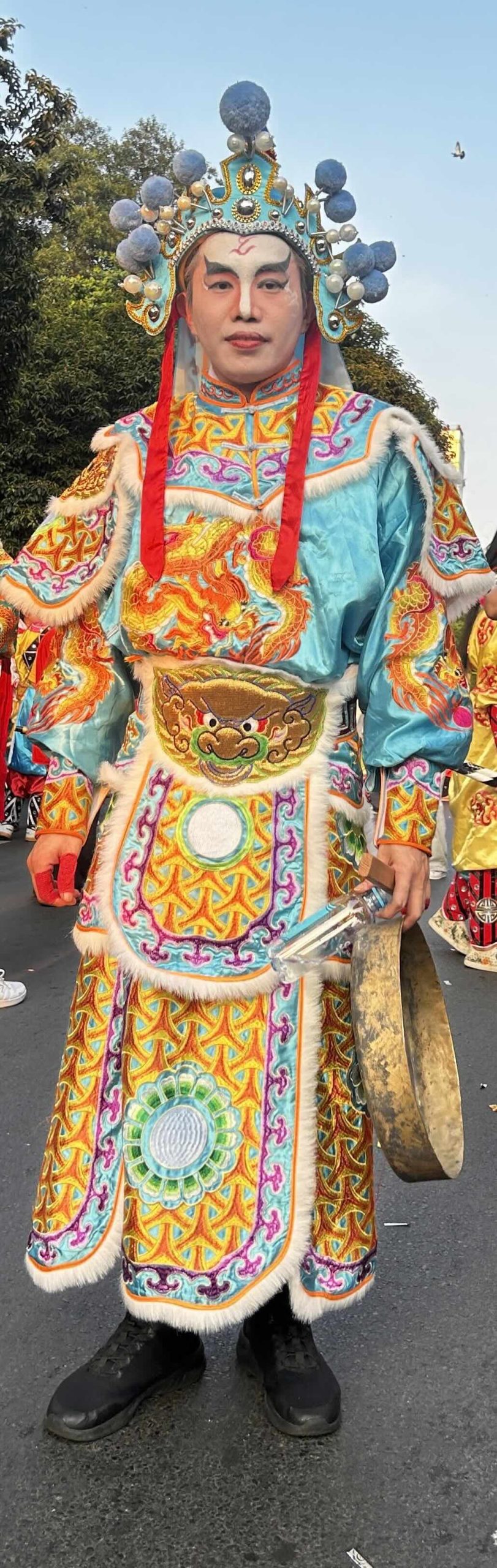
Performers portray characters inspired by the classic Chinese novel “Water Margin” and its legendary heroes of Liangshan Marsh. Holding wooden sticks, they move through intricate formations accompanied by drums and chants.
Yet this tradition might already have faded into memory were it not for people like Phat.
To outsiders, the performance often resembles a martial arts display. The painted faces, synchronized movements, and relentless clatter of wooden sticks evoke images of warriors preparing for battle.
But according to Phat, that interpretation captures only a part of its meaning.
The wooden sticks are not symbols of war. Instead, they represent protection. They are often decorated with symbols such as yin-yang motifs and other spiritual designs that carry cultural significance.
The purpose of the dance is not to display physical power. Rather, it is intended to drive away misfortune and to pray for peace, prosperity, harmony, and good fortune for the community.
This is the lesson Phat tries to pass on to younger generations.
A tradition can only remain alive when people understand its meaning. If only the outward form survives while the spirit is lost, preservation becomes little more than an empty exercise.
Today, many young people of Teochew descent in Cho Lon no longer speak their ancestral language fluently. Some understand only a few everyday phrases, while others remember little more than words they once heard from their parents or grandparents.
Revived through dedication
As language gradually fades, cultural practices become increasingly important bridges to collective memory.
That is why Phat sees Anh Ca Vu as more than a performing art. For him, it is another language. The drums tell ancient stories. The formations embody discipline and solidarity. The wooden sticks connect today’s youth to generations that came before them.
The revival of Anh Ca Vu in Cho Lon was not a matter of luck.
Years ago, members of the community realized that if they did not act quickly, the tradition could vanish altogether. A group of three people, including Quach Giai Phat, traveled to the Chaoshan region to learn directly from masters who had preserved the art form there.
They studied every step, every formation, every drum rhythm, and every performance technique.
When they returned to HCMC, Vietnam, they brought back more than knowledge. They also brought back responsibility.
Phat’s work extends far beyond evening rehearsals. Costumes must be maintained. Props must be repaired. New members must be trained. Funding must be secured. Relationships with community organizations must be nurtured.
Most of the troupe’s activities depend on volunteer dedication and support from Nghia An Assembly Hall. Perhaps the most remarkable aspect of the group is its openness. All are welcome.
Children, students, office workers, and market vendors stand side by side in the same formation. Some participants are as young as seven or eight years old, while others are already in their forties.
That diversity transforms cultural preservation from a specialized effort into a shared community endeavor.
What gives Phat the greatest optimism is the younger generation’s enthusiasm.
Many children arrive well before rehearsals begin. Even after practice ends, they linger to chat, refine their movements, and keep learning.
At a time when many cultural organizations struggle to attract young participants, this enthusiasm offers a powerful reason for hope.
When asked what Anh Ca Vu in Cho Lon, HCMC might look like in the next ten years, Phat does not offer grand predictions or ambitious visions.
His answer is simple, honest, and perhaps wise: “Who knows what tomorrow will bring?”