
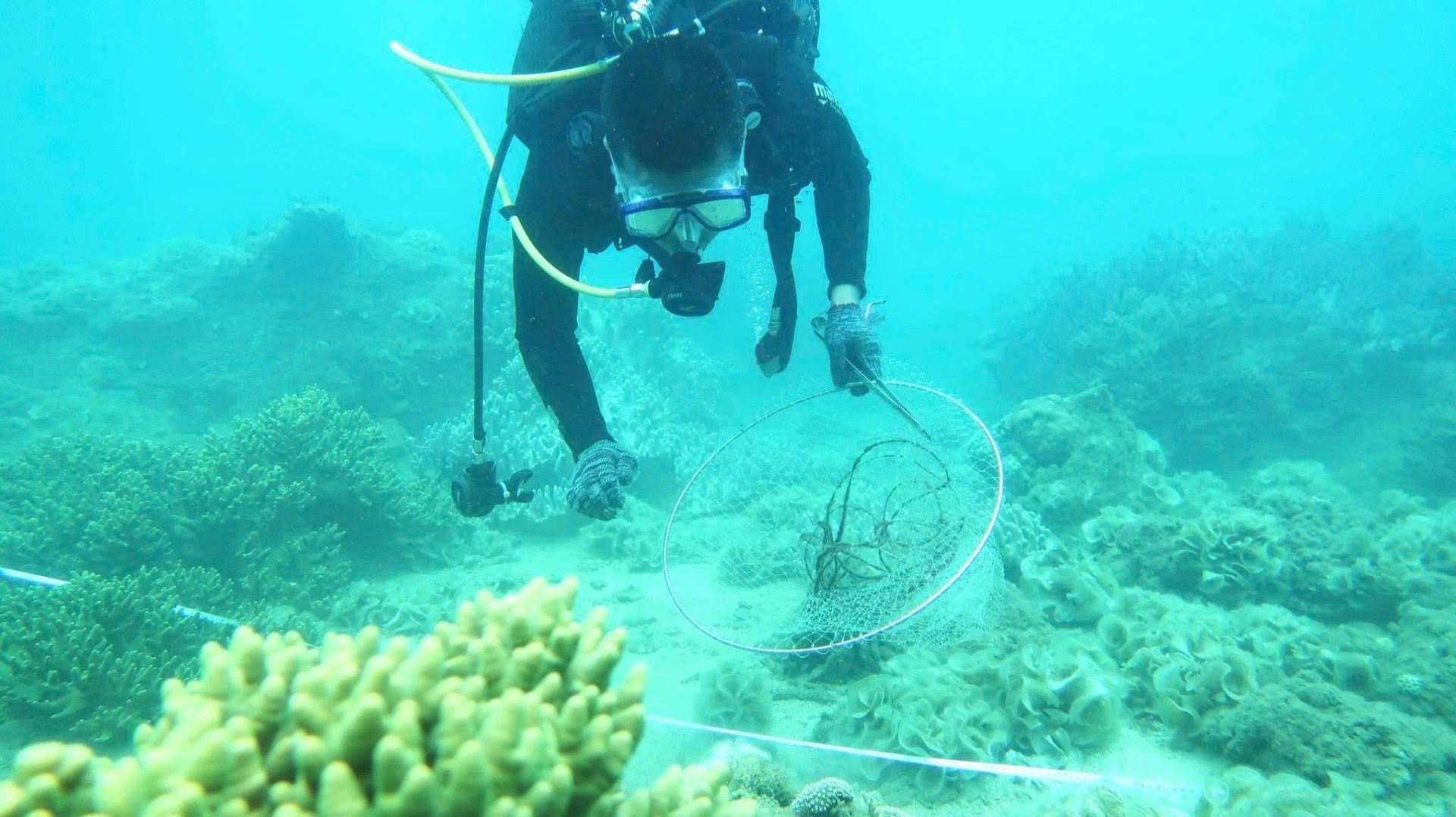
The forthcoming issuance of environmental management and protection regulations for the Cu Lao Cham – Hoi An Biosphere Reserve in Danang City marks an important legal milestone. It offers a moment to reflect on over two decades of persistence by an island community that chose to treat nature with care, crafting a remarkable story of recovery from the ocean floor to the forested hills.
Morning at Tan Hiep Market on Cu Lao Cham is free of the rustle of plastic bags. No white strips drift on the sea breeze. Instead, elderly women and young mothers stroll unhurriedly with sturdy baskets, worn smooth from hundreds of uses. Vegetables and freshly caught fish are wrapped in glossy banana leaves and bound with coconut fibers. Here, “Say no to plastic bags” is no longer a slogan—it is a way of life, a defining identity of this “green island” that leaves a lasting impression on visitors, especially international travelers.
From marine conservation to integrated nature stewardship
On Cu Lao Cham, environmental strictness extends far beyond plastic. It is woven into how residents protect their most precious natural assets. Take the red land crab (Gecarcoidea lalandii). A single crab requires 15–16 years to reach a shell width of seven centimeters. Conscious of that slow growth, locals enforce their own rules: only crabs that meet size standards may be harvested, egg-bearing crabs are strictly off-limits, and only eco-labeled crabs can be sold. The harvest season itself is carefully limited, running only from March to July.
The spirit of protection extends to lobster, one of the island’s most prized species. Each year, from
April 1 to May 30, all fishing and trading halt to allow spawning. Legal penalties—ranging from millions to billions of dong—reinforce compliance, but what truly distinguishes the island is a deeper shift in mindset. Fishers have evolved from extractors into stewards, guardians of the very resources that sustain them.
This grassroots commitment has become the bedrock of systemic change. When care for the sea becomes instinctive, conservation is no longer a top-down directive but a shared responsibility to protect a common home. That transformation—from individual awareness to collective governance—has propelled Cu Lao Cham forward in safeguarding its natural heritage for generations to come.
Cu Lao Cham is entering a new chapter, evolving from a marine protected area into a nature reserve. This shift is more than a change in legal status—it is a strategic move to dissolve administrative boundaries and unify the ecological relationship between more than 21,000 hectares of ocean and 1,600 hectares of forest.
Experts emphasize that forests act as natural filters, safeguarding freshwater—the lifeblood of both island residents and marine ecosystems. Conservation thinking is now expanding from sea to land. Just as only mature crabs are harvested offshore, onshore, forest leaves are collected seasonally and within ecological limits to preserve biodiversity.
The co-management model, long central to marine conservation, is being extended to the forests. Residents now take part in restoring native woodlands and sustainably harvesting non-timber products such as herbal leaves for tea. This integration creates a unified ecosystem, where each restored coral reef and each protected hectare of forest strengthens the island’s resilience.
Ecotourism and carrying capacity: A balancing act
As Cu Lao Cham positions itself as a national marine tourism hub, it faces the challenge of balancing growth with preservation. Environmental carrying capacity has become a mandatory threshold for all economic activities. From coral diving tours to forest treks, every venture must be grounded in scientific assessments of what nature can sustain.
Authorities in Danang City are working to ease infrastructure bottlenecks, prioritizing service quality over sheer visitor numbers. Plans for new waterway routes linking downtown Danang directly to the island, along with expanded cruise connections to Ly Son Island off Quang Ngai Province, aim to elevate high-end tourism while also strengthening social welfare and emergency response during rough seas.
By 2030, Cu Lao Cham envisions a comprehensive digital biodiversity database and the full implementation of ecosystem service payments. In this model, each visitor’s “ecological footprint” translates into direct funding for reforestation, coral restoration, and community livelihoods. Conservation thus shifts from being a fiscal burden to a long-term investment—one that sustains both nature and people.
Back at the market, the sight of women carrying worn plastic baskets embodies a deeper philosophy—patience and dignity in a community that thinks long-term. Upcoming regulations may read like dry administrative text, yet their spirit lives in small, consistent acts: refusing a plastic bag, releasing an egg-bearing crab back into the sea.
Cu Lao Cham is more than a clean, green destination; it is a living lesson in coexistence with nature. When forests are protected, they safeguard water for the sea; when the sea is respected, it sustains human livelihoods. The island’s story poses a broader question for heritage sites across Vietnam: will patience prevail in favor of long-term values, or will short-term gains erode identity and resources?
The answer, perhaps, is already there, in a simple, timeworn basket, filled with quiet but enduring awareness.