

Whether these words are fitting for a farewell, I cannot say. Yet as I look back on the more than one thousand days I spent contributing to the Saigon Times Group, from the summer of 2021 until now, through the “Tra du tuu hau” column in the Culture & Society section, these words emerged from the heart of a writer. They capture a journey that has meant far more to me than I can easily express, and one that will forever remain a cherished milestone in my life.
In early June 2021, HCMC seemed to retreat into itself. The city felt enclosed, almost suspended in time. Days passed slowly under the weight of uncertainty as the Covid-19 pandemic reshaped everyday life. Doors remained shut, footsteps disappeared from the streets, and barricades rose at the entrances of alleyways. The vibrant pulse that had long defined the city grew faint, replaced by an uneasy stillness. HCMC, once alive with movement and noise, now spoke only in hushed whispers and quiet sighs.
Yet the openness that has long defined the Saigonese, a quality shaped and refined over generations, proved stronger than the barriers that sought to keep them apart. Physical distance was shortened by human connection, and the walls of isolation were breached through the boundless space of the digital world. Information flowed relentlessly as people shared updates, advice, and urgent appeals along the fragile line between life and death. They reached out to one another, seeking comfort, support, and companionship, so that no one would have to face those long, uncertain days alone.
In the midst of those anxious days, I wrote an article titled “A Game of Hide-and-Seek”. It began with a memory from childhood: the familiar rhythm of counting –”five, ten, fifteen, twenty…” – while friends hid in secret corners, waiting to be found. Somehow, that innocent game seemed to mirror the world’s struggle against the coronavirus. This was before vaccines offered hope, when scientists were still working around the clock in laboratories and uncertainty hung over every corner of the world. There was no reliable means of stopping it, let alone catching something so invisible as it moved relentlessly across the planet.
It was a piece I was particularly proud of – brief in length, yet carefully crafted. After finishing it, I shared it on Facebook for friends to read and, perhaps, pass along. To my surprise, sub-editor Thanh Phuong from the Saigon Times found something of herself in those lines. She reached out and asked me to send the article for publication in the magazine’s next issue. Not long after came another piece, Saigon, Days of Isolation, inspired by a city under lockdown, where each household seemed like an island unto itself, and everyone was told to remain where they were. That was how my journey with the Saigon Times Group officially began.
I say “officially” because, before that, I had occasionally contributed articles to the magazine. Whenever Phuong needed a piece, she would reach out and I would write one. Nothing regular, just the occasional contribution. Among them were articles about the ban on “The Road You Once Walked (Con Duong Xua Em Di) song by Chau Ky and Ho Dinh Phuong, along with a handful of commentaries on cultural and educational issues. At that stage, however, my appearances in the paper were sporadic rather than the steady presence they would later become.
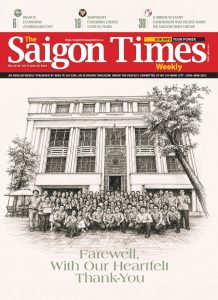 And so that connection endured, much like the tides of the Saigon River, forever ebbing and flowing. Each week, after finishing an article and sending it off, I would think of myself as being at low tide – free to turn my attention to other work. Then, when the piece appeared in print on Thursday, the tide would rise again. A quiet excitement would return, carrying me along as I searched for ideas for the next story. Week after week, the rhythm repeated itself: ebb and flow, writing and waiting, publication and inspiration. It became a cycle that never felt burdensome, only deeply rewarding.
There was joy in giving voice to my thoughts, and joy in finally putting something into words. At times, an idea would linger inside me for days, pressing quietly but insistently for release, until writing became the only way to ease that restless feeling.
From the days when Thanh Phuong still edited my submissions and discussed story ideas with me, through her retirement, and later during the years when I sent articles almost weekly to Minh Chau, the Saigon Times Group gave me a space to speak directly to its readers through a rather distinctive form of writing. One might call it a personal essay, a reflective sketch, or simply a narrative piece. Whatever the label, the ideal was always the same: brief yet graceful, thoughtful yet accessible.
Not every piece lived up to those ideals, I know. Yet my colleagues were generous enough to overlook the occasional rough edge, often receiving an article with an indulgent smile and a kind word.
Like any profession, writing is not a craft where every piece turns out well or every topic wins praise. Believing otherwise can easily become an illusion. That is why having an article published is something to be grateful for, but also a reason to keep improving. I often go back and reread my own work to find things I wish I had done better. It is always better to spot and correct those flaws yourself than to wait for someone else to point them out. Readers are often sharper than we expect, yet also more generous than we deserve. It is their generosity that makes me want to keep improving and never take it for granted.
Those were the thoughts that accompanied me each time I switched on my computer, eager to write another piece for Saigon Times.
Now, the meaning of saying goodbye to a newspaper, whether one calls it a farewell, a parting, or, in the language of an older verse, “folding away a worn robe, comes down to the same thing for me. It is not that one side departs while the other remains. Rather, it is the sadness of two companions finding themselves on separate paths. I will no longer write those weekly Tra du tuu hau columns, and the magazine itself will no longer exist as it once did.
Yet the stacks of Saigon Times that I have carefully kept over the past five years, stored in wooden chests and containing more than 130 of my published articles, remain. Each piece was presented with elegance and care, reflecting the newsroom’s respect for its readers. Together, they have become more than old newspapers. They are the record of a journey, and a story that time will not erase.
I say this because what I came to value was not only the Culture & Society section, with its dedicated contributors, but the magazine as a whole. Week after week, I also encountered the bylines of distinguished economists, veteran journalists, and respected experts whose work reflected a genuine concern for the challenges facing the country. Highly rigorous and deeply researched across a wide range of topics, the magazine consistently approached public issues with a constructive and thoughtful spirit.
Over a period not especially long, I poured onto those pages many of the thoughts, reflections, and restless emotions that often accompany a writer’s life. In return, I received far more than I could have expected: words of encouragement from the editorial team, a note of thanks with each contribution, fair compensation for every article, and never a missing complimentary copy of the magazine. Behind those gestures stood a newsroom of dedicated professionals who approached their work with remarkable care and commitment.
So if this piece reads like a conversation with a place that once welcomed my writing, that would be true. And if, in the spirit of Tra du tuu hau, it feels more like a farewell chat with a friend before parting ways, that would be equally true.