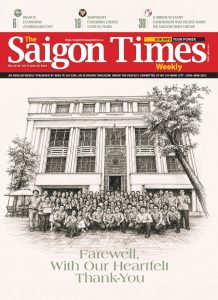
The first publication of Thoi bao Kinh te Sai Gon that I knew was The Saigon Times Weekly when I was a high school student back in 1998. To help me improve my English proficiency, my father saved money to buy the magazine for me. The initial purpose was not to help me study economics but to learn English.
Three years later, I had a chance to read the first article in Thoi bao Kinh te Sai Gon in the Vietnamese language when I learned about the liberalization of the current and capital accounts in Vietnam, a hot topic when Vietnam was on its way to accession to the WTO.
At that time, accession to such analytic information was not easy at all. Although the Internet was available, articles delving into a profound analysis of the Vietnamese economy in newspapers were not popular and were hard to find.
For me, Thoi bao Kinh te Sai Gon was an indispensable link in my undergraduate education in Vietnam. At the time, there were three main sources of information I could access. The first one was old curricula pertaining to economic integration. The second one was overseas advanced curricula translated into Vietnamese by local lecturers, or English-language documents available at some bookstores. These documents contained nothing about Vietnam, making it hard to connect theory with practice in Vietnam. The third was that most economic articles tended to feature news rather than in-depth analysis. For students, there was little chance to access reality, and experts’ talks were rare at that time.
 This makes Thoi bao Kinh te Sai Gon a unique publication, with profound analytic articles, clear messages about matters, and respect for differences in perspectives. At that time, the publication was therefore an indispensable resource for a university student like me, and I later used its documents in teaching students in Vietnam. An expert has likened Thoi bao Kinh te Sai Gon to The Economist of Vietnam, and I completely agree.
For such a fated connection, I always refer to Thoi bao Kinh te Sai Gon when writing economic analyses about Vietnam and the world.
Thoi bao Kinh te Sai Gon’s publications play an important role in connecting knowledge about the exchange rate, for instance, with specific policies relating to people, just like bamboo toothpicks. The article “Exchange Rate and a Bamboo Toothpick” by Nguyen Van Phu in Thoi bao Kinh te Sai Gon, published 10 years ago, reflected diverse perspectives. If you replace some of the 2026 detailed information in this article, it is still surprisingly topical.
A publication with many articles that are still topical after 10 years makes the author of quite a few articles in the magazine proud, makes students and teachers confident in their citations, and this is enough to confirm the publication’s role and position.