
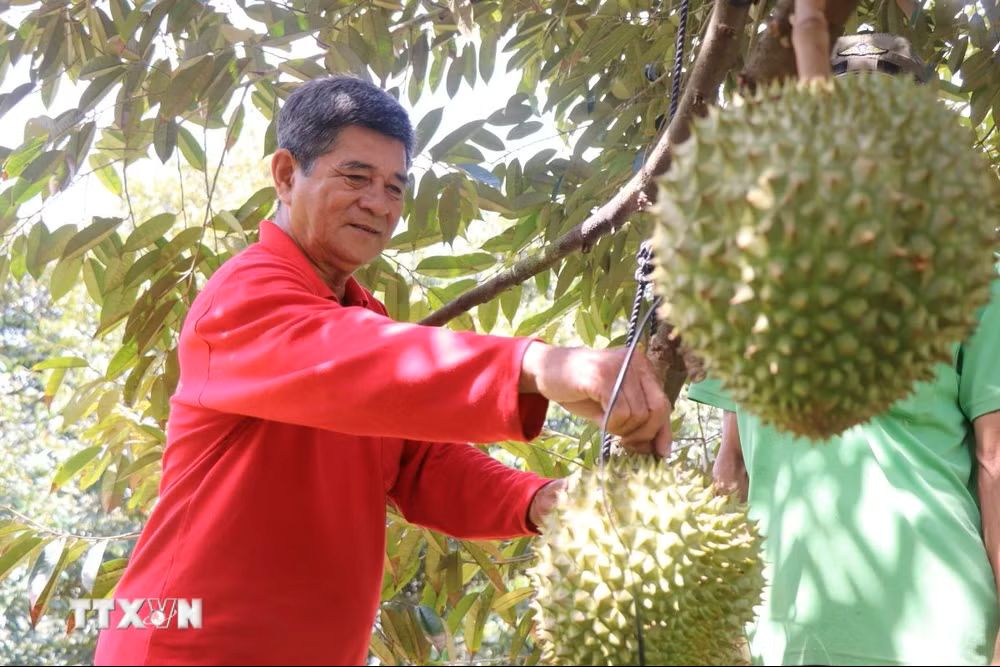
HCMC – The Mekong Delta city of Can Tho is promoting off-season durian cultivation and stronger supply chain linkages as falling prices and rising regional competition put pressure on growers.
As of mid-May 2026, the city had more than 14,400 hectares under durian farming with estimated output of 120,000 tons. However, prices of the popular Ri6 variety in key growing areas such as Phong Dien and Truong Long have dropped by around VND20,000 against a year earlier to VND30,000-45,000 per kilogram. At some orchards, traders have purchased durians in bulk at only VND20,000-35,000 per kilogram, depending on quality.
The decline was attributed to abundant supply and overlapping harvest seasons with neighboring producers including Thailand, Laos and Cambodia. Rising input costs have also increased pressure on growers’ profit margins.
Against this backdrop, supply chain partnerships have emerged as a stabilizing factor for some producers. Truong Khuong A Cooperative, for example, has maintained selling prices of VND35,000-45,000 per kilogram through long-term contracts with export companies.
To maintain these partnerships, growers are required to follow strict quality control standards, including limits on pesticide residues and cadmium contamination. Cost-saving cultivation methods have also helped cooperative members reduce production costs to VND15,000-17,000 per kilogram, well below the market average, helping secure stable profits.
To address longer-term challenges, Can Tho’s agriculture sector is shifting its focus toward off-season production, with harvests targeted from November to March to avoid peak harvest periods in competing countries and capitalize on strong demand from China. Around 20% of the city’s durian-growing area has successfully adopted off-season cultivation, according to local authorities.
At the same time, the city is accelerating the issuance of planting area codes for more than 2,700 hectares of durian farms. The codes are required for export traceability and market access.
Authorities are also encouraging farmers to form concentrated cultivation zones of more than 10 hectares to reduce costs and expand access to higher-value markets such as the European Union, the United States and ASEAN countries.