
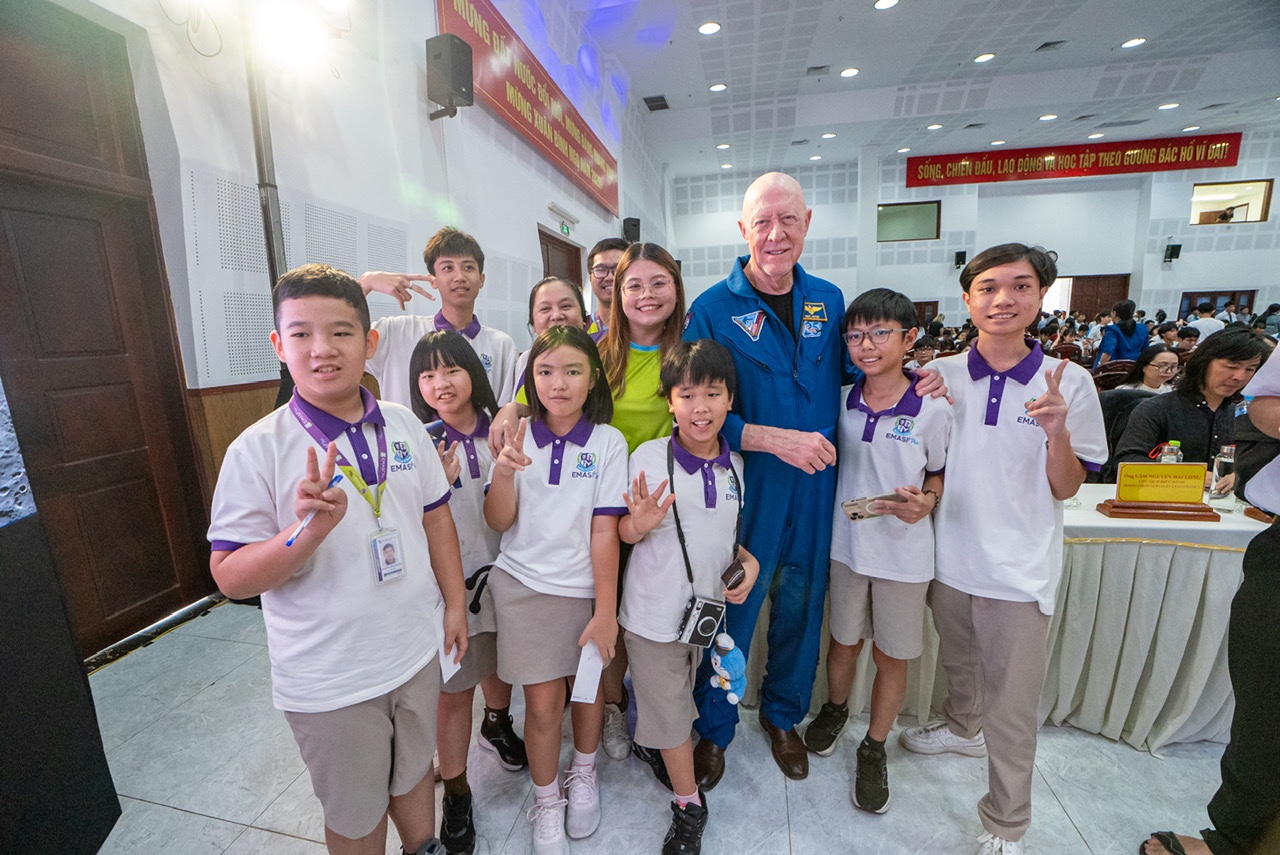
On May 28 in Can Tho, Vietnam Space Week 2026 officially kicked off. Inspiring stories were shared by international aerospace experts serving as speakers, such as former astronaut Michael A. Baker in the “Astronaut Talk Show,” bringing new insights about space to thousands of guests and students.
However, the more remarkable aspect lays in the event’s overarching message: the journey to conquer the universe does not begin with rockets, but with classrooms, curiosity, and the spirit of exploration among young people. Through a wide range of experiential activities — from robotics, drones, and AI to astronomical observation — Vietnam Space Week not only brought science closer to the public, but also demonstrated Vietnam’s desire to enter the technology race through its most important resource: people.
From stories beyond orbit to aspirations in the classroom
One of the most memorable moments during the “Astronaut Talk Show” came when former NASA astronaut Michael A. Baker described the feeling of viewing Earth from space — where national borders disappear, leaving only a fragile blue planet amid the darkness of the cosmos.
Baker commanded four Space Shuttle missions, accumulating a total of 965 hours working in space. Yet rather than focusing solely on aerospace engineering or historic flights, he emphasized the value of education and the spirit of discovery.
That message was echoed by Dr. Josef Schmid — NASA aerospace medicine specialist, who drew attention in 2021 as “the First Human Holoported to Space.” In his presentation titled “Vietnam as a Space Ship ready to launch!”, Schmid did not tell students they had to become astronauts. Instead, he said that everyone has a place aboard the “Vietnam ship.”
“Vietnam is the ship. Every student, teacher, and community leader in this room is part of the crew,” he said.
According to Schmid, education is not only a path toward personal advancement but also “the engine of national progress.” He cited figures showing that Vietnam is entering a pivotal stage of technological development: in 2025, around 180,000 new students enrolled in STEM fields, accounting for 36% of total university admissions, while the national target is to train 50,000 semiconductor engineers by 2030.
But what he stressed was not merely the need for engineers or programmers. “Vietnam does not just need coders — it needs doctors who understand data, teachers who understand science, and leaders who understand technology,” he said.
At times, the atmosphere inside the auditorium resembled an inspirational gathering more than a scientific conference. Students continuously asked questions about life in space, zero-gravity environments, and the possibility of human settlement on the Moon. Yet behind those seemingly distant questions was something much closer: the aspiration to participate in the future of global technology.
Speaking at the opening ceremony, Nguyen Van Khoi, Vice Chairman of the Can Tho People’s Committee, said the event was not merely a scientific exchange activity but also a forum to inspire creativity and the desire to pursue knowledge among young people.
“The values of knowledge and inspiration spread from today’s program will continue to nurture the pioneering spirit of younger generations, contributing to the building of a Vietnam developed through knowledge, technology, and innovation in the new era,” he said.
“Vietnam is a spaceship ready for launch”
If Michael Baker’s talk transported audiences into space, Dr. Josef Schmid’s presentation brought science much closer to everyday life.
He outlined a STEM roadmap consisting of 10 “missions” that students in any province of Vietnam could carry out, even without modern laboratories. The first missions require only paper, pencils, and smartphones: keeping climate diaries, measuring rainfall, surveying water quality, monitoring community health, or mapping cultural heritage sites using GPS.
“Students do not need expensive equipment — a notebook, a smartphone, and a curious mind are enough to begin,” he said.
One example repeatedly mentioned by Schmid was how students could use smartphones to record the story of a centuries-old communal house or pagoda in their locality, tag it with GPS coordinates, and store it on a digital platform. According to him, this is precisely where STEM, technology, and cultural identity intersect.
“Technology does not replace tradition — it preserves it for the next generation,” he said.
The message resonated strongly with the Mekong Delta — a region facing enormous pressure from climate change while also possessing rich cultural heritage and biodiversity. In sample exercises presented during the event, Schmid repeatedly encouraged students to monitor temperature, rainfall, humidity, and changes in monsoon seasons to better understand climate change in Vietnam, one of the countries considered most vulnerable to rising sea levels.
At the STEM Day experiential zone at the Hau Giang Innovation Support and Technology Incubation Center (ISC), activities involving robotics, drones, LEGO STEM, VR/AR technology, and astronaut simulation models attracted large numbers of students.
Many students experienced controlling robots or using virtual reality headsets simulating space environments for the first time. But what interested international experts even more was the potential to connect these experiences with Vietnam’s real-world challenges — from smart agriculture and environmental monitoring to heritage preservation.
Dr. Nguyen Xuan Xanh, a scientist who studied and taught in Germany, highly praised the significance of Vietnam Space Week in inspiring scientific thinking.
According to him, for thousands of years, humanity has looked toward the sky not only out of awe, but also out of the need to measure time, support agriculture, and understand the world. The desire to explore the heavens helped shape modern natural sciences and mathematics.
“The dream of exploring the sky led to the formation of natural sciences and the development of mathematics, benefiting Earth immeasurably,” he remarked. In his view, Vietnam Space Week is an important step in inspiring Vietnamese youth to participate in the space economy, which is projected to be worth trillions of dollars.
Not only inspiration, but also planting the seeds of the space economy
One notable aspect of Vietnam Space Week 2026 is that the event goes beyond merely “inspiring” people. Behind the talk shows and experiential activities lies a broader strategic message: Vietnam needs to prepare human resources for the future high-tech and space economy.
In his presentation, Dr. Josef Schmid repeatedly emphasized that every classroom in Vietnam could become a “small research station,” where students learn to observe, measure, build, test, and share data.
He described a “national learning nervous system” — a platform connecting students and teachers from Ha Giang to Ca Mau through the internet, where they could upload environmental data, field photos, or local cultural maps into a shared system.
According to him, this is not simply STEM education, but a way to build data science capabilities and technological thinking from an early stage.
These directions also reflect Vietnam’s broader national picture today. The government is strongly promoting STEM, AI, semiconductors, and digital transformation as new growth drivers. Resolution 57-NQ/TW, issued at the end of 2024, identified the development of a world-class science and technology workforce as a national priority.
In that context, Vietnam Space Week emerges as an effort to move space science beyond academia and turn it into a catalyst for education, innovation, and the digital economy.
Notably, the decision to host the event in Can Tho sends a clear message: innovation is not reserved only for major cities. It also implies that local communities themselves possess unique knowledge about biodiversity, agriculture, and culture that no textbook can replace. STEM, therefore, should not only mean learning programming or robotics, but also solving concrete local problems.
A classroom in the Mekong Delta can study water quality. A group of students in mountainous areas can map cultural heritage using GPS. A coastal community can monitor erosion and extreme weather. According to the experts, such small activities form the foundation of national scientific capability.
Closing his presentation, Dr. Josef Schmid delivered a simple yet thought-provoking message: “Learn something. Build something. Share something. Serve Vietnam.”
He then repeated a concise phrase that could also be regarded as the event’s central message: “Vietnam is the ship. Learning is the fuel. The future is the destination.”
Dr. Josef Schmid: From a bicycle to ideas reaching into space
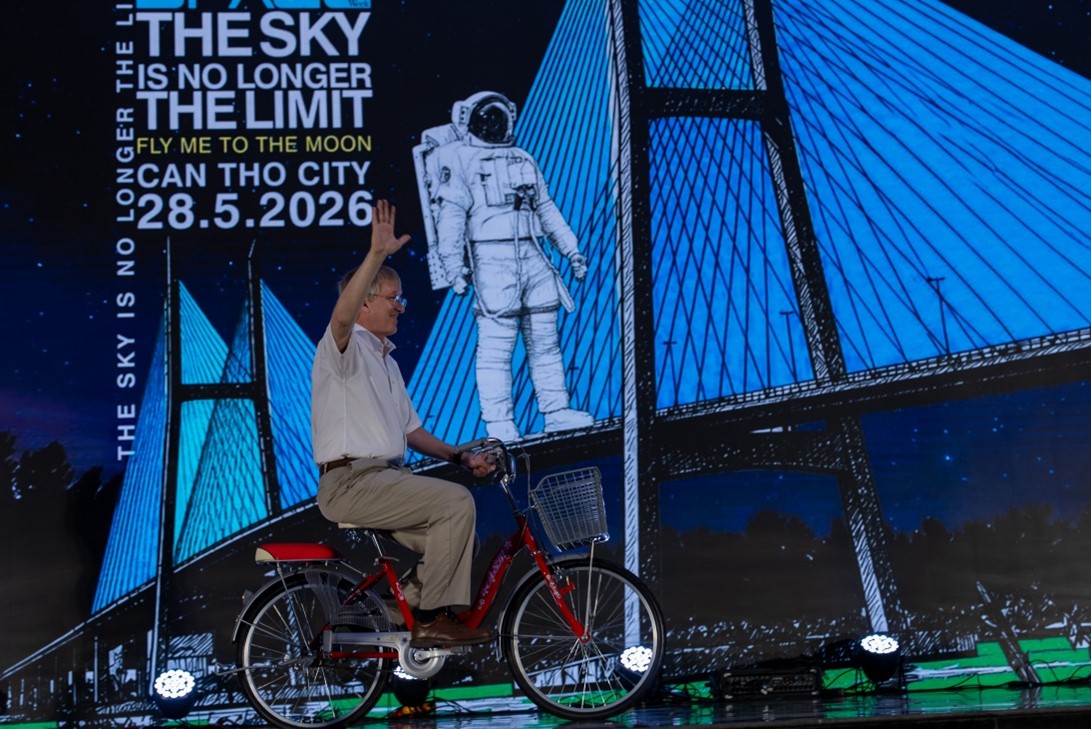
Dr. Josef Schmid surprised the audience by riding a bicycle onto the stage amid applause and cheers from thousands of students at Vietnam Space Week 2026. The space medicine expert said many of the most important ideas in his life had emerged while cycling. “The bicycle, pencil, and paper have always been my companions from childhood to today,” he shared. Through this special appearance, he conveyed the message that science does not necessarily begin with expensive equipment, but with curiosity, imagination, and each person’s creative ability. Photo: Organizing Committee.