
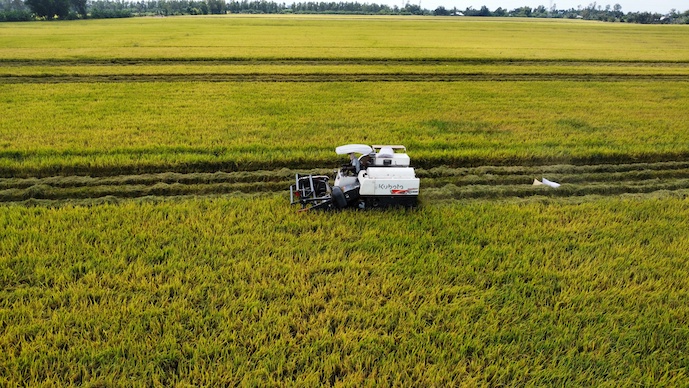
HCMC – Localities in the Mekong Delta have registered over 860,000 hectares for the high-quality, low-emission rice project, a decrease from previous projections.
At a meeting held in Can Tho City to review two years of implementing the “one-million-hectare sustainable high-quality rice” initiative, the Department of Crop Production under the Ministry of Agriculture and Environment said that the total planned area through 2030 now stands at 869,013 hectares, down by around 70,000 hectares compared to earlier registrations.
This adjustment follows a review of technical eligibility criteria, including irrigation infrastructure, the capacity for low-emission farming practices, and the readiness for measurement, reporting, and verification systems. Despite the reduced total area, pilot models covering over 12,500 hectares have yielded impressive results. These include a 30-50% reduction in seed usage, a 30% cut in nitrogen fertilizer, and a profit increase of about VND5.3 million per hectare compared to traditional methods.
These farming practices can help reduce emissions by an average of 3-4 tons of CO2 equivalent per hectare. To date, over 18,000 hectares have met the standards for the “Green Vietnamese Low-Emission Rice” label, with the first 500 tons already exported to Japan. Furthermore, the World Bank’s Transformative Carbon Asset Facility (TCAF) has attracted registrations from over 15,500 hectares, signaling international support for the region’s green transition.