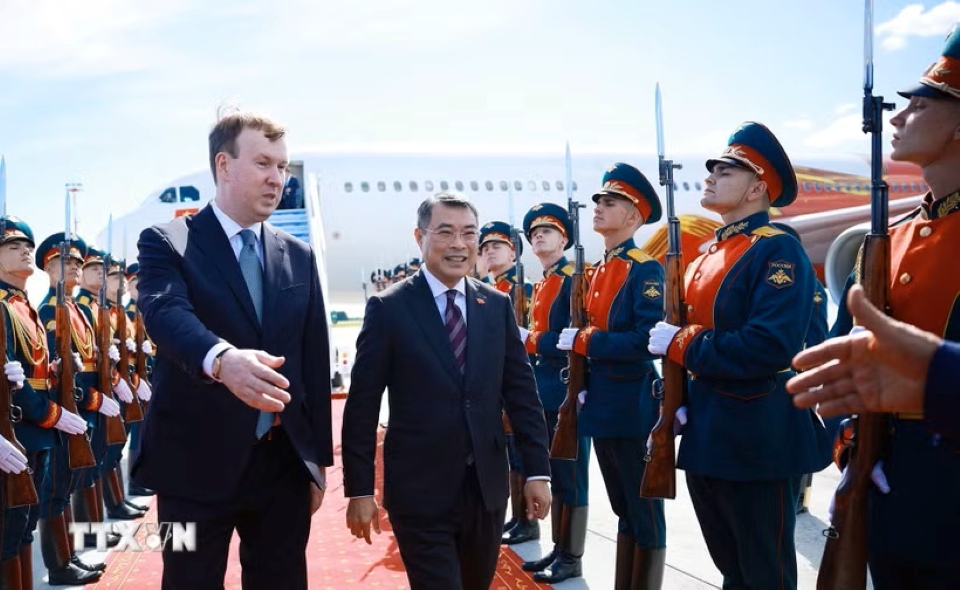
HCMC – Vietnamese Prime Minister Le Minh Hung arrived in Kazan, the capital of Tatarstan, on June 16 (local time) to attend a summit marking the 35th anniversary of ASEAN-Russia relations at the invitation of Russian President Vladimir Putin.
The visit marks Hung’s first trip to Russia since taking office and underscores Vietnam’s commitment to strengthening political ties and advancing the ASEAN-Russia Strategic Partnership in a new phase of development.
The summit, scheduled for June 17-18 in Kazan, will focus on shaping the future direction of ASEAN-Russia cooperation across three pillars: political-security affairs, economic cooperation, and socio-cultural exchanges.
Vietnam is expected to play an active role in promoting practical cooperation in areas with significant untapped potential, including trade, science and technology, digital transformation, non-traditional security, energy, and broader economic connectivity with the Eurasian region.
On the sidelines of the summit, Prime Minister Hung is expected to meet President Putin and hold talks with leaders of Tatarstan to discuss measures aimed at removing obstacles to cooperation and accelerating the implementation of high-level economic agreements.
The gathering comes as the ASEAN-Russia Strategic Partnership, elevated in 2018, seeks new economic drivers amid growing geopolitical challenges. Russia’s decision to host the summit in Kazan reflects its efforts to deepen engagement with the Asia-Pacific region and reaffirm support for ASEAN’s central role in the regional architecture.
For Vietnam, the visit signals the Government’s continued commitment to a foreign economic policy centered on balance and diversification while placing greater emphasis on practical cooperation and measurable outcomes through concrete projects.
Economic cooperation between ASEAN and Russia, particularly within the broader Eurasian economic space, continues to offer considerable room for growth in trade and energy security. Vietnam’s focus on technology, digital transformation and energy cooperation highlights a shift from traditional trade flows toward knowledge-intensive industries and strategic infrastructure.
Expected high-level discussions between Prime Minister Hung and President Putin could provide an opportunity for both countries to explore more flexible payment and logistics arrangements, helping facilitate business connectivity and support more resilient trade ties amid global economic uncertainty.