
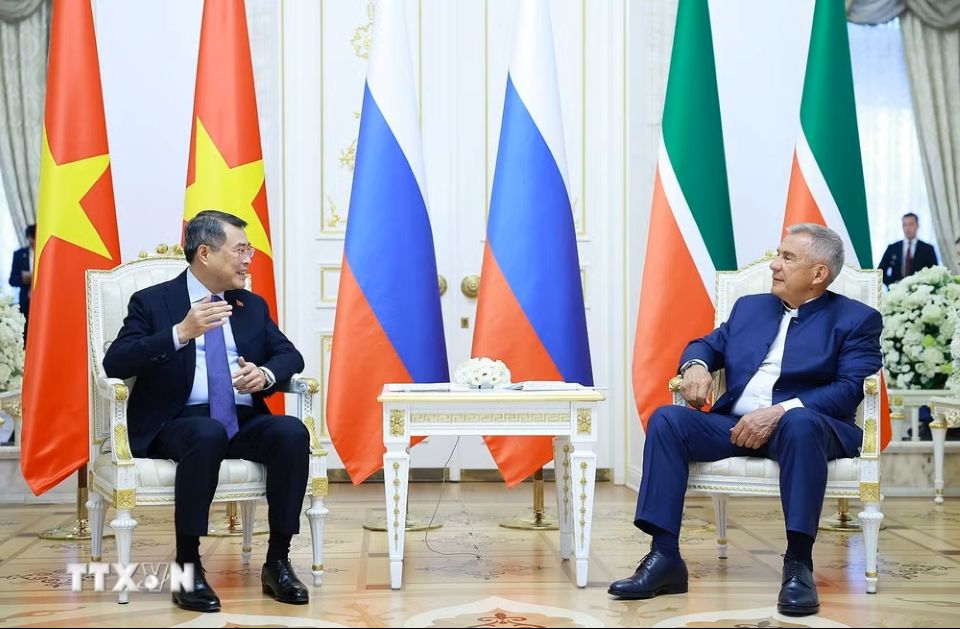
HCMC – Strengthening direct links between localities and businesses in Vietnam and Tatarstan is expected to unlock investment opportunities in underdeveloped sectors such as information technology, heavy manufacturing, and tourism and commercial air connectivity.
At a meeting in Kazan on June 16, Prime Minister Le Minh Hung and Rustam Minnikhanov, head of the Republic of Tatarstan, identified a range of cooperation opportunities based on the complementary strengths of their respective economies.
Tatarstan is home to several industries that align closely with Vietnam’s development needs, including heavy truck manufacturing, petrochemicals, chemicals, civil aviation, textiles, and furniture production. The republic is also known for its extensive network of small and medium-sized enterprises and a thriving information technology sector, whose industrial parks generate around US$10 billion in annual revenue.
To capitalize on these opportunities, Tatarstan proposed expanding cooperation with Vietnamese localities, increasing commercial flight connections between Kazan and Hanoi, and establishing a Vietnamese Consulate General in Kazan to facilitate trade, investment and tourism.
Prime Minister Hung welcomed efforts to deepen ties between local governments and businesses and reaffirmed Vietnam’s commitment to creating favorable conditions for Tatarstan businesses seeking long-term investment opportunities in the country.
From a broader economic perspective, stronger cooperation at the local and business levels is seen as a key step toward translating into concrete outcomes the comprehensive strategic commitments agreed upon by the leaders of Vietnam and Russia in May 2025.
Although bilateral trade has maintained steady growth in recent years, it remains below the potential of the two economies. Vietnam’s emphasis on facilitating business activity reflects a pragmatic approach to economic diplomacy that places enterprises at the center of cooperation and views high-tech and industrial projects as important drivers of future growth.
Tatarstan’s efforts to build partnerships with Vietnamese provinces and cities could also open the door to a new model of economic cooperation. The republic’s heavy industry and chemical companies may find investment opportunities in Vietnam’s industrial parks and economic zones while benefiting from the country’s extensive network of free trade agreements.
At the same time, Kazan’s experience in developing billion-dollar information technology parks could offer valuable lessons for Vietnam’s emerging innovation hubs as the country accelerates its digital transformation agenda.
The combination of Russia’s strengths in technology and capital-intensive industries and Vietnam’s dynamic market and flexible supply chains could provide a foundation for deeper economic cooperation and new growth opportunities in the years ahead.







