
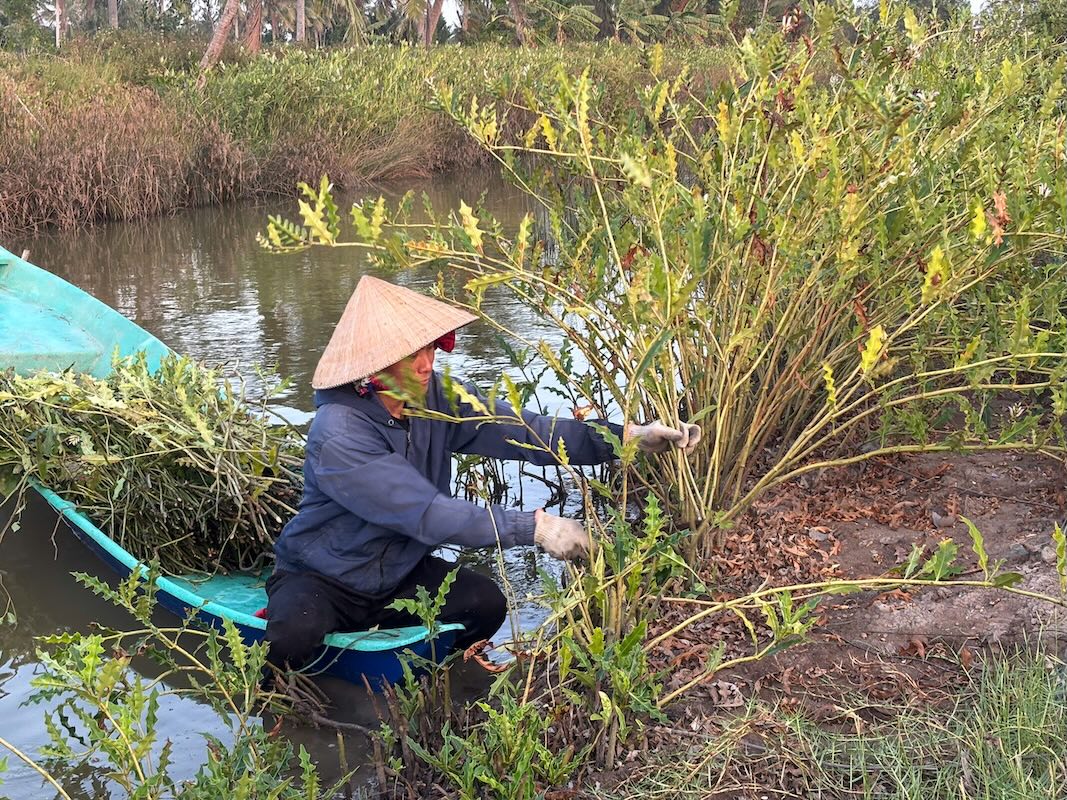
Along the banks of shrimp ponds in Ca Mau, an overlooked plant is inspiring a new model for livelihoods and sustainable development.
For decades, Vietnam’s southernmost province of Ca Mau has been synonymous with shrimp, crab and vast stretches of brackish-water aquaculture ponds. Yet beyond the bustle of its seafood industry, a quieter story is unfolding along the earthen embankments that border those ponds. What was once overlooked land—and a hardy wild plant known locally as o ro—is becoming the foundation of an agricultural startup that blends local knowledge, scientific research and the search for more sustainable livelihoods.
Building science into a local resource
When Lam Quoc Nhut returned to his hometown of Ca Mau around 2018-2019, he was struck by a landscape that raised more questions than answers.
After leaving the dynamism of HCMC behind, he found many shrimp pond embankments lying unused, overgrown with weeds and native vegetation. Yet in this saline environment, a variety of indigenous plants thrived with little or no human intervention.
Through a process of experimentation, Nhut identified o ro—a wild shrub rooted in the muddy banks of canals and waterways—as a promising candidate. The plant survives some of the region’s harshest conditions, but turning an overlooked wild species into a commercially viable health product required a different way of thinking about investment.
“If the project is going to survive, it has to create products with genuine scientific and technological value—products that are commercially viable while also generating research value from native resources,” said Nhut, founder and chief executive officer of Halofai Saltwater Agriculture Co., Ltd.
That vision led to the establishment of a production facility spanning more than 500 square meters and a manufacturing process designed around quality control and product safety. For a startup operating with limited resources, the investment was significant. Every product must undergo testing and certification before reaching consumers.
Creating value from a saline ecosystem
At first glance, plant-based salt may seem little more than an alternative seasoning. A closer look at its biological composition, however, reveals important differences.
Conventional sea salt consists primarily of sodium. Halofai’s flagship product, by contrast, is made entirely from o ro and contains a naturally occurring balance of sodium and potassium. According to the company, this balance may offer advantages for people managing high blood pressure or kidney-related conditions. The product also contains trace minerals and naturally occurring iodine, along with a milder flavor profile derived from plant matter.
Seeking to broaden the value of Ca Mau’s saline ecosystem, Halofai has expanded into other products, including pure acerola juice grown on acidic saline soils and ADOLI dietary supplements derived from extracts of o ro and sea hibiscus.
Perhaps more importantly, the model is beginning to create economic opportunities for local residents.
Once regarded as little more than a wild plant, o ro is now generating supplementary income for farmers. Halofai purchases raw material at around VND1,200 per kilogram. After an initial growing period of six to eight months, the plant can be harvested repeatedly without replanting. Its root system also helps stabilize pond embankments and provides a natural habitat for aquatic species.
“We’re not promoting large-scale cultivation,” Nhut said. “Our goal is simply to make productive use of the unused land along pond banks and create additional income for local households.”
Challenges remain
The effort to bring a wild coastal plant into the marketplace has been anything but straightforward.
Like many agricultural startups, Halofai continues to grapple with a chronic shortage of capital. Production equipment, factory facilities and product certification require substantial investment, while access to bank financing remains difficult for young businesses lacking collateral.
Before establishing its current facility, the company pieced together funding from startup competitions, local industrial promotion programs, personal savings and loans from relatives and friends.
Today, a different challenge has emerged: a mismatch between production capacity and market demand.
The company currently sells only about 100 kilograms of plant-based salt each month, despite having the capacity to produce 400-500 kilograms. To address the gap, Halofai plans to focus on research and manufacturing while seeking commercial partners to help expand distribution and market reach.
Ultimately, the company’s ambitions extend beyond product sales.
At its core, the project reflects a broader effort to change how local resources are perceived. The wild plants that flourish in Ca Mau’s saline landscapes, Nhut argues, should not be viewed as weeds but as ecological assets capable of generating economic value and supporting sustainable livelihoods.
From a shrub growing untended along shrimp pond embankments, a different development path is taking shape in Vietnam’s far south—one that seeks to transform the ordinary gifts of nature into new opportunities for local communities.
There is also an economic logic behind the product’s premium price.
According to Halofai’s production process, more than 100 kilograms of raw o ro plant material are required to produce just one kilogram of finished plant-based salt. The retail price of around VND600,000 per kilogram may therefore seem high at first glance.
Yet for a typical family of four consuming roughly 10 grams per day, the cost amounts to about VND6,000 daily. Spread across the household, that works out to roughly VND1,500 per person per day—about the price of a glass of iced tea, but potentially with long-term health benefits.