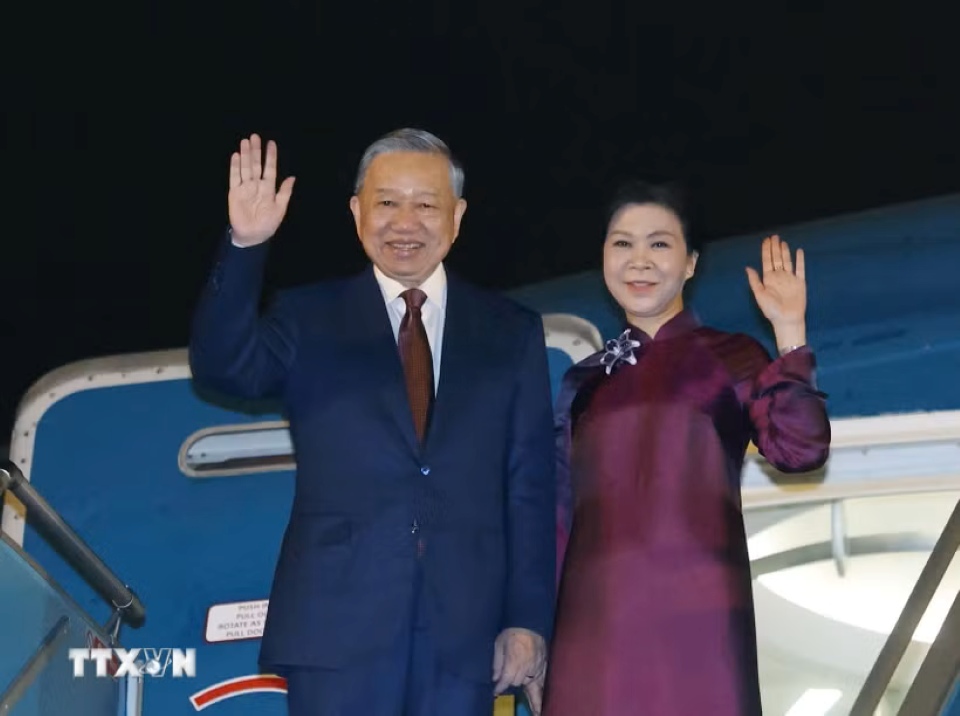
HCMC – To Lam, General Secretary of the Communist Party of Vietnam and State President, on April 14 left for China for a state visit from April 14 to 17, 2026, accompanied by his spouse and a high-level Vietnamese delegation.
The trip marks his first state visit to China in his capacity as the country’s Party General Secretary and State President. It comes exactly one year after Xi Jinping, General Secretary of the Communist Party of China and President of China, paid a state visit to Vietnam in April 2025. It is also the third bilateral exchange between the two countries’ top leaders in less than two years.
The delegation includes senior officials such as Tran Cam Tu, Politburo member and Permanent member of the Communist Party of Vietnam (CPV) Central Committee’s Secretariat; Bui Thi Minh Hoai, Politburo member and Secretary of the Party Central Committee, President of the Central Committee of the Vietnam Fatherland Front; Nguyen Duy Ngoc, Politburo member and head of the Central Organization Commission; Phan Van Giang, Politburo member, Deputy Prime Minister and Minister of National Defense.
Specifically, the presence of senior officials overseeing economic, trade, and foreign affairs portfolios is expected to open up new avenues for substantive cooperation, particularly in promoting more balanced trade and attracting high-quality investment into Vietnam’s priority sectors.
In an article published in the People’s Daily newspaper ahead of his visit, To Lam outlined four key pillars to advance Vietnam–China relations in a more substantive and deeper manner in the new era.
First, strengthening a solid political foundation through regular high-level exchanges and enhanced strategic communication, which he described as essential to building trust and expanding practical cooperation while effectively managing emerging issues.
Second, shifting cooperation from expanding scale to enhancing quality. This includes accelerating strategic infrastructure connectivity, particularly three standard-gauge railway projects in northern Vietnam, while deepening integration of production, supply chains, and economic corridors. Science, technology, innovation, and digital transformation are expected to become new drivers to boost each country’s self-reliance.
Third, reinforcing social foundations and people-to-people exchanges, with a focus on youth and intellectual engagement. The 2026–2027 period has been designated as key years for tourism cooperation, aimed at fostering stronger public connections and enabling younger generations to shape the future of bilateral ties in the 21st century.
Fourth, managing differences and maintaining a peaceful environment by resolving disputes through peaceful means in line with international law and the legitimate interests of both sides, while enhancing dialogue and restraint to ensure regional and global stability.
The visit comes as both countries enter critical development phases. Vietnam is implementing the Resolution of its 14th National Party Congress, with a focus on breakthroughs in digital transformation, while China is launching its 15th Five-Year Plan centered on high-quality development.