
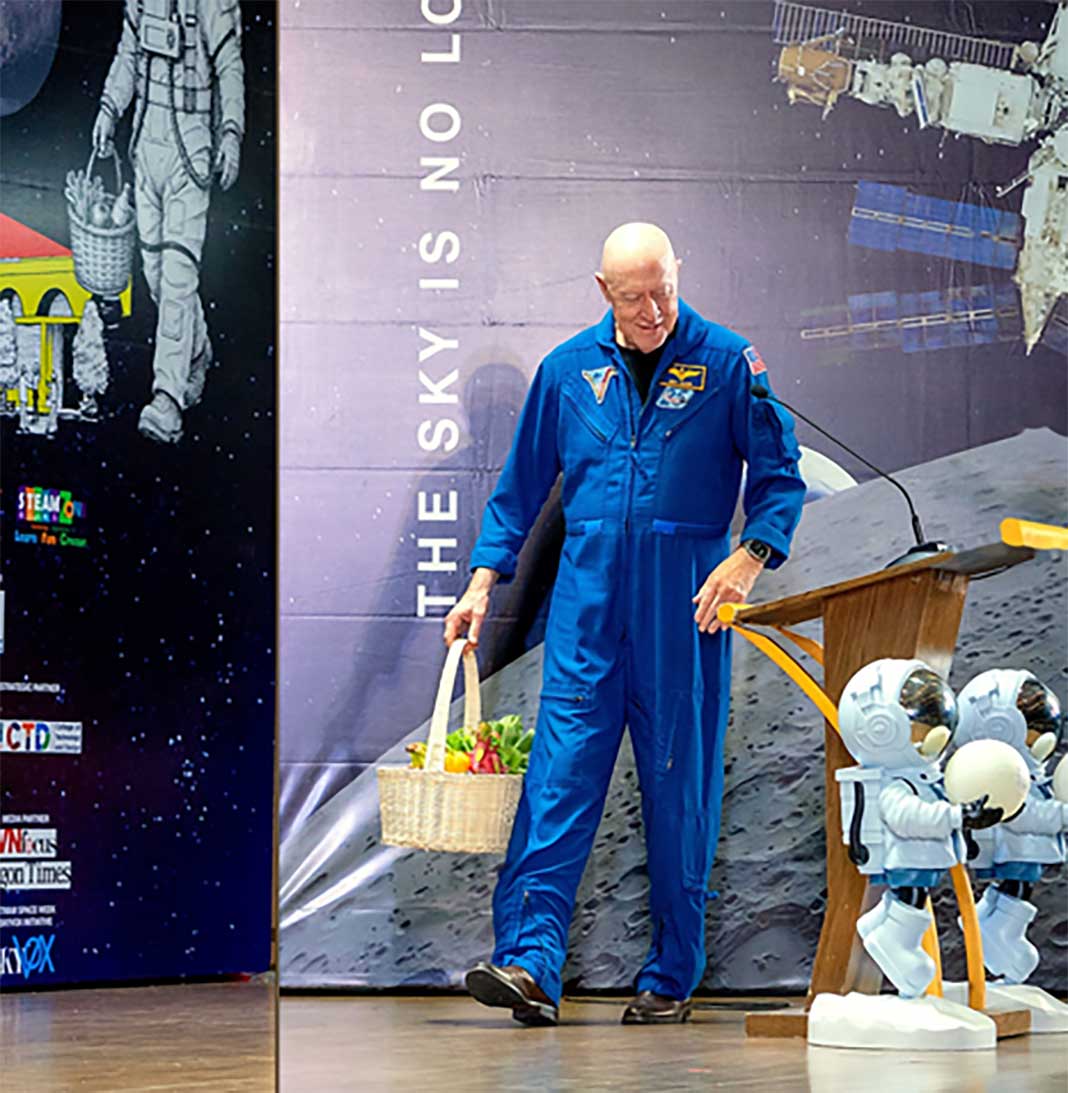
A former NASA astronaut walked onto the stage carrying a basket of vegetables from Ben Thanh Market, setting the tone for an inspiring conversation with nearly 1,000 students in Ho Chi Minh City.
For years, conversations about space in Vietnam have largely revolved around symbolic milestones: the country’s first satellites, the dream of sending a Vietnamese astronaut into orbit, or future missions to the Moon and Mars.
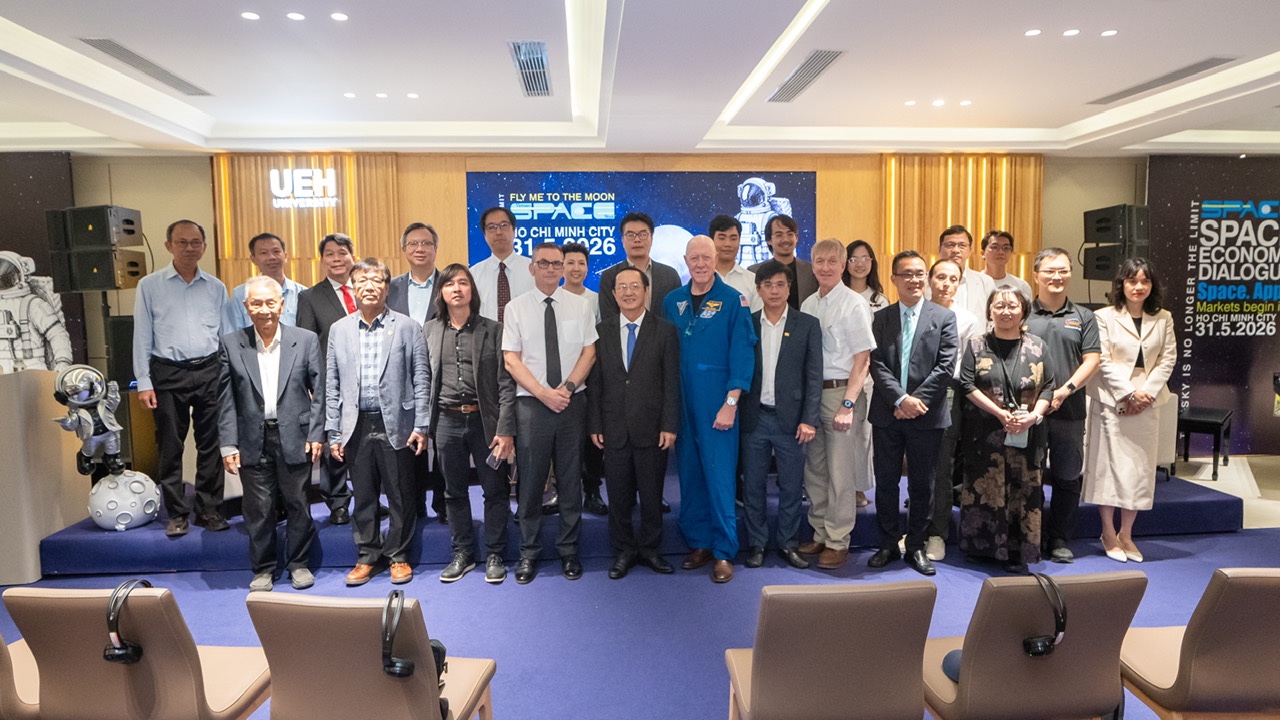
But at the Space Economy Dialogue, held on May 31 at the University of Economics Ho Chi Minh City (UEH) as part of Vietnam Space Week 2026, the focus shifted toward a far more practical question: How can Vietnam make money from space?
Under the theme “Fly Me to the Moon: Where Space Meets Business,” the event marked the first dedicated dialogue on the space economy in Vietnam. Co-organized by the Saigon Times Foundation, the Innovation Services Center (ISC), and STEAMZone, it brought together international experts in space economics, astronomy, space technology, and innovation, alongside business leaders, investors, university executives, and policymakers.
While the previous edition of Vietnam Space Week focused primarily on STEM education and scientific inspiration, this year’s dialogue reflected a new perspective: viewing space as an emerging economic sector where data, technology, and talent may create as much value as rockets and launch systems.
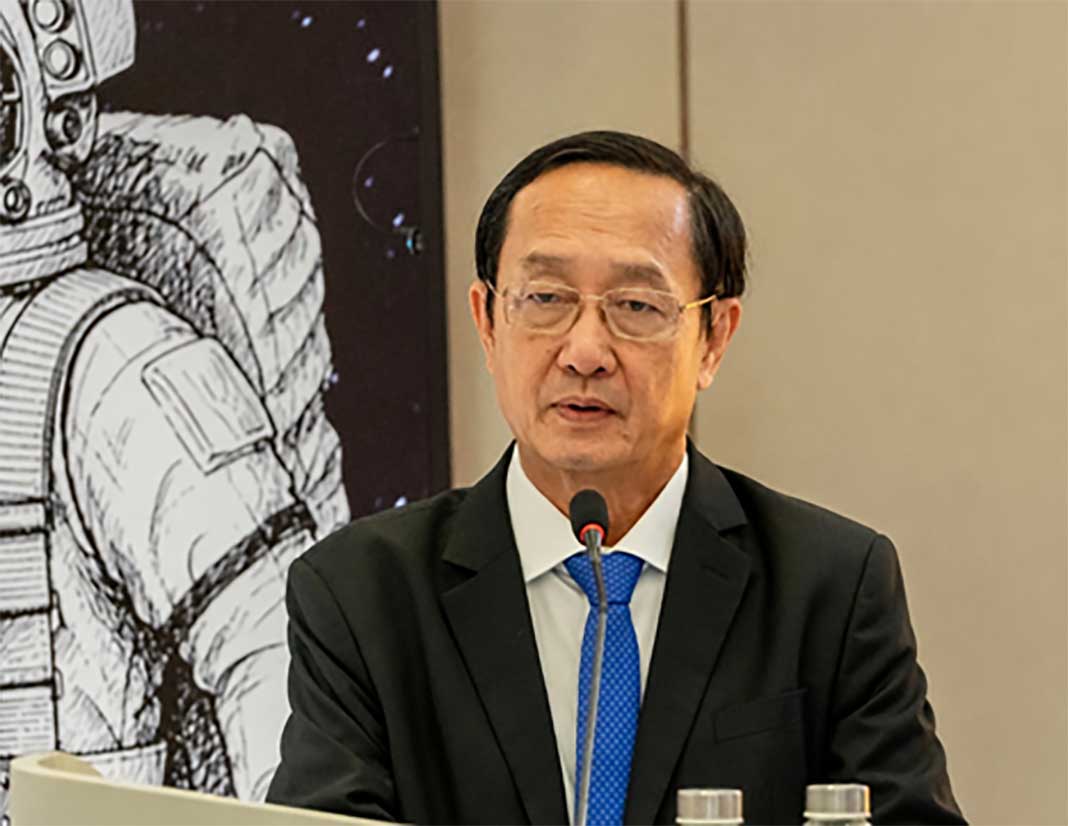
Opening the session, Huynh Thanh Dat, Deputy Head of the Central Commission for Propaganda and Mass Mobilization and former Minister of Science and Technology, described the decision to focus on the space economy as “timely and appropriate.”
“Today, we look to the sky not only to dream—but to understand, to master, and to shape the future,” he said.
Not rockets but skills
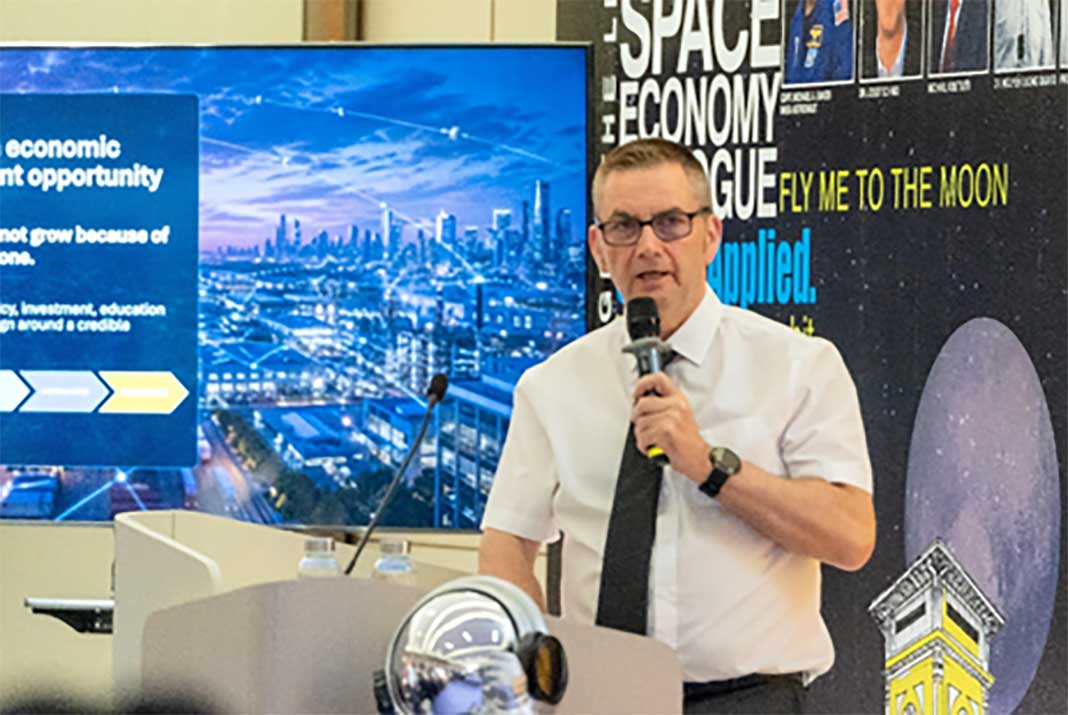
One of the most striking messages came from Michael Koetsier, a British space economy specialist and former Vice President of rocket company Skyrora.
While many emerging nations begin with ambitions to build rockets or establish domestic launch programs, Koetsier proposed a different path.
For developing economies, he argued, the greatest opportunities lie not in expensive launch infrastructure but in the downstream sector—where satellite data is transformed into commercial services such as Earth observation, precision agriculture, logistics, weather forecasting, disaster management, telecommunications, data analytics, and AI-powered applications.
The idea was captured in a phrase repeatedly referenced throughout the forum: “The most valuable launch system of the future will not be a rocket—it will be a graduate.”
Behind that statement lies an entirely different development philosophy. Rather than viewing physical infrastructure as the foundation of growth, the modern space economy increasingly treats skills and human capital as strategic infrastructure.
If cities once competed for investment through ports, airports, and industrial parks, space-economy investors are now paying close attention to workforce capabilities.
Notably, many questions directed at Koetsier were not about rockets or satellites. Instead, participants wanted to know what specific skills international investors seek before committing capital to local space-data businesses.
The discussion highlighted a new reality: many of the highest-value jobs in the modern space economy are found not on factory floors assembling satellites, but in data centers, software firms, analytics companies, and applied research laboratories.
Space is not just for engineers
If Koetsier represented the economic and investment perspective, Dr. Josef Schmid, NASA flight surgeon and pioneer of holographic medical communication, offered a broader vision.
Through his concept of “SpaceShip Vietnam,” Schmid emphasized that the space industry cannot be built solely by aerospace engineers or astronauts.
Behind every space mission stand physicians, data scientists, lawyers, educators, entrepreneurs, policymakers, and communicators. It is because fields such as space biomedicine, health-data analytics, STEM education, insurance, finance, project management, and science communication may all become important components of a future space economy ecosystem.
The message resonated particularly strongly because the forum was hosted by UEH, the Strategic Partner of Vietnam Space Week 2026. It reinforced the idea that space is gradually becoming a story for the entire economy—not just for engineers.
Revenue first or knowledge first?
One of the most thought-provoking discussions centered on development philosophy.
While Koetsier stressed the importance of generating revenue from downstream applications, Vietnamese astrophysicist Nguyen Luong Quang of CEA Saclay in France argued that a sustainable space economy cannot rely solely on short-term commercial opportunities.
Without investment in fundamental research, he warned, technological achievements risk becoming “buildings constructed on sand.”
His view was echoed by Professor Kotaro Kohno of the University of Tokyo, who has been involved in major astronomy projects such as the TAO Observatory and the ALMA telescope network.
History shows that many technologies now taken for granted—from imaging sensors and signal processing to advanced optical systems—originated from research once dismissed as lacking immediate economic value.
That raises a familiar dilemma for many developing countries: with Vietnam’s R&D spending still around 0.4% of GDP, should limited resources be directed toward basic science or toward commercially viable applications capable of generating faster returns?
Perhaps the answer lies in a clear separation of responsibilities: government support for fundamental science, universities and businesses leading applied innovation, and revenues from downstream industries helping sustain the scientific foundation that makes future breakthroughs possible.
From technology buyer to technology supplier
Perhaps the strongest signal emerging from the Space Economy Dialogue was not found in the keynote speeches but in the questions posed by the business community.
One notable example came from Tierra Joint Stock Company, a diamond jewelry business, which asked Michael Koetsier how chemical vapor deposition (CVD) diamond technologies might enter the New Space supply chain—from radiation-resistant sensors and optical materials to advanced electronic components.
Rather than discussing STEM outreach or inspiration, the company wanted to know what business models could simultaneously sustain short-term cash flow while building long-term R&D capabilities necessary to become a Tier-2 or Tier-3 supplier to private satellite-launch companies.
Such questions went far beyond scientific curiosity. They reflected a shift in mindset: from learning about space technologies to becoming an active participant in the industry’s global value chain.
Experts ranging from astronauts and NASA physicians to astronomers responded to highly technical questions involving optical materials for space telescopes, radiation-resistant CVD diamond chips for deep-space missions, and their potential applications in life-support systems and wearable medical technologies for astronauts.
Following the event, Michael Koetsier reflected on the importance of the dialogue.
“The Space Economy Dialogue on May 31 was a fantastic highlight of the week. The discussion did an excellent job bringing together government, industry, and academia to focus on the tremendous opportunities opening up for Vietnam, particularly in the downstream sector. The volume of thoughtful questions from local businesses showed that the market is genuinely ready to engage,” he said.
When an astronaut walks onstage carrying vegetables from Ben Thanh Market
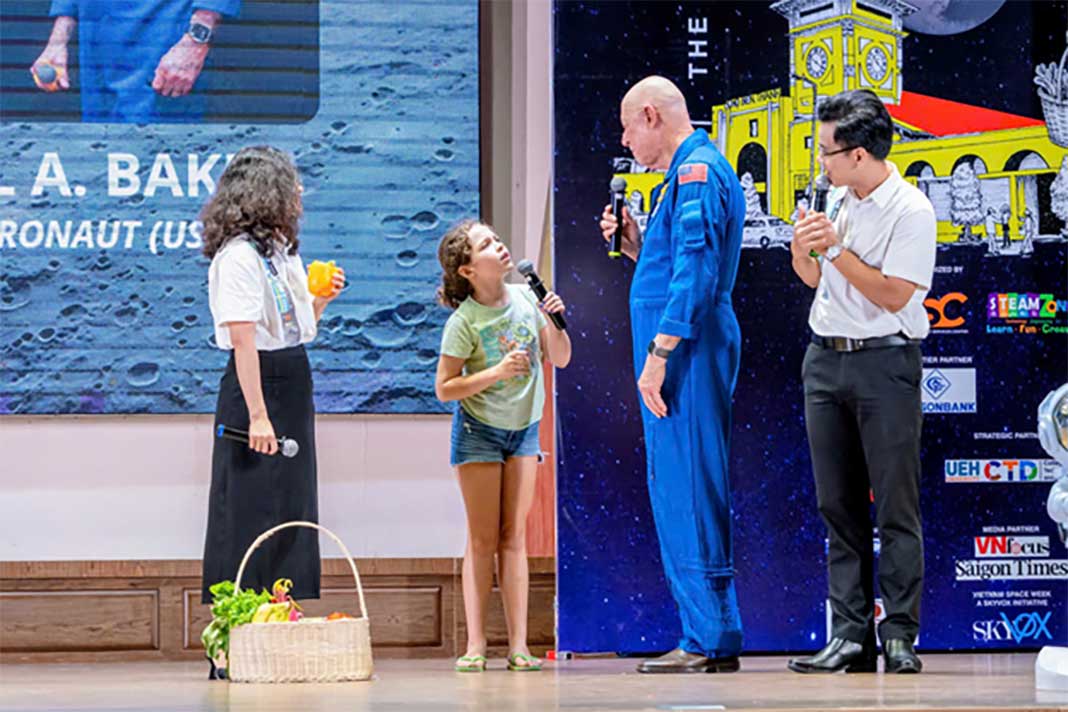
Later that afternoon, nearly 1,000 students packed the UEH auditorium to witness a memorable moment.
Former NASA astronaut Michael A. Baker—a veteran of four Space Shuttle missions with more than 965 hours in space and commander of the historic STS-81 mission to Russia’s Mir space station—walked onto the stage wearing his iconic blue NASA flight suit while carrying a woven basket filled with Vietnamese mangoes and vegetables, as if he had just stopped by Ben Thanh Market before heading into orbit.
The image perfectly recreated the official Vietnam Space Week 2026 poster and symbolized a simple message: Space is not distant. It begins with everyday life.
During the Real Space Talk session, Baker recounted the launch experience, the first sensation of weightlessness, and the unforgettable moment of seeing Earth from 400 kilometers above the planet.
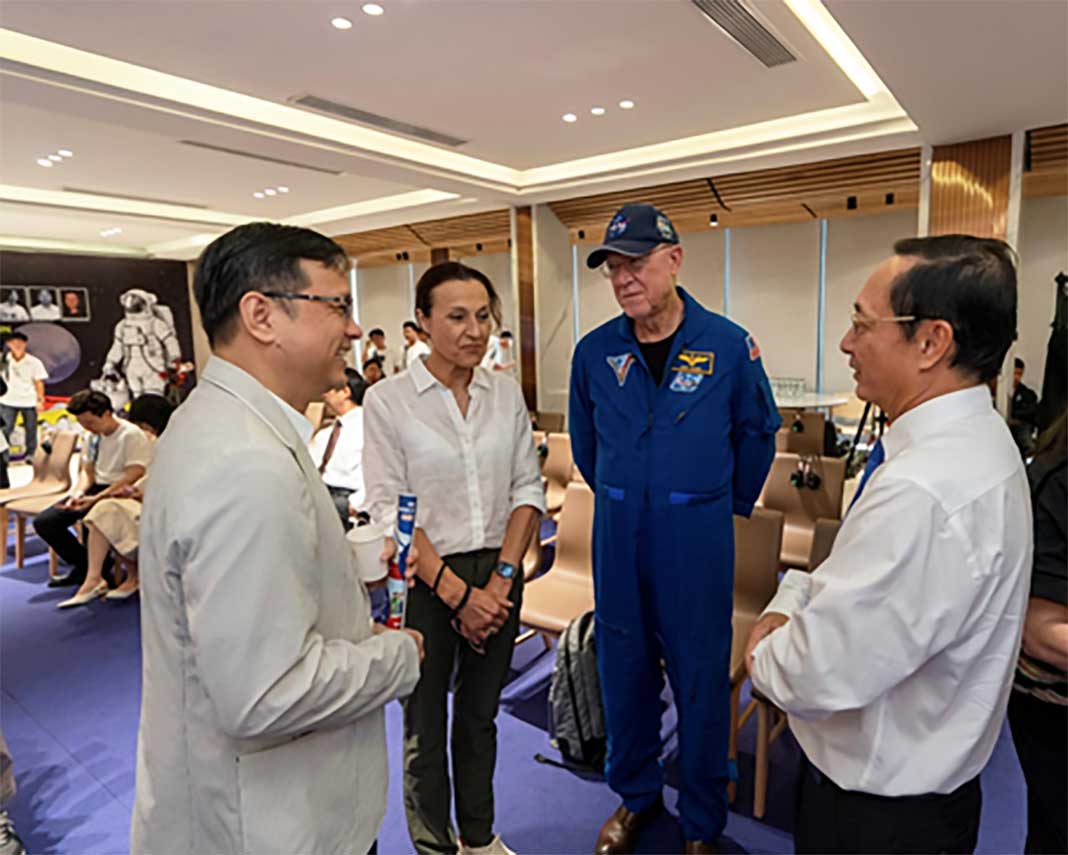
Alongside him, Dr. Josef Schmid explained how a physician could effectively appear aboard the International Space Station through hologram technology without ever leaving Earth.
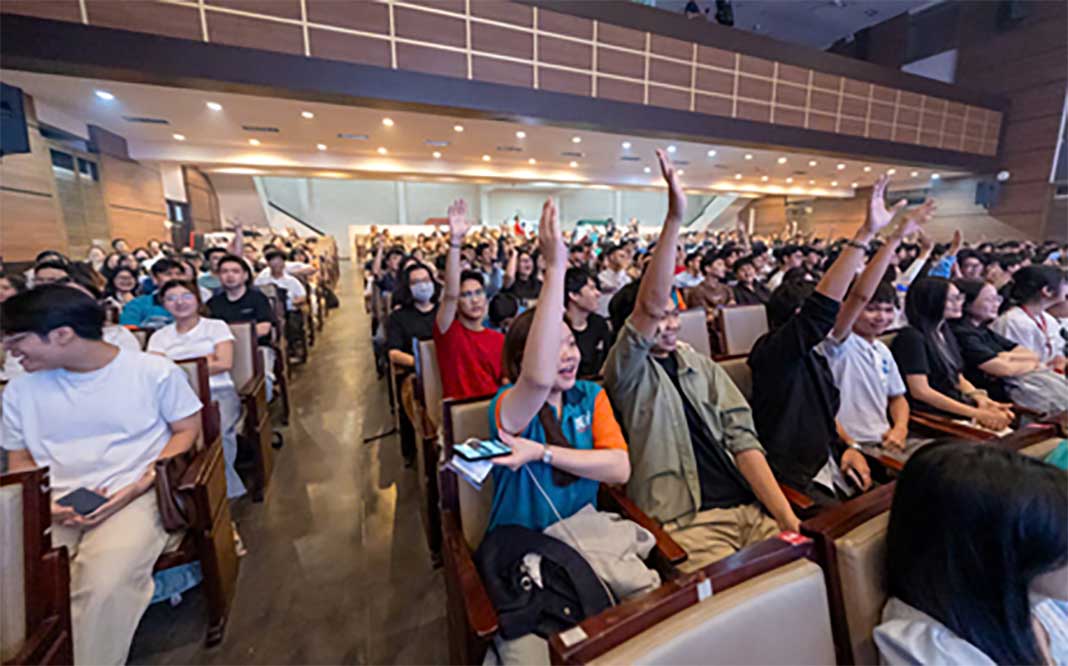
The most energetic part of the event came from the audience itself.
Students lined up at microphones, asking questions that ranged from scientific to deeply personal: Does weightlessness hurt? How do astronauts eat and sleep? What does Earth look like from space? Could a Vietnamese astronaut one day fly into orbit?
Baker and Schmid answered each question with patience and enthusiasm.
The students left a particularly strong impression on Baker.
Reflecting on his return to Vietnam after first participating in Vietnam Space Week in 2023, he said the warmth of the Vietnamese people and the enthusiasm of young participants were what brought him back.
“Our trip to Vietnam in 2023 was my first visit to Vietnam and it was truly an amazing experience,” Baker said.
“The people of Vietnam are so warm and welcoming. The students were so enthusiastic, optimistic and curious. They demonstrated a sincere interest in lifelong learning and were an inspiration to me and our group.”
He added that the organizers were eager to return not only to reach more students but also to expand the conversation toward the development of Vietnam’s space industry.
“There are many opportunities for companies and young graduates,” he said.
Asked what remained with him most after this year’s event, Baker pointed again to the people he met.
“The thing that stays with me the most is the warm and welcoming feeling we received from all the people we encountered in Vietnam. Especially the wonderful, vibrant, enthusiastic, motivated and curious students. I would say that the future of Vietnam is in good hands with such young people.”
His message to Vietnam’s younger generation was simple: “Stay curious, work hard and stay dedicated to lifelong learning.”
Michael Koetsier later echoed that sentiment.
“The depth and sophistication of the students’ questions demonstrated that they were not merely listening attentively; they were seriously considering careers in the space sector. The energy in the room suggests that Vietnam’s space economy has a bright and highly motivated future.”
The sky is no longer the limit
As the global space economy moves toward a projected value of trillions of dollars in the coming decades, the question facing Vietnam may no longer be when it will build its own rockets or send its own astronauts into space.
A more important question may be: What products, services, and knowledge will Vietnam contribute to this industry?
The Space Economy Dialogue did not provide definitive answers.
But it did mark an important shift in how space is being viewed in Vietnam—from a symbol of scientific exploration to a genuine economic sector where opportunities exist not only in orbit but also in data, technology, education, and human capital here on Earth.
The theme of Vietnam Space Week 2026—“The Sky Is No Longer the Limit”—was more than an event slogan.
It was an invitation to an entire generation of young Vietnamese to dream bigger and reach farther than ever before.
Because when a former NASA astronaut sets a basket of vegetables from Ben Thanh Market beside a microphone and begins telling stories about space, everyone understands something important: The door to the space economy is already open.
And it begins today—with the ambitions, talents, and aspirations of the Vietnamese people themselves.
Vietnam Space Week 2026 was co-organized by the Saigon Times Foundation, the Innovation Services Center (ISC), and STEAMZone.
As the event’s Frontier Partner, SAIGONBANK reaffirmed its role as a forward-looking financial institution while demonstrating a long-term commitment to education, technology, and innovation through future-oriented social responsibility initiatives.
Singapore Global Network, serving as Visionary Partner, helped connect Vietnam with international experts, businesses, and development models. The University of Economics Ho Chi Minh City (UEH) participated as Strategic Partner, fostering stronger links between universities, the academic community, and the innovation ecosystem.
The event was also supported by RainScales, AI Coaching, and DigiTEX as Mission Partners, alongside media partners VNFOCUS Communication Corporation and The Saigon Times. Vietnam Space Week 2026 additionally received valuable support from numerous benefactors and individuals in Vietnam and abroad, helping bring the program to a wider community.