
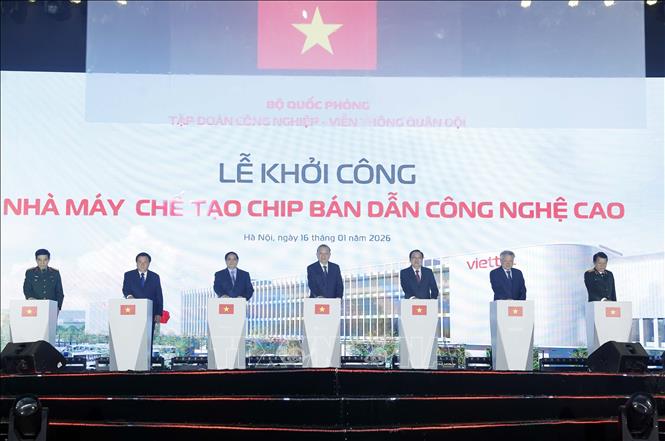
HCMC – Vietnam on January 16 broke ground on its first semiconductor chip fabrication plant at the Hoa Lac Hi-Tech Park in Hanoi City, marking the country’s first move to establish in-country chip manufacturing capacity.
The project is being developed by Viettel Military Industry and Telecoms Group (Viettel) under an assignment from the Ministry of National Defense, based on a Government resolution.
Party General Secretary To Lam and Prime Minister Pham Minh Chinh attended the groundbreaking ceremony, along with senior Party and State leaders, Government officials, representatives of foreign missions, international organizations, and domestic and foreign partners.
The plant will be built on a 27-hectare site at Hoa Lac Hi-Tech Park and is planned as a national infrastructure facility serving semiconductor research, design, testing, and production.
Once operational, it is expected to supply chips for sectors including aerospace, telecommunications, the Internet of Things, automotive manufacturing, medical equipment, and automation.
A complete semiconductor chip production process consists of six main stages: product definition, system design, detailed design, chip fabrication, packaging and testing, and integration and validation. Vietnam has participated in five of these stages, but chip fabrication—the most complex step—has not previously been carried out domestically.
The new plant is intended to complete the full semiconductor production chain in Vietnam.
According to Viettel Chairman and General Director Tao Duc Thang, the group aims to complete construction, receive technology transfer, and begin pilot production by the end of 2027. From 2028 to 2030, the plant will focus on optimizing processes and improving production efficiency to industry standards.
PM Pham Minh Chinh said the project is a strategic milestone reflecting Vietnam’s goal of deeper participation in the global semiconductor value chain, in line with the national semiconductor industry strategy to 2030, with a vision to 2050.
He said the global semiconductor industry is valued at about US$2.3 trillion and plays a key role in economic development, industrial capacity, and national security.
Party General Secretary To Lam emphasized that Vietnam is prioritizing artificial intelligence as a breakthrough field, alongside tax incentives for chip and semiconductor manufacturing and support for research and development. Artificial intelligence is expected to become a key driver of economic growth and innovation, serving people and supporting human development, he added.
According to PM Chinh, Vietnam has issued multiple policies to support the sector. The National Assembly has passed 12 laws to promote science, technology, innovation, and digital transformation, creating a legal framework for semiconductor development.
Vietnam has approved a national semiconductor industry development strategy and a human resources development program targeting the sector through 2030, with orientation to 2050.
After years of preparation, Vietnam is home to nearly 60 chip design firms, including 13 domestic companies, and has become a major center for chip packaging and testing. The country currently has about 6,000 semiconductor engineers, according to the Government.
Several global technology groups, including Intel, NVIDIA, Samsung, Qualcomm, Marvell, Amkor, and ASML, have invested in or cooperated with Vietnam in semiconductor-related activities.
The prime minister set targets for 2030 including at least 100 chip design companies, one chip fabrication plant, and around 10 assembly, packaging, and testing facilities. Vietnam also aims to train more than 50,000 semiconductor engineers by that year.
He instructed the Ministry of National Defense to oversee Viettel in implementing the project in line with regulations and schedule, and assigned ministries and Hanoi authorities to ensure funding, technology support, site clearance, and infrastructure for the plant’s construction and operation.