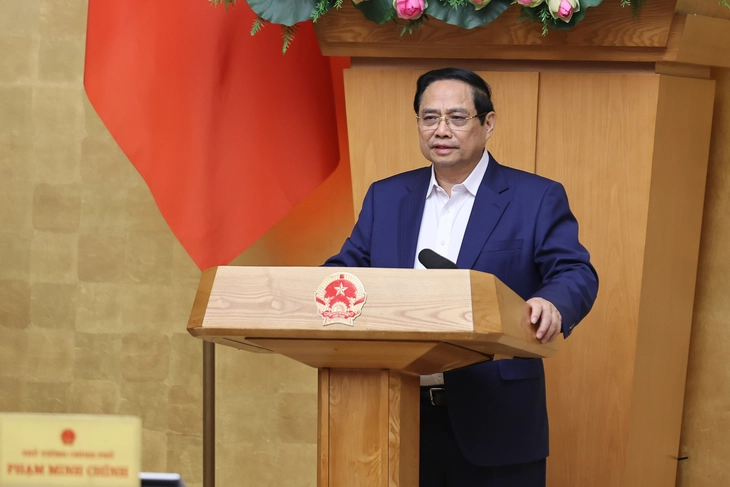
HCMC – Prime Minister Pham Minh Chinh said Vietnam’s economy continues to face significant pressure from inflation while public investment disbursement has not met requirements.
He was speaking at the Government’s monthly cabinet meeting for November held on December 6 to review a wide range of issues, including the socio-economic performance in November and the first 11 months of 2025, the allocation and disbursement of public investment capital, progress on the three national target programs, and the Government’s administrative reforms. Also on the agenda were reports on the two-tier local government model, a draft resolution on temporary housing support during land clearance, and priority tasks for December and beyond.
PM Chinh said global developments remained complex and unpredictable, with heightened strategic competition, fragmentation, and slowing global trade and investment. While inflation is cooling in some major economies, risks remain elevated.
November also saw major domestic political events, including the 14th plenum of the Party Central Committee and the 10th sitting of the 15th National Assembly, as the country works toward fulfilling the socio-economic targets for 2025 and the 2021-2025 period.
The Government continued to focus on disaster response after prolonged storms and floods that caused substantial human and economic losses.
Despite these challenges, PM Chinh said socio-economic conditions remained positive, with improvements recorded month after month. The 11-month performance in 2025 outpaced the same period in 2024 across most indicators, thanks to efforts from the entire political system and the public under the leadership of the Party.
Macroeconomic conditions remained stable, inflation was kept under control, major economic balances were maintained, and growth drivers were supported. Social welfare improved, cultural and social activities received attention, and national defense, security, and external relations were strengthened.
However, the PM stressed that the economy continues to face a number of shortcomings and risks. Inflationary pressure, exchange rate volatility, and external shocks remain significant due to Vietnam’s high level of openness. Public investment disbursement continues to lag behind expectations, and several business sectors are still struggling.
Gold and real estate prices remain elevated, while implementation of the two-tier local government model has faced staffing and technological infrastructure challenges in some areas. Meanwhile, lingering storms and prolonged rainfall have disrupted daily life and economic activity.
The Prime Minister requested delegates to provide detailed evaluations of the Government’s management work, the performance of ministries and localities, and the economic results for November and the year to date. He asked them to identify obstacles, root causes, and lessons learned, while assessing the outlook for the months ahead.
He emphasized the need for concrete measures to safeguard macroeconomic stability, control inflation, and ensure GDP growth of 8% or higher in 2025. Key priorities include boosting exports, accelerating public investment disbursement, supporting industrial, agricultural, and service production, and stimulating year-end consumer demand.
The PM also called for continued attention to post-disaster recovery, as well as cultural, social, defense, security, and foreign affairs issues.