
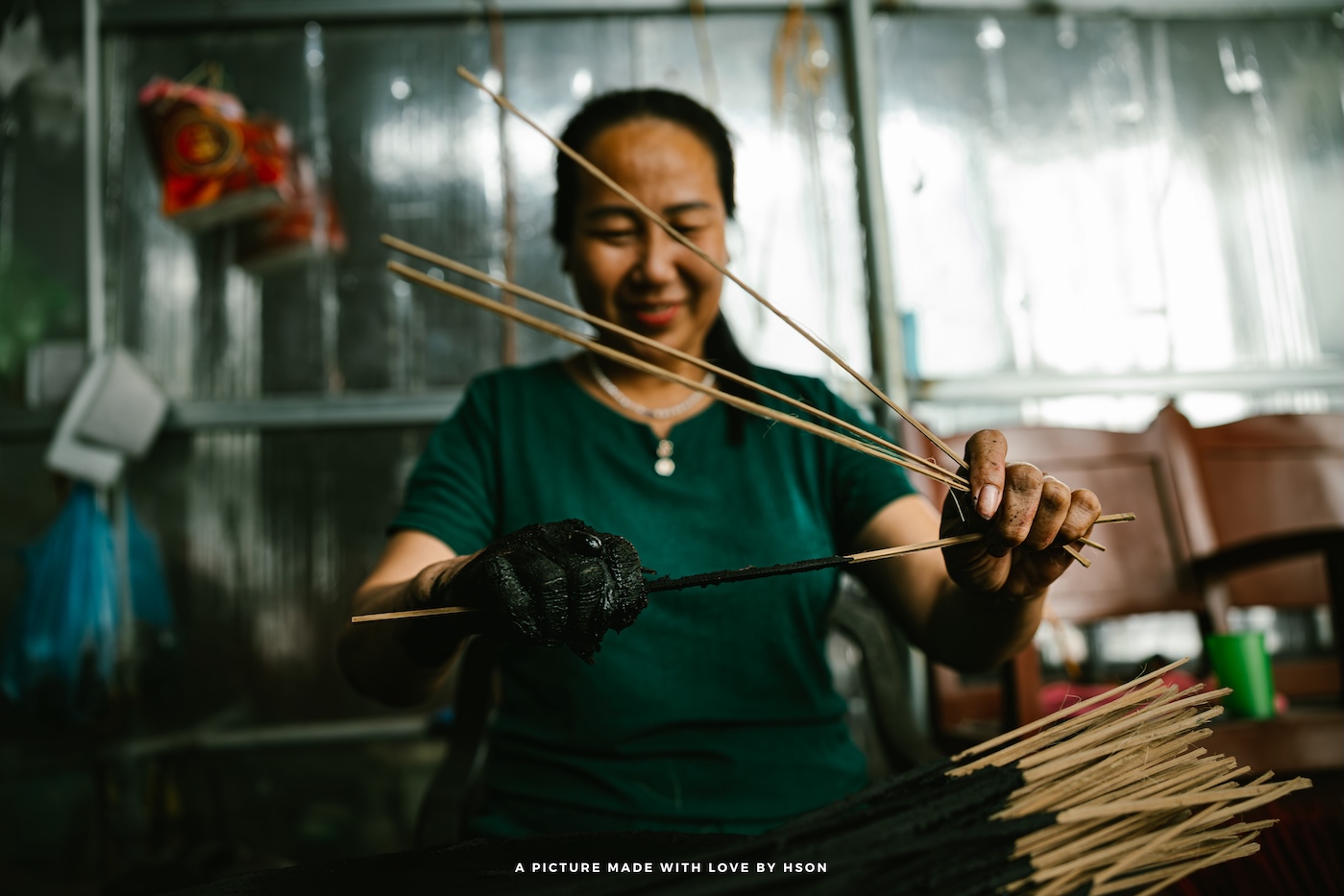
Van Quan Village in Dien Ha Commune, Hung Yen Province, is home to one of the region’s long-standing incense-making traditions, passed down through generations. More than a livelihood, the craft has become a cultural hallmark of the rural landscape.
What sets Van Quan’s black incense apart is its entirely natural composition. Artisans burn soybean stems and fragrant grass to ash, then grind the ash into a fine powder. This base is blended with herbs such as platycladus leaves, ligusticum and agarwood to create a distinctive, gentle aroma.
The process demands patience and skill. After mixing the ingredients using time-honored recipes, workers roll the incense by hand into even, slender sticks. These sticks are then dried in natural sunlight, ensuring a steady burn, minimal smoke, and a soft fragrance.
Beyond its spiritual uses, Van Quan incense reflects indigenous knowledge of herbs. According to local artisans, a quality stick should have an appealing color, a natural scent, and a stable burn.
Despite modern changes, the village continues to sustain production, preserving tradition while creating jobs. On sunny days, bundles of incense laid out to dry fill the courtyards, releasing a faint fragrance that drifts through the air, a simple yet evocative scene of rural life.
In today’s rural economy, maintaining traditional crafts such as incense-making not only supports income but also safeguards cultural identity. In Dien Ha Commune, these villages remain a vital source of livelihood.
Alongside broom-making, incense production in Van Quan remains vibrant. Some households have embraced modernization. Nguyen Thi Sim’s family, for instance, has invested in machinery for a 700-square-meter workshop, operating 10 production lines that produce more than 700,000 sticks per day.
Meanwhile, others remain committed to traditional methods. Artisan Pham Thi Nin noted that black incense contains no chemicals and relies solely on natural materials. Each worker produces about four kilograms of material per day, roughly 30,000 sticks. Income is modest, but it helps preserve the soul of the craft.