
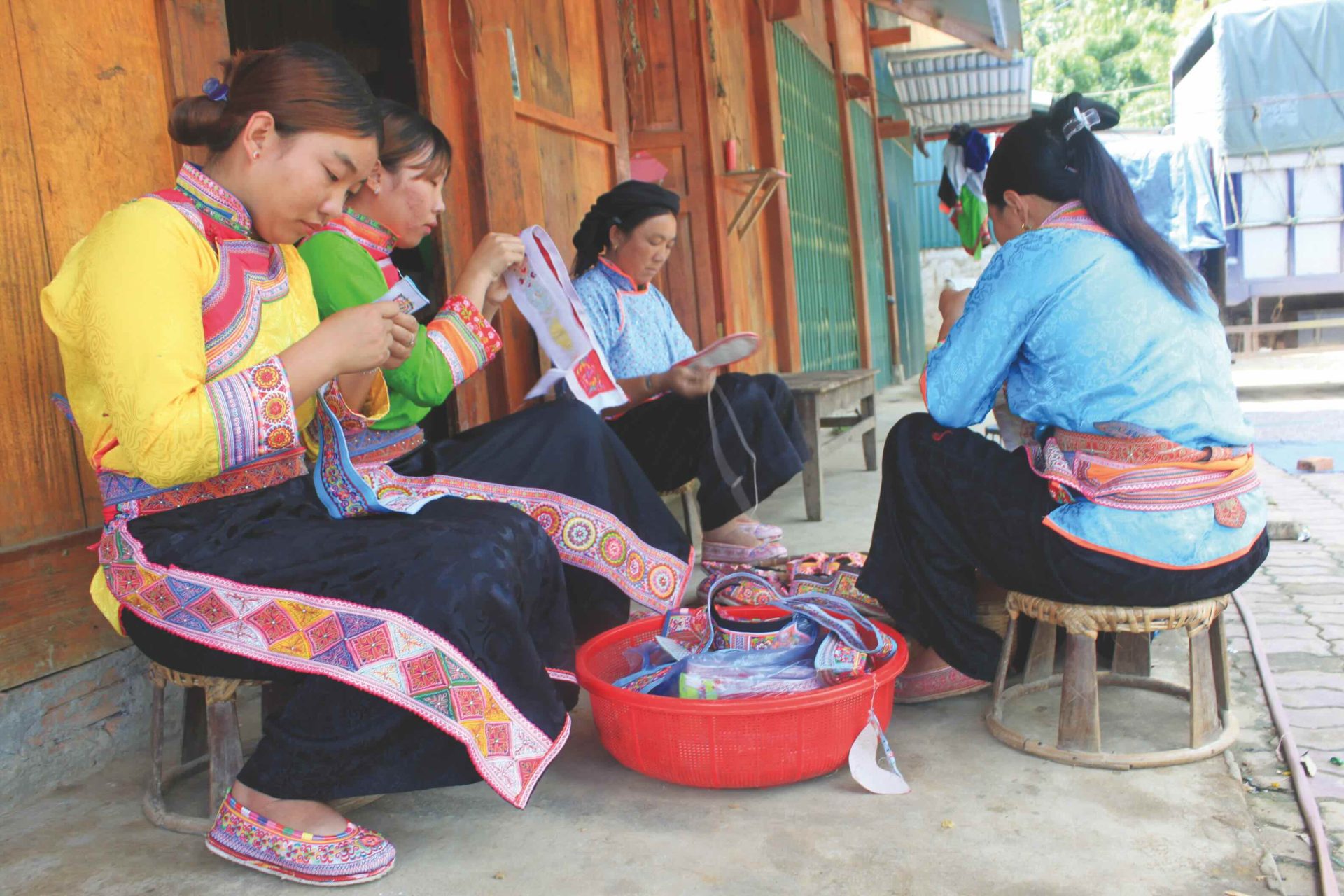
Vietnam is home to 54 ethnic groups comprising more than 100 sub-groups and branches. Living across diverse ecological environments, these communities have developed rich bodies of indigenous knowledge unique to each group. The culture of weaving, embroidery and the creation of decorative motifs on women’s garments is a highlight.
To describe something beautiful, Vietnamese people often liken it to “brocade weaving and floral embroidery.” Whether referring to virtue or vice, Vietnamese metaphors frequently draw from the world of textiles. The language itself reflects how deeply weaving and clothing are embedded in everyday life and cultural consciousness.
Ethnic identity
The Dao Tien minority embroider scenes from daily life and ancestral symbols onto clothing as a way of reminding younger generations to honor their forebears. Common motifs include single and paired dogs, often stitched along the hems of women’s garments, shamans’ robes and ceremonial attire worn during the Dao Tien men’s coming-of-age ritual. Some costumes feature eight-petaled flowers alongside dog motifs, while others combine pairs of dogs and birds.
The Thai ethnic people believe the three greatest beauties in life are sunlight falling across rocky mountainsides, vast fertile fields surrounding a village, and women skilled in weaving cloth and embroidering scarves.
Thai women also incorporate weaving tools into textile designs. One example is can pia, a spindle-like tool used during the earliest stage of thread-making. Thread unwound from the can pia is softened with ash water, dyed, spun and wound onto bobbins for weaving or embroidery. The object appears in a love story about a couple who vow to remain together for eternity, even after death: “May you become the can pia while I become the silk thread.”
The eight-petaled booc san flower motif likewise originates from folklore. Legend has it that an early Thai settler became lost and exhausted while clearing forestland. Sitting beneath a tree namely san, he survived after eating one of its fallen fruits. To commemorate the fruit that saved their ancestor during the era of settlement, Thai weavers began incorporating the flower motif into textiles.
Dragon motifs are also common in Thai weaving, symbolizing strength and filial devotion. Among Thai communities in Nghe An Province, dragons are associated with rainbows. Children are warned never to point at a rainbow, lest the dragon punish them by crippling their arms. A two-headed dragon motif, known as the “dragon of happiness,” represents a couple sharing one heart and one destiny. Parents often give daughters skirts embroidered with the symbol when they marry, wishing them lifelong harmony.
Among the Ha Nhi people, groups are distinguished through women’s clothing. Communities whose women wear bright red garments with colorful embroidery are known as Ha Nhi Hoa, while those whose women wear black attire are called Ha Nhi Den.
Elders in Bat Xat, Lao Cai Province, and Phong Tho, Lai Chau Province, explain the prevalence of indigo clothing among the Ha Nhi through migration history. During their southward migration from China, the leading group consisted mainly of strong young men and women who traveled quickly and carried most of the dyeing materials and embroidery patterns. Those left behind, the elderly, weaker women and children, moved slowly and retained only knowledge of earthen-wall construction, indigo dye production and simple embroidery techniques. As a result, indigo became the dominant color of their clothing.
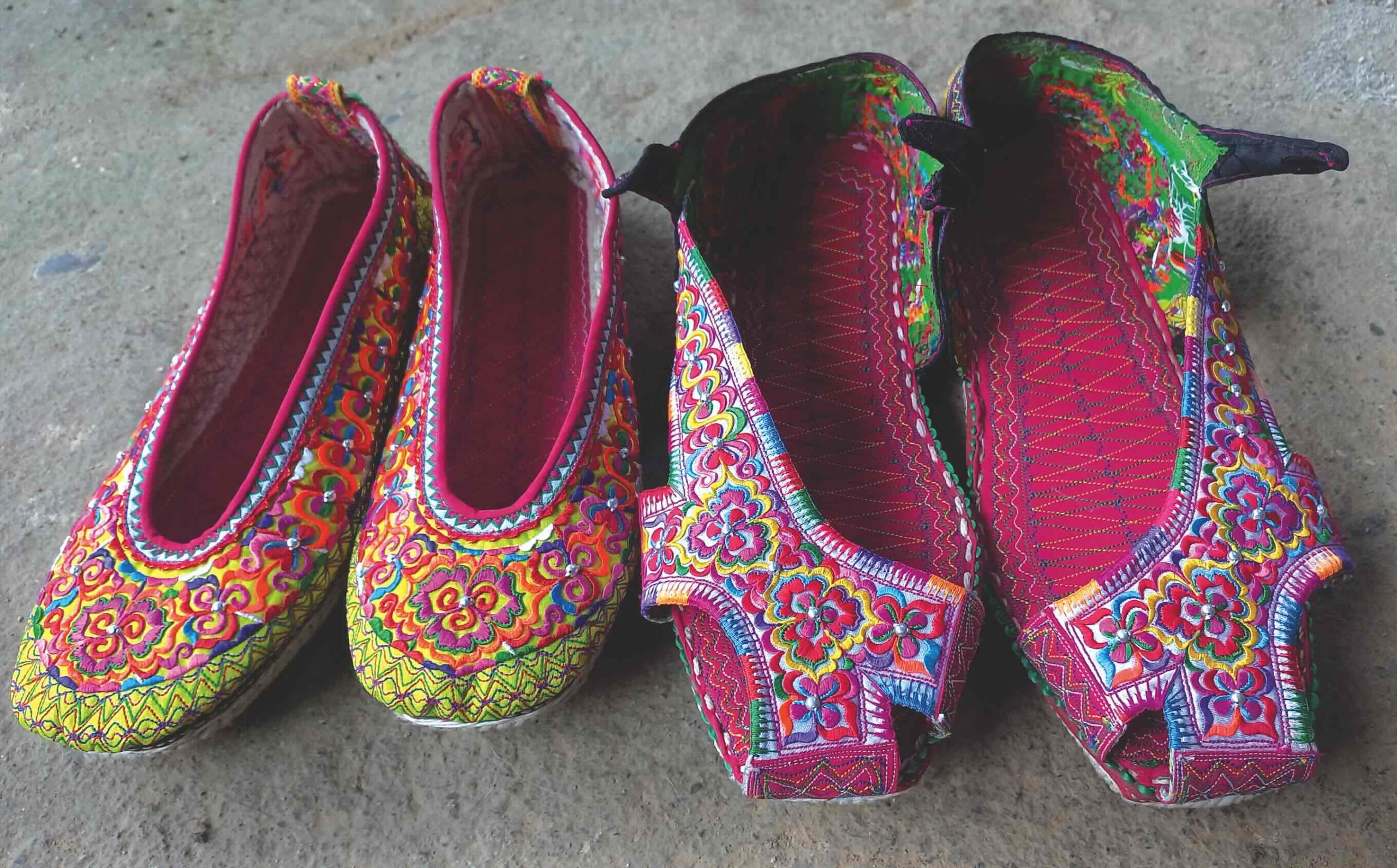
For years, Ro Ong Ka Uong has devoted herself to reviving the traditional B’No C brocade-weaving village in Lang Biang Ward, Lam Dong Province. She says that among the K’ho people, a woman’s beauty is reflected partly through her clothing. A beautiful woman is expected to weave skillfully, coordinate colors and create distinctive patterns. K’ho brocade is dominated by dark blue and black tones, but its beauty lies in geometric motifs, rectangles, squares, crosses, diamonds and spirals, alongside stylized flowers and birds crafted through dexterity, imagination and creativity.
Among the Mong people, the dead must be dressed in hemp garments or their ancestors will not recognize them. At Mong funerals, one can determine how many children the deceased had simply by looking at the clothesline erected above the coffin, since each child prepares a new hemp outfit for a parent to wear on the journey to the ancestral world.
Mong families traditionally carry three treasured possessions when migrating: a stone mill for grinding corn, the mistress’s skirt and bamboo tubes containing rice, corn and hemp seeds. The Mong have no written script, and their skirts serve as cultural texts. Embroidered patterns recount battles against Han invaders who seized their land, while three vertical bands symbolize the rivers they crossed during their southward migration.
Alongside food, clothing perhaps reveals most clearly the material and spiritual life of a people, an ethnic group or an individual. Hidden within fabrics, garments and jewelry is a fascinating history of humanity itself.
Keeping the flame alive
The writer has long been passionate about researching clothing and adornment, particularly from anthropological perspectives and within the slow-fashion movement. While traveling across Vietnam to research and write “Vietnam – An mac thong dong” (literally means Vietnam – Dressing at leisure), he was delighted to meet people who shared the same passion.
Many are not only preserving traditional attire but also adapting it creatively by incorporating ethnic motifs into streetwear, tablecloths, smartphone cases and product packaging.
Authorities in Lam Dong and Phu Tho provinces have effectively implemented regulations requiring teachers and students at ethnic boarding schools to wear traditional attire at least once a week, typically on Mondays during flag-raising ceremonies. In Xin Man Commune, Tuyen Quang Province, boarding schools even teach high school students to embroider traditional Nung U and Tay motifs during handicraft classes.
Belgian designer Aldegonde van Alsenoy first visited Dhroong Village in Ta Lu Commune of Dong Giang District, Quang Nam Province — now Dong Giang Commune of Danang City — in 2012 and immediately fell in love with Cotu clothing.
Traditional Cotu brocade is strikingly beautiful but heavy and cumbersome for urban wearers. Seeking to make the garments lighter and more accessible while preserving their identity, van Alsenoy — affectionately known as Ava — adjusted proportions, refined color palettes and modified beadwork techniques to create the Cotu yaya collection.
Stretching out her arms in the pose of Cotu women performing the Tang tung yaya dance, often described as an offering to Heaven, Ava explained the meaning behind the label. Holding up a Cotu cloak adorned with delicate beadwork, she remarked that traditional products sometimes require modern technology. Her work eventually evolved into six designs aimed at international markets.
Rather than reproducing complete traditional outfits, Ava extracted selected brocade motifs and used them as accents on collars, sleeves, skirt hems, necklaces, bracelets and earrings paired with silk garments inspired by European fashion.
Beyond Avana, she also launched the label Co’tu,re — a play on the words “Cotu” and “haute couture” — in collaboration with Belgian stylist Nele de Block, who is based in Portugal. Their collections have appeared at fashion weeks across Europe and often sold out within weeks of being displayed in luxury boutiques.
The collections include dresses, shirts, trousers, shoes, handbags, necklaces, bracelets, earrings and rings. Ava markets the products in Belgium and Vietnam, including Hoi An, Danang and Hue, while Block distributes to Japan, France and Italy.
Their designs blend European silhouettes with Cotu skirts, trousers and scarves. The fusion of Cotu tradition and contemporary fashion has created sustainable livelihoods for Cotu women in Dhroong Village.