
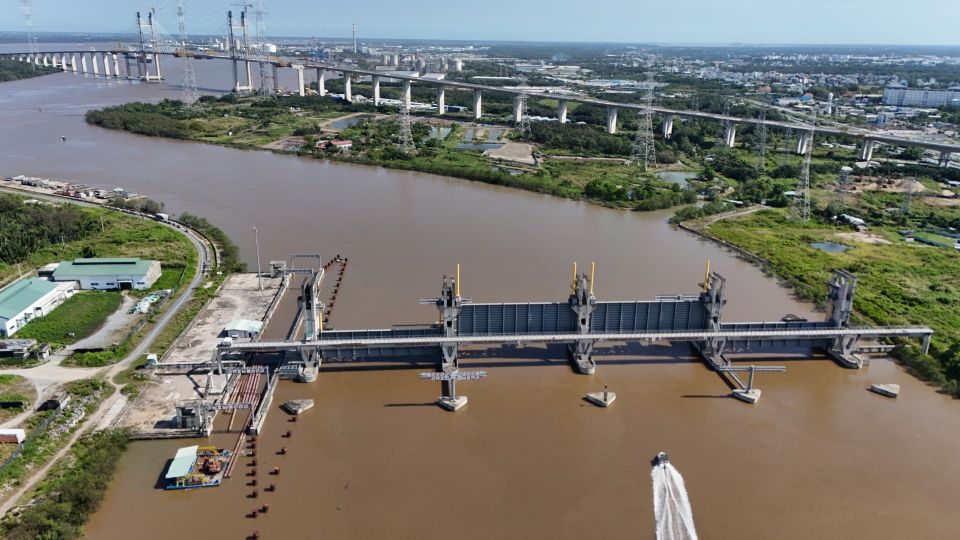
HCMC – Ho Chi Minh City is at a critical juncture in its water management strategy as it seeks to both remove legal and financial bottlenecks to complete a nearly VND10-trillion tidal flood-control project this year and develop a new flood prevention and wastewater treatment plan with a long-term vision extending to 2060.
The dual-track effort reflects a growing recognition that the city must move beyond localized flood-control measures toward a more comprehensive approach to urban water management amid mounting pressures from high tides, land subsidence and increasingly extreme weather.
In the near term, city authorities are under pressure to complete the first phase of the HCMC tidal flood-control project, which incorporates climate change considerations. The large-scale infrastructure scheme includes six major tidal gates at Ben Nghe, Tan Thuan, Phu Xuan, Muong Chuoi, Cay Kho and Phu Dinh river mouths, along with embankments and an automated supervisory control and data acquisition (SCADA) system.
The project is designed to protect a 570-square-kilometer urban core area that is home to more than 6.5 million residents.
According to the investor, Trung Nam Group, the project was 93% complete as of June 2026. However, progress has been hampered by funding constraints stemming from delays in finalizing amendments to the build-transfer (BT) contract and a land-payment mechanism. The delays have pushed additional interest expenses to around VND2.5 trillion.
In response, the Government has instructed city authorities to resolve the remaining issues and ensure the project is completed this year.
The urgency of these efforts has been underscored by recent weather events. Heavy rainfall on June 16 and 17 coincided with high tides, causing localized flooding on several low-lying roads in eastern and southern parts of the city, including Pham Huu Lau Street in District 7, exposing the limitations of the existing drainage system.
Urban planners say that completing the VND10-trillion flood-control project is a necessary step but not a sufficient solution to HCMC’s chronic flooding problem.
The roots of the challenge lie in outdated planning frameworks, including flood-control master plans approved in 2001 and 2008, which did not fully account for the impacts of climate change, sea-level rise and rapid urbanization that has reduced natural water absorption areas.
More than 60% of the city lies at elevations below two meters above sea level, while ongoing land subsidence continues to increase flood risks. Under such conditions, relying solely on traditional engineering solutions such as expanding drainage canals and sewer networks is unlikely to provide a lasting answer, especially as the Dong Nai-Saigon river basin faces growing pressure from both upstream flood releases and rising sea levels.
Recognizing these challenges, HCMC has partnered with Dutch experts to develop a new flood-control strategy for the 2026-2060 period.
The proposed plan marks a shift from a defensive approach to one centered on urban water management and nature-based solutions. Instead of simply trying to expel water from the city, the strategy aims to create more space for water through ecological retention lakes, expanded urban green areas that improve natural infiltration, and watershed-based management zones.
Urban planners say that only a combination of structural defenses—such as the six tidal gates nearing completion—and non-structural measures, including preserving natural flood-retention areas, can strengthen the city’s resilience and better protect lives and property in an era of climate change.