
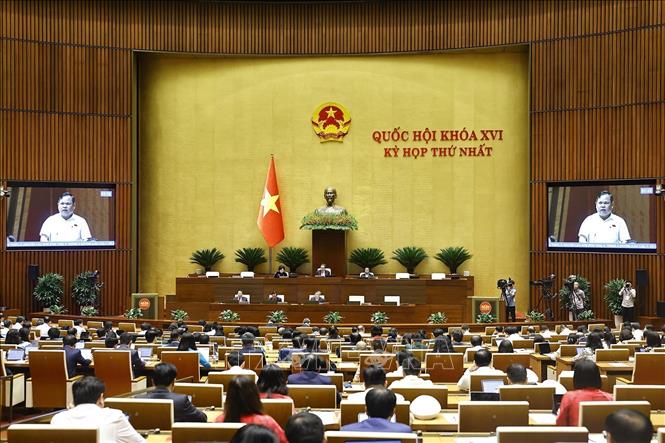
HCMC – Lawmakers called for raising the tax-free revenue threshold above the proposed VND1 billion per year, with some suggesting a cap of up to VND3 billion during the National Assembly sitting on April 23.
The proposal was discussed as the National Assembly reviewed amendments to four tax laws, namely personal income tax, value-added tax, corporate income tax, and special consumption tax.
The Ministry of Finance has proposed setting the tax-free threshold for household businesses and individuals at up to VND1 billion per year, doubling the current VND500 million. The same level would apply to value-added tax.
Finance Minister Ngo Van Tuan said the change would reduce state revenue by about VND4.8 trillion from household businesses and individuals, and around VND2.1 trillion from some 256,000 small businesses, bringing the total estimated impact to VND7 trillion.
While lawmakers broadly supported giving the Government authority to set thresholds, several called for clearer limits to ensure stability.
Trinh Tu Anh, an NA deputy from Lam Dong Province, proposed setting a range in law, with a minimum threshold of VND1 billion and a ceiling of VND2 billion, allowing the Government to adjust within that band.
Nguyen Duy Thanh, a deputy from Ca Mau Province, argued the draft lacks a clear adjustment plan and suggested raising the threshold for household businesses to VND3 billion per year.
Thanh said a business with VND3 billion in annual revenue, or about VND250 million per month, may earn roughly VND20 million in profit after costs such as rent, interest, and labor. He also warned that assigning full authority to the Government without a defined framework could create uncertainty, especially for small businesses. He called for clear principles or a fixed range linked to indicators such as per capita income or inflation.
Many deputies agreed that the current VND500 million threshold no longer reflects economic conditions. Based on projected per capita GDP of around VND128–130 million in 2026, the existing level equals about four times per capita income, lower than levels seen in comparable economies.
Lawmakers also pointed to differences in cost structures across sectors. In trading and food services, input costs can account for up to 80–90% of revenue, while other services have higher margins. They suggested considering sector-based thresholds.
Concerns were raised about possible abuse, with warnings that businesses could split operations into multiple entities to remain below the threshold. Deputies proposed rules to aggregate revenues of related parties.
On tax administration, lawmakers emphasized reducing compliance costs. They noted that time, procedures, and filing requirements add to the burden on taxpayers and called for simpler processes and wider use of digital systems.
Deputies also recommended aligning thresholds for personal income tax and value-added tax to reduce complexity, and issuing implementing decrees three to six months before the law takes effect.
Ngo Van Tuan said the proposed threshold had been assessed based on its impact on both revenue and taxpayers, and would be further refined before submission to the National Assembly.







