
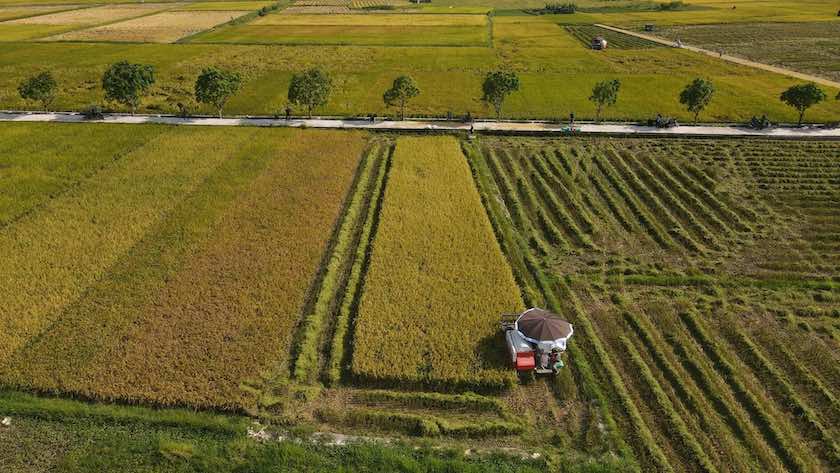
The most important requirement in export markets remains high-quality, safe production. Low emissions are considered an additional criterion that markets encourage and share with producers as part of broader environmental protection efforts.
Pham Thai Binh, chairman of Trung An Hi-tech Agriculture Company, said Trung An will continue to export an additional 1,000 tons of low-emission, green Vietnamese rice to Europe and Australia, with 500 tons allocated to each market. The price now exceeds US$1,000 per ton, reflecting the market’s recognition of the added value from sustainable, eco-friendly production.
Following its first shipment of over 400 tons of green rice to Japan last year, the company has so far exported around 70,000 tons of this product worldwide. Although this volume remains modest compared to Vietnam’s total annual rice exports, it signals a significant shift in the industry—from competing on quantity to prioritizing quality, safety, and sustainability. This transition marks an important step toward achieving Vietnam’s net-zero commitment by 2050.
At a conference on May 18, 2026, organized by the Steering Committee to implement the plan for low-emission production in cultivation from 2025–2035, with a vision to 2050, Nguyen Thi Thu Huong, deputy director of the Department for Cultivation and Plant Protection, reported that 22 cities and provinces have already issued action plans for emission reduction. Several localities have begun piloting specific models.
In Quang Tri Province, an emission-reduction rice model has been deployed across 13 communes, covering more than 6,000 hectares. Meanwhile, Hung Yen Province plans to apply alternate wetting and drying irrigation techniques on 3,000 hectares of paddy fields and install emission measurement equipment in 2026.
 Alongside these initiatives, the cultivation sector is accelerating efforts to promote low-emission farming practices and the efficient use of fertilizers, crop protection chemicals, and irrigation water. It is also encouraging the reuse of agricultural by-products, advancing circular agriculture, and building a comprehensive emissions data system. In 2026, the sector will continue refining technical processes as well as the measurement, reporting, and assessment systems for key crops such as rice, corn, coffee, and durian.
Looking ahead to 2030, the sector aims to establish low-emission production zones for rice, coffee, fruit, and corn tailored to the strengths of each ecological region. It will also standardize emissions measurement and reporting systems from the central to local levels, develop value chains for low-emission agricultural products, and strengthen origin tracing to meet the green standards required by export markets.
However, the experience of businesses exporting “green” rice to global markets shows that low emissions alone are not the decisive factor. What international buyers value most is still high quality and safe production. Low emissions serve more as an “additional criterion” — welcomed by the market and shared with producers to protect the environment.
This reflects a broader reality: concepts such as “green,” “low carbon,” or “low emission” are increasingly embedded in international trade standards, but they cannot replace fundamental requirements like product quality, food safety, origin traceability, and supply chain reliability. Put simply, “green” credentials cannot rescue a poor-quality product, but they can help a good product stand out and gain a competitive edge in the market.
Low emissions are not inherently synonymous with high quality. In practice, achieving emission reduction targets while maintaining agricultural product standards requires a very strict technical balance. Emission reduction efforts focus primarily on optimizing irrigation water, reducing chemical fertilizer use, limiting methane emissions, and reusing agricultural by-products. By contrast, product quality depends on factors such as seed selection, crop nutrition, pest management, harvesting techniques, and post-harvest preservation.
If inputs are reduced mechanically without proper technical control, emission reduction targets may come at the cost of declining productivity and product quality. For example, excessive fertilizer cuts can deplete soil fertility, while alternate wetting and drying irrigation, if not aligned with crop growth stages, can negatively affect yields.
In other words, low emissions are not simply about “less carbon.” They require the simultaneous optimization of environmental sustainability, productivity, and product quality. This is why premium markets purchase rice not merely for its low-carbon credentials, but because it combines high quality with sustainability. In this context, low emissions serve as an added value — a differentiator for products that already meet rigorous standards.
Nevertheless, the long-term significance of the green trend remains undeniable. As environmental standards increasingly emerge as a form of “new trade barrier,” businesses that take the lead in developing low-emission production zones, ensuring transparent origin tracing, and adopting sustainable practices will gain a competitive edge in global markets.
This advantage extends beyond pricing. It encompasses the ability to secure market access, strengthen brand reputation, and integrate more deeply into international value chains. In this sense, sustainability is not only about compliance but also about building resilience and long-term competitiveness.
Nguyen Nhu Cuong, former director of the Cultivation Department, emphasized the need to promptly formulate and publicize low-emission cultivation processes for each crop as a foundation for synchronized implementation. For perennial plants, he noted that evaluation should go beyond emission reduction volumes to also consider carbon absorption and storage capacity, providing a more comprehensive perspective on green production.