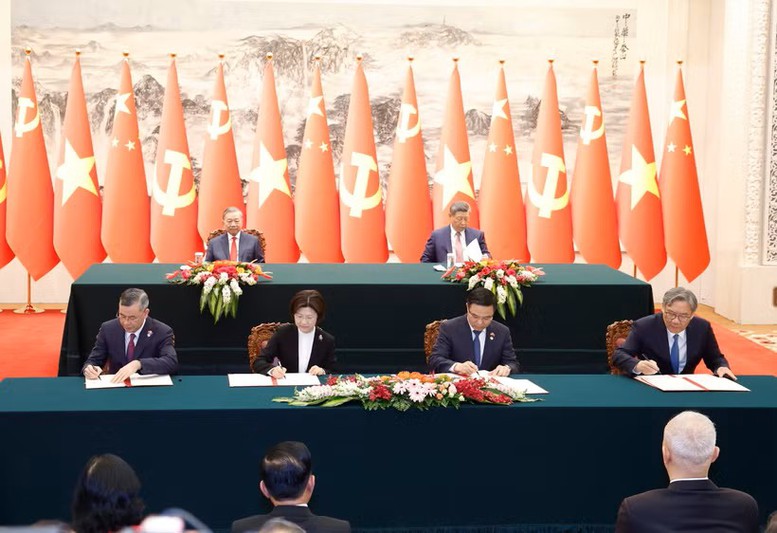
HCMC – The new customs cooperation agreement signed on April 15 between Vietnam and China will expand data sharing, support customs clearance, and strengthen efforts against cross-border crimes.
The signing of the agreement between Vietnam’s Finance Minister Ngo Van Tuan and Sun Meijun, head of General Administration of Customs of China took place during a state visit to China by Party General Secretary and State President To Lam.
The new deal replaces the 1993 agreement and sets a legal framework for cooperation as bilateral trade exceeded US$250 billion in 2025, according to the Government news website (baochinhphu.vn.
The Department of Vietnam Customs said cooperation will focus on exchanging information on policies, regulations, import-export data, and risk indicators. The aim is to support customs clearance and improve the detection and prevention of violations.
The agreement also expands cooperation in digitalization. Both sides will implement electronic data exchange, develop single-window mechanisms, and connect smart border gates. Programs for authorized economic operators will be broadened. A coordination mechanism at the director-general level will continue, along with direct contact points to handle arising issues.
Smart border gate deployment will be prioritized on road and rail routes. Specialized inspections will be simplified. Authorities expect the agreement to help align management, facilitate trade, and strengthen control as cross-border flows increase.
On the same day, the Mekong Dragon VIII operation was launched online with 24 customs and law enforcement agencies participating.
The initiative, launched by Vietnam and China in 2018, aims to strengthen customs control cooperation in the Asia-Pacific. This year’s operation involves the United Nations Office on Drugs and Crime, the Regional Intelligence Liaison Office for Asia and the Pacific, Hong Kong Customs, and the Australian Border Force.
The Department of Vietnam Customs reported multiple drug-related cases in 2025 and the first quarter of 2026, involving various substances. The agency noted the need to improve risk analysis, forecasting, and management capacity.
Mekong Dragon VIII is expected to enhance intelligence sharing and coordination among agencies. Participants also discussed applying technologies such as artificial intelligence and big data in customs control, and expanding cooperation with logistics and express delivery firms.
The operation targets transnational crime while contributing to regional security, environmental protection, and biodiversity conservation.