HCMC – Vietnam needs a more sustainable approach to high-rise development that integrates public transport, public spaces and climate resilience amid rapid urbanization, said experts at the Tall Building Forum 2026.
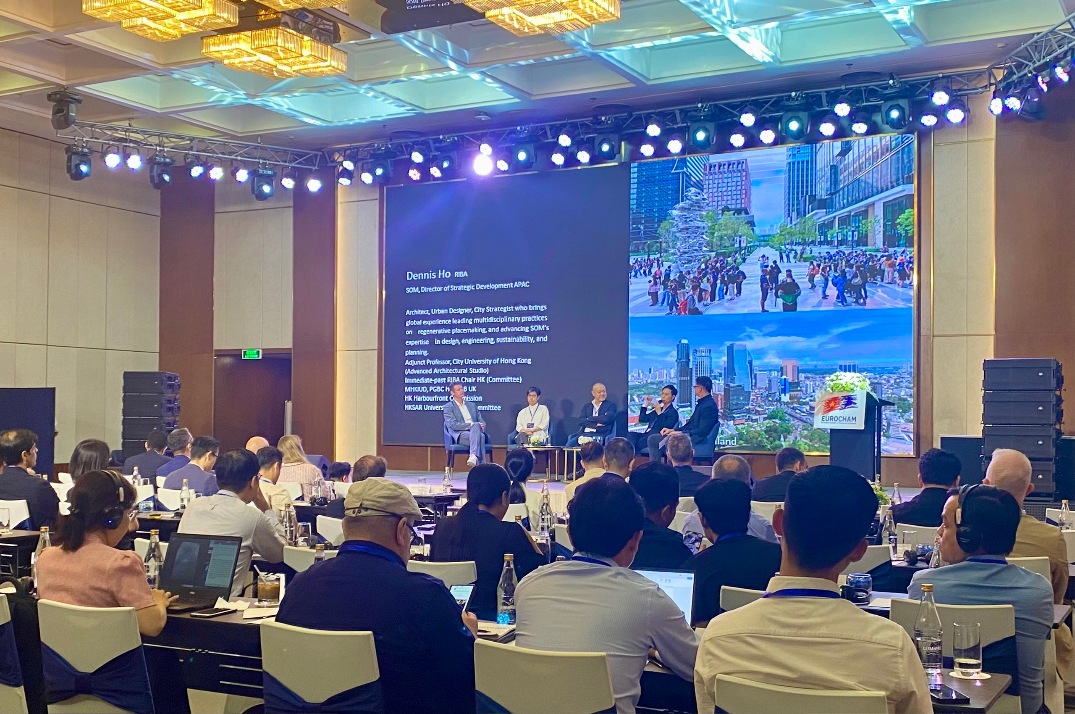
The forum was held by the Construction Sector Committee (CSC) of the European Chamber of Commerce in Vietnam (EuroCham) in partnership with the Council on Vertical Urbanism (CVU) in HCMC on May 14, focusing on sustainable high-rise development in urban areas.
In his opening remarks, Jean Jacques Boufle, vice chairman in charge of Advocacy at EuroCham, said sustainable urban development and high-rise buildings are becoming increasingly urgent priorities as Vietnamese cities continue to expand rapidly.
He said this year’s forum focused on topics including transit-oriented development (TOD), sustainable high-rise design, affordable housing and integrated urban development strategies.
Le Minh Long, deputy director general of the Department of Science, Technology and Environment under the Ministry of Construction, said rapid urbanization has fueled strong growth in Vietnam’s high-rise sector, improving land-use efficiency and supporting economic development, but also creating new urban and environmental challenges.
He stressed that green, energy-efficient and environmentally friendly buildings should remain a priority as Vietnam advances its sustainable development commitments.
He also called for stronger technical standards on air quality, energy use and waste management, along with better integration between high-rise development and urban infrastructure through advanced models such as compact and eco-urban development.
At the discussion sessions, many experts said future high-rise development should not focus solely on building height or density, but also on the quality of living spaces and the overall urban experience.
Dennis Ho, director of Strategic Development APAC, Skidmore, Owings & Merrill (SOM), stressed that the key issue is not “the height” but “the space between the heights,” referring to the quality of public spaces and the connection between people and the urban environment.
High-rise projects should create community-oriented living environments with walkability and attractive public spaces, rather than focusing solely on maximizing floor area.
Tony Chan, associate principal planning leader SEA, ARUP, said urban development around metro lines is an inevitable trend to curb urban sprawl and improve the efficiency of public transport systems. However, he warned that current approaches still tend to assess individual sites in isolation rather than considering their overall contribution to the broader district and city.
Future projects should be evaluated using broader criteria such as public transport connectivity, climate resilience, the quality of public spaces and social contribution, instead of relying mainly on population density or floor area ratios.
Florence Chan, principal at Kohn Pedersen Fox (KPF), said cities such as HCMC need to improve land-use efficiency and pursue sustainable high-rise development strategies amid increasingly limited resources.
She added that design processes should incorporate more technology and innovation, as traditional approaches are no longer sufficient to integrate multiple climate adaptation solutions in Vietnam.
Meanwhile, Marc Salemink, associate director at UNStudio, said megacities inevitably face challenges related to urban mobility and public transportation.
Alongside high-rise development, cities need to establish public transport networks aligned with residents’ travel patterns to create more seamless and convenient mobility flows, thereby reducing reliance on private vehicles.
HCMC should adopt investment policies that not only focus on urban expansion but also help cities address structural challenges affecting businesses and investors. In particular, he noted that HCMC’s TOD policies should be supported by accurate data systems and effective data utilization methods to help attract investment into sustainable and high-potential projects.