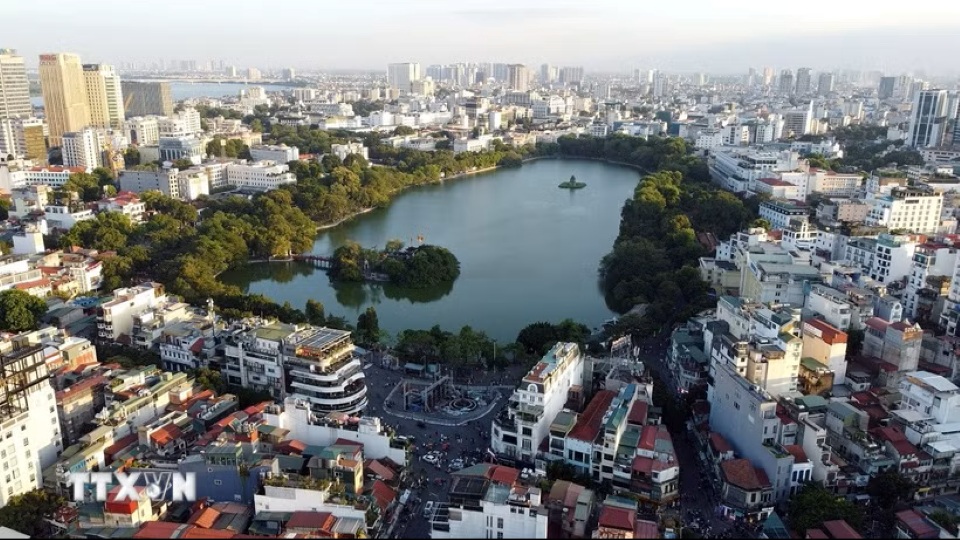
HCMC – Hanoi has unveiled an ambitious long-term urban development plan targeting gross regional domestic product (GRDP) of around US$200 billion and per capita income of at least US$18,800 by 2035.
Under Decision No. 2512/QD-UBND recently signed by the city government, the capital city aims to develop into a leading financial, trade and innovation hub in the Asia-Pacific region across a planned area of more than 3,359 square kilometers.
To achieve these goals, Hanoi plans to adopt a “multi-layered, multi-polar and multi-center” urban structure, with the Red River serving as the city’s central landscape axis. The city also expects cultural industries to become a new growth driver, contributing 15% to 20% of Hanoi’s GRDP in the long term.
The master plan sets a vision for 2045 in which Hanoi will become a regional innovation nucleus, and by 2065, a global city with one of the highest living standards in the world.
Under the spatial planning strategy, urban construction land will be capped at 55% to 60% of the city’s total area, with the remainder reserved for green corridors and ecological systems. Hanoi also aims to eliminate chronic traffic congestion hotspots by 2030 through the expansion of urban railways and transit-oriented development (TOD) public transport models.
Alongside promoting breakthroughs in science, technology and digital governance, the city plans to restore inner-city rivers and transform Hoa Lac Hi-tech Park into a major research and development center.
Beyond 2085, Hanoi envisions becoming a model sustainable megacity that serves as a global hub for commerce and knowledge flows across its more than 335,000 hectares of natural land area.