
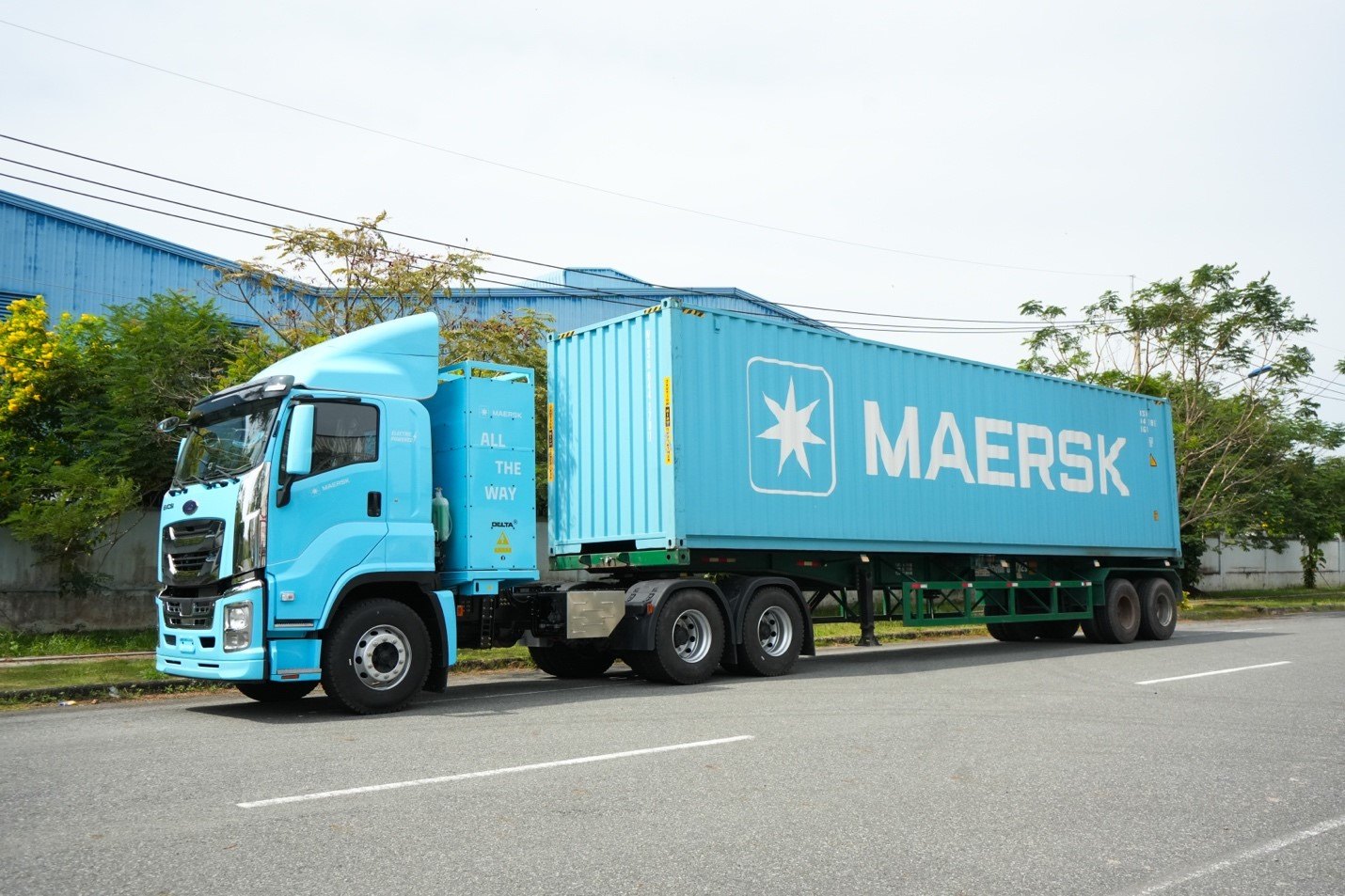
Maersk, a global leader in integrated logistics, has announced a new initiative in Vietnam to provide customers with the option to use electric trucks for inland container transportation. This marks one of the first deployments of heavy-duty electric trucks in the country.
The electric trucks will be dedicated to transporting cargo between Maersk’s Container Freight Station (CFS) and the main gateway ports in Ho Chi Minh City and Dong Nai such as Cat Lai Port, Binh Duong Port and Dong Nai Port.
The new electric trucks are now undergoing final preparations for full deployment by the first quarter of 2026. Maersk is working together with a local energy partner to set up a charging station, approximately 5 km from its CFS, to support efficient and uninterrupted operations.
Kevin Burrell, Area Managing Director of Mekong (Vietnam, Thailand, Cambodia, Myanmar) says, “We are seeing a surge in interest of electric vehicles (EVs) in Vietnam, driven by environmental awareness and technological advancements.”
According to statistics from the International Council on Clean Transportation, electric trucks reduce greenhouse gas (GHG) emissions by 63% per trip compared to diesel trucks.
Supporting companies looking to decarbonise their supply chains
Maersk will purchase Energy Attribute Certificates in the form of I-RECs, a universally recognised standard that certifies the renewable origin of electricity, to cover the entire electricity consumption for these electric trucks.
With these electric trucks, Maersk can begin offering its ECO Delivery Inland service in Vietnam. Customers will receive GHG emission visibility reports to support their Environmental, Social, and Governance (ESG) reporting and align their supply chains with decarbonisation goals.
Businesses in Vietnam which are looking to reduce their greenhouse gas footprint can turn to Maersk for our range of solutions across different transport modes, be it for shipping, air freight or inland transportation.
Russell Pang, Area Head of Logistics & Services Products of Mekong, says, “We plan to keep expanding our fleet of electric trucks and we aim to replace all our diesel trucks by 2040.”
Vehicle electrification is emerging as a major logistics trend, driven by regulatory mandates, rising fuel costs, and ESG goals. Road transport accounts for 12.2% of global GHG emissions, and electrification is expected to contribute to reducing GHG emissions and optimising costs.
Maersk will continue working with partners and customers to expand electric truck adoption. Inland electrification, including use of electric trucks, is in line with Maersk’s ambition to achieve net-zero GHG emissions across its global operations by 2040. The company currently has electric trucks deployed or under trial with partners in more than 14 countries, including Thailand, China, Brazil and Spain.







