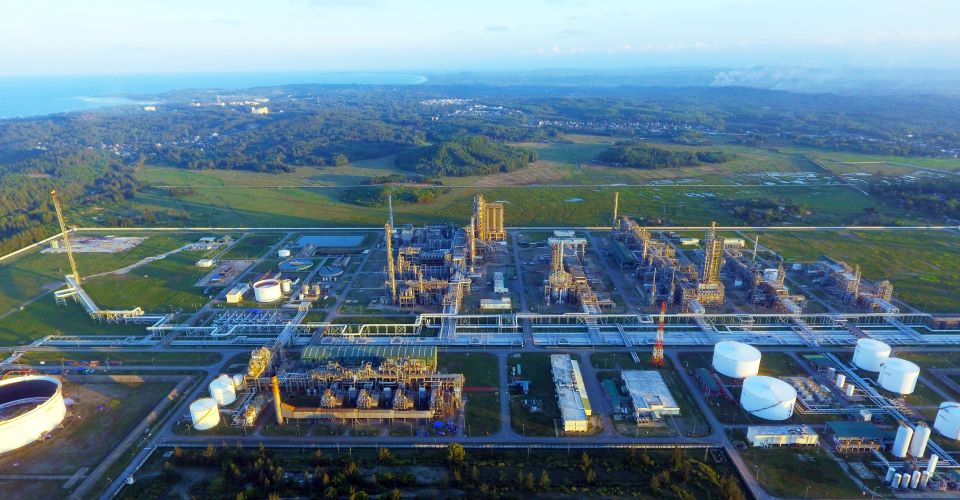
HCMC – Binh Son Refining and Petrochemical (BSR), the operator of the Dung Quat Refinery in Quang Ngai Province, is urgently seeking priority access to domestic crude oil and condensate as global supply disruptions threaten to derail its production targets.
According to company’s CEO Nguyen Viet Thang, the Dung Quat Refinery currently sources 30–35% of its crude oil feedstock from imports, primarily from West Africa, the Mediterranean, the U.S. and partially from the Middle East. Consequently, should the U.S.-Israel war on Iran persist, oil prices, surcharges, freight rates, and insurance premiums could surge, sending input costs and financial risks rising significantly.
Since the beginning of this year, to prepare for double-digit growth targets and proactively respond to global anomalies as well as climate change impacts, BSR has increased its inventory, maintained flexible production based on market demand, and diversified its feedstock sources. Under the direction of the Ministry of Industry and Trade and Petrovietnam, BSR has signed crude oil supply agreements with two major U.S. energy corporations, ExxonMobil and Chevron, to ensure stable supply and contribute to balance Vietnam–U.S. trade.
For the March–May 2026 period, BSR has contracted to purchase approximately three million barrels of imported crude oil through various grades. Although these sources are not located within the direct conflict zone, geopolitical tensions in the Middle East may still indirectly impact delivery schedules, shipping costs, insurance and maritime security.
Notably, with an estimated demand for spot contract purchases of approximately 900,000 to one million barrels in May 2026 and 1–1.3 million barrels in June 2026, operating the refinery at 118–120% of its capacity will face immense pressure regarding pricing and supply accessibility.
To mitigate these risks, BSR has formally petitioned the Government and Petrovietnam to implement a temporary mechanism that prioritizes domestic feedstock for the Dung Quat Refinery. The proposal includes a recommendation to restrict domestic crude exports through the end of the third quarter of 2026. Specifically, for the critical May–June window, BSR is requesting permission to bypass traditional tenders and directly purchase crude from the Ruby, Bunga Orkid, and Chim Sao fields at the highest recent market rates to ensure an uninterrupted flow of fuels to the domestic market.